Ezra
Earth AbidesEzra is Ish’s friend, helper, and lasting counterweight to the loneliness of leadership. A genial wanderer who returns with a family and remains part of The Tribe through its crises and transformations, he contributes less through invention than through an unusual talent for making people comfortable, reading character, and helping one person work better with another. His life beside Ish shows how much a surviving community depends on forms of intelligence that do not build machines or command attention.
Identity and First Arrival
Ezra first appears among the restless people who follow the smoke rising from San Lupo Drive. Most of these wanderers seem stunned and unsettled, like bees separated from a hive; Ish and Em generally hope they will move on, partly because another person in their small household could create an uncomfortable triangle. Ezra is the exception. Ish remembers him strolling down the street on a hot September day: a florid, narrow face, a half-bald head reddened by the heat, and bad teeth that showed when he stopped and smiled. His greeting carries the trace of a North-of-England accent behind its American words.
He stays until after the first rains. Even when his teeth are bothering him, he remains pleasant, and the babies smile at him. Ish and Em would like him to stay permanently, but they fear the complications of adding an outsider to their household. When Ezra seems restless, they send him away with a joking suggestion that he find a pretty girl and return. They are sad once he has gone. At the time they cut the numeral 2 into the flat rock to mark the year, they still think of him as someone who would have been a good helper and a welcome presence. They name that year the Year of Ezra, preserving his place in their lives even though they do not expect to see him again.
Return and Place in the Community
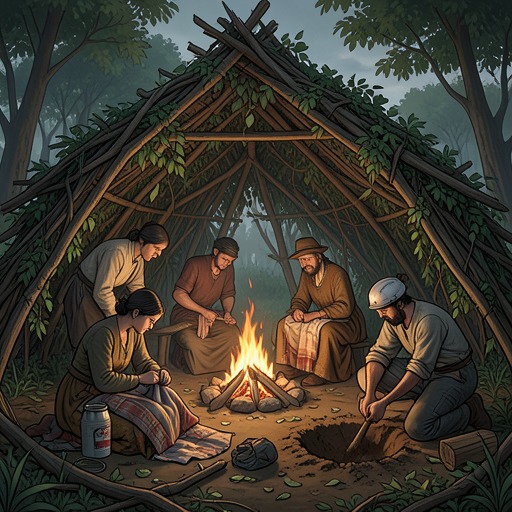
More than a year later, in early spring of Year 4, Princess races barking toward the street and a car horn sounds. Ezra has returned in a battered-looking car crowded with people and household goods. Alongside him are Molly, a younger woman named Jean, a frightened half-grown girl, and a little boy. He introduces Molly and Jean as his wives without embarrassment. The arrival recalls, for Ish, a family of migrants reaching California in the Old Times, but this is not simply a passing visit: Ezra has returned with a household of his own.
Ish later measures Ezra’s gifts against the problem of rebuilding civilization. He sees in him a genius, but not the creative drive that could set a new civilization in motion. That distinction does not diminish Ezra’s importance; it clarifies it. Ish’s hopes for renewed technology and large-scale recovery have gone unfulfilled, and The Tribe remains dependent on the remnants of the past. Ezra is not the inventor or organizer Ish imagines a new civilization might require. His distinctive ability is personal: he makes others feel at ease and helps relationships function. Ish feels warmth simply looking at his familiar ruddy face and pleasant smile, a friendship that has survived separation and the changing shape of their community.
Judgment, Mediation, and Crisis
Ezra repeatedly intervenes at moments when Ish’s authority or confidence is under strain. When Jack leaves a discussion, Ish grows angry; Ezra speaks quickly to cover the awkwardness, invites Ish to continue, and reminds the group that Ish has ideas worth hearing. His tact helps Ish regain composure. The episode also forces Ish to recognize that Jack is an adult who can act independently, not merely a boy or a son to be directed. Ezra does not settle the conflict by asserting power. He makes room for the conversation to continue.
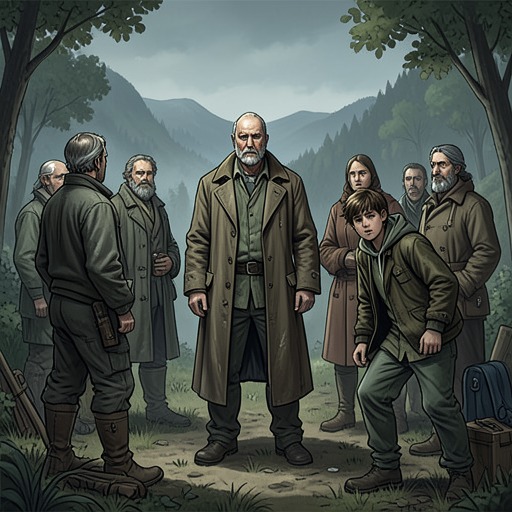
That same attentiveness becomes more consequential when Charlie’s conduct alarms the community. During a test designed to make Charlie remove his vest, Ezra pretends to feel chilly and asks him to take it off. Charlie refuses, strengthening Ezra’s suspicion that he is concealing something in a pocket he has altered. Ezra identifies the concealed object as a small pistol, giving Ish a concrete danger to address. But his investigation does not stop at the weapon. He speaks with Charlie to learn about him, then breaks his usual reticence to disclose that Charlie has several sexually transmitted diseases. The revelation shocks the adults, including George and Em, who understand the threat in a way the boys do not.
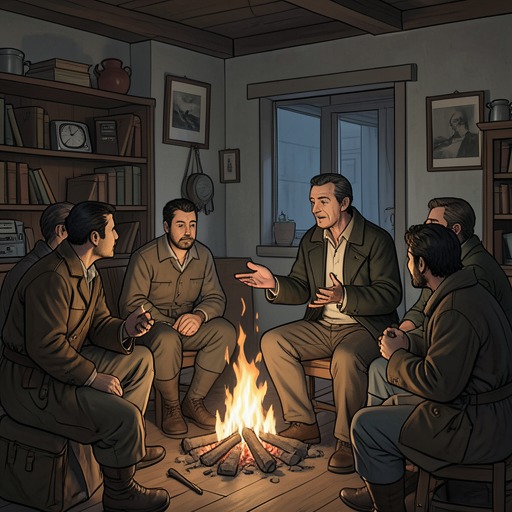
When Ish gathers the others to discuss what to do, Ezra is among the small group present as they reach the conclusion that The Tribe has a right and a duty to defend itself. His contribution is not a formal law or a ready-made precedent: it is the information and judgment that allow the group to grasp the stakes. Earlier, after Ish’s suggestion of an expedition catches the community’s imagination and grows into a plan for a transcontinental journey, Ezra also helps turn Ish’s repeated, ineffective arguments toward a proposal the group can act on. Across these episodes, he notices what is happening between people and helps a scattered discussion become collective attention.
Companion and Counselor in Old Age
Ezra’s usefulness endures beyond moments of immediate crisis. During the epidemic, people come to Em in grief and fear: one woman leaves after Em helps her recover courage following a child’s death, and George comes terrified after Maurine suffers a relapse while their grandchild gasps. Em sustains them, but the scenes also belong to the life Ezra shares with the community whose grief she is carrying. Later, by common consent, he is placed in charge of the funeral services for the plague victims. The appointment recognizes a role grounded in trust and fellowship rather than technical skill or command.
As the years pass, Ish and Ezra become the two old men on a hillside in a world where nearly everyone else is young. With little happening that distinguishes one year from another, they speak increasingly about the distant past and sometimes reflect on life. Ish still finds wisdom in Ezra. Ezra compares a tribe to a child: it can be shown a direction and guided somewhat, but in the end it will follow its own way. The comparison gives language to the limits Ish has encountered while trying to direct The Tribe’s development. A community cannot simply be made to fulfill its elder’s design.
Ezra also gives Ish a generous account of their generation’s uneven abilities. The Tribe, he thinks, will not be brilliant, because the people who survived were not brilliant in that sense; perhaps exceptional brilliance was not suited to survival. George supplied carpentry, Ish foresight, and Ezra the knack of making one person work better with another, even if he accomplished little by himself. Above all, Ezra insists, they needed Em, whose courage kept them from surrendering to despair. His assessment refuses to mistake conspicuous achievement for the whole of a community’s strength.
Death and Lasting Significance
One day Ish sits on the hillside in the sun and notices that no one is beside him. Only then does he understand that Ezra is gone, and that no one will ever again sit there with him. The realization makes him grip the hammer, now so heavy that he struggles to lift it even with both hands. Its meaning has changed: the tool is also the symbol of a tribal god, while the friend who might once have shared the hillside is absent. The loss is registered not through a reported illness or a described death scene, but through the empty place beside Ish and the sudden force of recognition.
Ezra’s ending brings his quiet importance into focus. Ish is left with the object that embodies his own authority, but loses the companion whose judgment, warmth, and social ease repeatedly helped him bear it. Ezra never becomes the architect of a restored civilization. Instead, he helps people make one another more capable: easing embarrassment, discerning danger, supporting shared decisions, and offering perspective when Ish can no longer expect the tribe to follow his plans. In The Tribe’s history, that modest-seeming gift is not incidental to survival. It is one of the ways a community holds together across generations.