Final Power-System Shutdown
Earth AbidesThe Final Power-System Shutdown marks the end of the Power-and-Light system that had continued operating after the Great Disaster emptied it of the people needed to maintain it. For Ish, the last lamps fading from red to darkness turn an abstract failure of infrastructure into a direct encounter with the new world: no electric light remains visible on the streets or across the bridge, and only a candle offers a steady replacement. The event demonstrates both the impressive resilience of the old network and the limit built into that resilience: automation could postpone collapse, but it could not eliminate the need for care.
A System Built to Continue
In the first days after the disaster, the newspaper Ish read described a society that had suffered enormous losses but had not immediately ceased functioning. Although a third of the population was reported dead, telephone service and water, light, and power still remained in most cities. That account helps establish the extraordinary interval before the final shutdown: human society had been devastated, yet some of its systems continued to serve people who were no longer there to operate them.
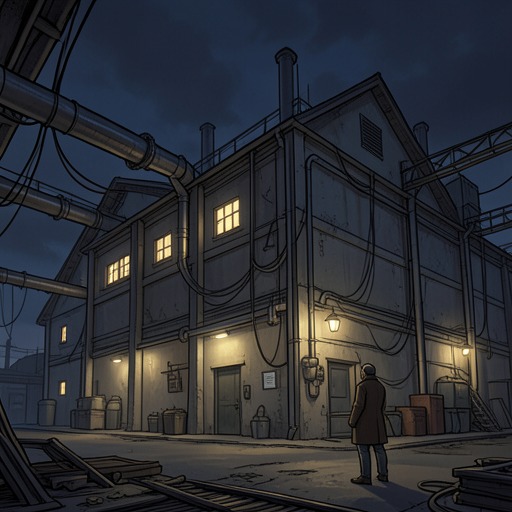
The Power-and-Light system was designed with extensive automatic safeguards. If a broken wire cut a town off from the network, the system adjusted before the wire had even fallen to the ground. If one power-house failed, other power-houses across hundreds of miles rapidly took up the load. Even after the workers fell sick and the disaster ended their lives, generators continued sending their carefully timed pulses through the wires. The lights therefore remained on not because the system had become independent of people, but because its many layers of redundancy temporarily concealed their absence.
Its concealed weakness lay in the governors controlling the generators. They had never been made wholly automatic: workers inspected them for oil every ten days and might need to add oil once a month. After roughly two months without care, the oil supplies ran low and the governors began failing one by one. When a governor failed, the water nozzle changed angle so that water passed through without turning the wheel. The generator then stopped revolving and supplied no more power. Each lost generator placed a greater burden on those still functioning, making decline cumulative rather than isolated.
The Last Fade
Ish encounters the shutdown at home, where he has fallen asleep in an easy chair rather than going to bed. When he wakes, the lamps have dimmed until their filaments glow orange-red, and the room has fallen into half-darkness. He has not switched them off. The gradual change makes the failure difficult to treat as a single break: the system is still present, but its remaining capacity is visibly ebbing away.
The fading also carries meaning beyond the room. Ish recognizes light as more than a household convenience, connecting it with life, knowledge, and the long human history in which light has served as an emblem of understanding. That reflection does not stop him from steadying himself; he recalls how long the network continued to function after its workers were gone. But as the lamps dim further, he stays awake, wishing the end would come quickly rather than drag on.
The filaments fade in a slow progression, briefly seeming to brighten before going out. Princess stirs and gives a half-bark in her sleep. Ish goes outside and considers whether only a local line has failed, but the view supplies no reassurance: smoke thickens the darkness, the moon appears orange, and there is no light along the streets or anywhere on the bridge. He concludes that this is not an isolated outage but the end of the system as he has known it.
After the Current
The shutdown leaves Ish shaken, but he responds practically. He searches for the candles kept in his mother’s drawer, sets one in a candlestick, and returns to sit beside its weak, steady flame. The contrast is exact: the electric network had depended on intricate machinery and a far-reaching supply system, while the candle gives little light but continues to burn without that infrastructure. The old system’s disappearance is therefore registered not only as a loss but as a forced change in the scale and means of daily life.
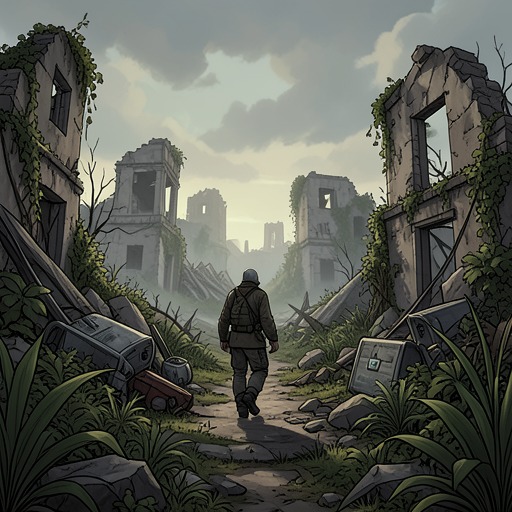
The next day, rain exposes similar vulnerabilities in the built environment. On San Lupo Drive, leaves wash into a drain-pipe and block it; water crosses the street, floods over a curb, and cuts a small gully through the overgrown ground before reaching a storm sewer. Ish understands that the obstruction could be cleared in minutes, yet this is only one of countless neglected points. The incident is not presented as a direct result of the electrical shutdown, but it extends the same principle: roads, drains, and walls function only while people keep repairing and clearing them.
The novel also traces that principle through the water supply. A flawed section of aqueduct pipe, once patched and then left without inspection, gradually leaks as corrosion continues; later, water drains through open faucets, leaking joints, and broken pipes until the reservoir’s remaining water is only a thin covering at the bottom. These failures are distinct from the generators’ failing governors, but they share the same underlying dependence on maintenance. The power system’s final darkness makes that dependence immediately visible, while the spreading failures of other infrastructure show why no automated network can preserve the old order indefinitely without human attention.
Significance
The shutdown is both an ending and a revelation about the conditions that made the old world seem durable. The network could reroute electricity around broken wires and compensate for failed power-houses, but it could not compensate forever for the disappearance of routine labor. Its collapse turns the general idea of a weakest link into a sequence of precise failures: dwindling oil, governors dropping out, water bypassing turbines, generators stopping, and lamps going dark.
For Ish, the moment also marks a boundary between inherited systems and immediate survival. The old world’s electrical light had continued long enough to make its absence feel delayed, almost as though civilization might persist through its own machinery. A candle replaces it, modestly and without promise of restoration. The surrounding failures of drainage and water supply deepen the event’s significance: the disaster did not simply destroy infrastructure in one stroke. It left networks standing, then exposed how much their apparent independence had always depended on human upkeep.