George
Earth AbidesGeorge is a carpenter whose work gives Ish’s post-disaster community practical strength, even as Ish repeatedly underestimates his intelligence. He arrives as a dependable craftsman, contributes to repairs and shared labor, and helps the group through moments of crisis. His death in Year 26 makes his value unmistakable: afterward, the roofs are less well maintained and the trim goes unpainted.
Identity and Arrival
Ezra finds George and Maurine while wandering and brings them to the attention of Ish’s group. George is a large, shambling, good-natured man, gray at the temples when Ish first meets him. His speech is uncertain, but his hands are deft at carpentry. Maurine, about ten years younger, shares his attachment to domestic work: she loves housekeeping as George loves carpentry. Ish privately weighs their usefulness and judges them solid, comfortable people, more likely to strengthen than burden the small group. The two are not selected for brilliance or specialized expertise; their steadiness matters in a community with few people to choose from. George and Maurine travel back with Ish and Ezra in Ish’s station wagon.
At San Lupo Drive, George’s skills make him useful well beyond woodworking. Over the years he learns plumbing, painting, and other household jobs, preserving practical abilities from the Old Times that are difficult to replace. Ish thinks George has probably never read a book and regards him as intellectually dull. That assessment describes Ish’s view, not the full measure of George’s contribution: the community needs both the foresight Ish supplies and the work George can actually do.
Craft and Everyday Work
George’s value appears in concrete proposals as well as completed repairs. When Ezra reminisces about motion pictures and the possibility of bringing them back for the children, George turns to a more immediate possibility: with one or two boys helping, he thinks he could get a gas refrigerator working within a few days. The contrast does not make one man’s interests worthless and the other’s superior; it shows how George’s attention returns to equipment and the practical labor of making it function.
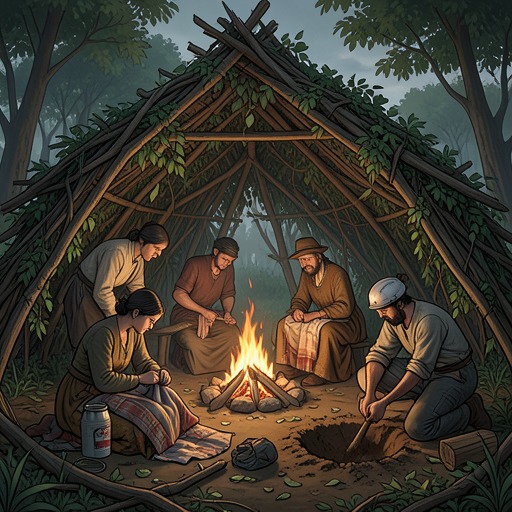
His skills matter again when the group considers how to connect pipes to restore access to water. Asked whether he could make a proposed connection, George agrees that he can work on the plumbing, while recognizing that simultaneous demand from everyone would remain a problem. Later, as the community digs a well, George anticipates the construction it will require. He goes to fetch planks so that the sides can be walled in as the well deepens. Ish is confident that George will finish the work. In Ish’s account, George has carried the work habits of the Old Times so strongly into the new society that he may never truly learn to play.
George’s labor is not an abstract emblem of competence. He appears in overalls marked by use, carrying a pipe wrench, and remains associated with the repeated maintenance that makes a shared home livable. His knowledge includes carpentry, plumbing, and painting; later, the decline in roof repair and painted trim after his death gives these tasks a visible consequence. The group’s dependence on George is therefore practical and cumulative: small repairs are part of how it keeps its shelter in order.
Judgment and Community Life
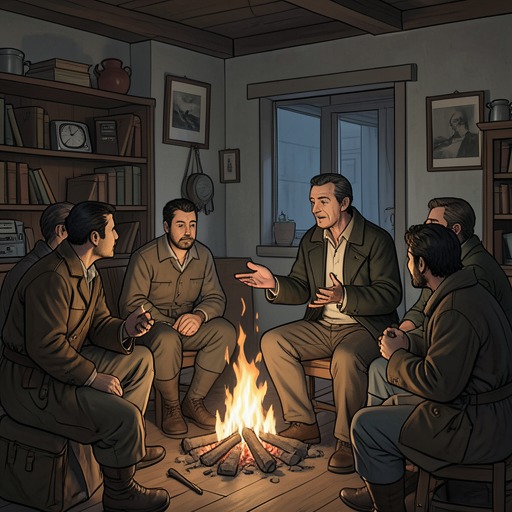
George’s most striking contribution is not a repair but an argument about Evie. When Ish objects to Charlie’s relationship with her partly because he fears that her children might inherit intellectual limitations, George questions the assumption beneath that concern. He suggests that Evie’s apparent limitations may have followed the childhood trauma of being left alone after everyone around her died, rather than representing her innate capacity. Ish cannot be sure that George is right, but recognizes that the possibility has force for the others.
The moment complicates the contrast Ish draws between intelligence and usefulness. George is not presented as a trained scholar or a great theorist; nevertheless, his patient reasoning opens a possibility Ish had failed to consider. His argument also changes how the group can understand Evie: rather than treating her only as a fixed problem, they can imagine her as someone whose childhood circumstances shaped her. George’s words do not settle the question, but they influence the community’s view of Charlie’s relationship and Evie’s place within it.
George’s steadiness also becomes crucial when the community carries out Charlie’s execution. Ish remembers the event with physical revulsion and believes that, without George’s solidity, the group might not have gone through with it. George knots the rope and sets up the ladder. The work is practical, but its consequence is grave: he helps the community enact a decision that Ish later regards as both an ending and a beginning. The narrative does not present George as the decision-maker; his role is to make the chosen action possible, a further instance of the weight his practical competence carries.
Crisis, Faith, and Inherited Customs
During the typhoid epidemic, George and Maurine turn to prayer, as does Molly and some of the younger members. They fear that God may be exacting retribution for Charlie’s death. Ralph considers taking his unstricken family away, but Ish argues that an isolated group could be in greater danger if its members are already infected. George’s response to the crisis is thus part of a community marked by fear, religious interpretation, and the need to remain together.
When Maurine suffers a relapse and their grandchild is gravely ill, George comes to Em in a state of terror. Em offers no explanation about God, yet George leaves with renewed courage. The episode places his family’s vulnerability beside the strength he usually gives others through work: the skilled, solid craftsman is also an old man who needs support. At the funeral for the epidemic’s victims, he wears a conservative dark-gray suit, probably the one he had worn to funerals when he was a deacon in the Old Times, or its twin. Maurine stands beside him in black and a veil. Their clothing preserves older funeral proprieties amid the group’s otherwise improvised garments, making George and Maurine bearers of customs that survive even when the institutions around them have disappeared.
Death and Legacy
George dies in Year 26 while painting on a ladder. No one ever learns whether his heart stopped and caused him to fall or whether an accidental fall killed him. The uncertainty remains unresolved, but the consequence is plain: after he is gone, the roofs are never kept in such good repair and the trim is no longer painted. Maurine lives for a time in their neat house, where the bridge lamps do not light and the console radio does not play, then dies before the year ends. The community names the year for the deaths of George and Maurine.
Later, Ish and Ezra remember George and Maurine together, including Maurine’s radio that never worked. Ezra identifies George’s carpentry as one of the things the community needed, alongside Ish’s foresight and his own ability to help people work together. This accounting corrects Ish’s narrow measure of intelligence without pretending that George was a visionary: the group’s survival depends on different abilities, including the unglamorous skill of keeping houses and equipment usable. George’s absence is registered not through a grand monument but through neglected roofs and unpainted wood, the precise work that had once made his presence dependable.