Grasshoppers
Earth AbidesGrasshoppers are a sudden, destructive force in the Bad Year, the drought-stricken period when The Tribe sees how sharply the land can change after human control has vanished. They consume what the starving Cattle have left behind, then die as conditions shift; the outbreak and the cattle deaths make the countryside seem irrecoverably barren. For Ish, the episode illustrates ecological readjustment. For the people living through it, that explanation offers little comfort while the land looks dead and their confidence in its ability to recover begins to falter.
Place in the changing ecology
In the years after the Great Disaster, the surviving community notices repeated shifts in animal abundance. Ants and Rats had been conspicuous plagues in the first months. Cattle subsequently became increasingly numerous in the good grazing country: horses were rarely seen, and sheep not at all. The people had enough tough steak, but also had to watch for charging bulls, turning the need to dodge them into a sport they called bull-dodging.
The grasshopper outbreak arrives against this background of altered animal populations, but under different conditions. Drought has left little grass, and hungry Cattle roam widely in search of food. The scale of the grasshopper swarm is not measured, and its origin is not explained. What the account does establish is its abruptness and reach: the insects appear suddenly and consume vegetation across the already stressed landscape.
The outbreak and its effects
The grasshoppers eat what the Cattle have not reached. They strip leaves from trees and take the flesh from ripening peaches, leaving the seeds hanging from bare branches. Their feeding compounds the damage already done by drought and by the hungry herds. The crisis is not simply a shortage of one crop or one kind of food; the visible vegetation that might have suggested the land could sustain life is being removed as well.
After the feeding comes another reversal: the grasshoppers die. Their death marks the end of the swarm, but not a return to stability. By then, the land appears stripped bare, and dead Cattle lie by the hundreds in dry stream beds and muddy waterholes. The episode places the insect die-off within a wider sequence of ecological distress: drought limits food, Cattle range in search of it, Grasshoppers consume what remains, and the herds themselves subsequently perish. The account does not assign the cattle deaths to the Grasshoppers; both are part of the same devastating year.
Ish’s explanation and the community’s response
Ish tells the others that these disruptions belong to the jostling of nature after human controls have been removed. In his explanation, a grasshopper plague was bound to occur in the first year when conditions favored the insects, now that cultivation no longer disturbed their breeding grounds. He presents the swarm not as evidence that nature has permanently failed, but as an outbreak enabled by the changed conditions of a world without people managing the land.
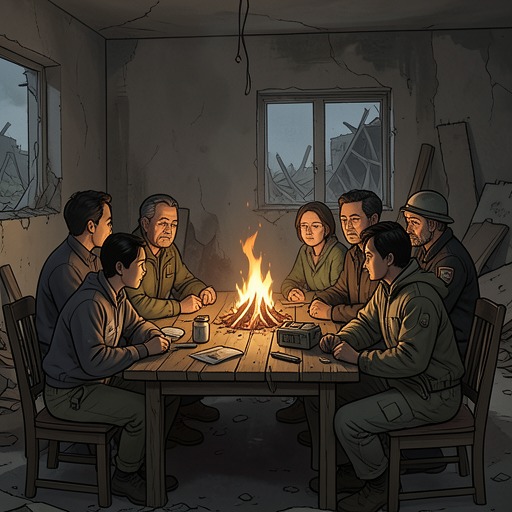
The explanation is difficult for the community to accept when the evidence before them looks so bleak. With the air burdened by the aftermath of mass animal deaths and the ground apparently stripped, Ish himself becomes despondent about the future, despite his rational account. George and Maurine turn to prayer; Jean openly doubts that recent events support belief in God; Molly falls into periods of depression and weeping. Ezra and Em are the adults best able to take events as they come. The older children seem less affected, while the nursing babies, except Em’s, become fretful, deepening their mothers’ distress. The outbreak therefore registers not only as ecological damage but as a strain on the community’s ability to endure uncertainty.
Recovery and the name of the year
Two weeks after the first rain, the people look out and find the hills faintly green with new grass. The sight brings an abrupt change in feeling: Molly and Maurine weep with pleasure, and Ish feels relief. The rain does not erase what happened, but the sprouting grass answers the fear that no seed remained and the land might never recover. The narrative sets this modest sign of renewal against the preceding destruction, without suggesting that the ecosystem has returned to its former condition.
At the winter solstice, the community gathers at the smooth rock where it cuts the year’s numeral and chooses a name for the year that has passed. They consider names recalling the four babies, the dead Cattle, and the Grasshoppers. The year’s disaster weighs most heavily, and they settle on Bad Year. The insects thus persist in the community’s memory as part of a collective reckoning: an outbreak whose duration is brief, but whose effects on vegetation, human confidence, and the naming of time are lasting.
Narrative significance
The Grasshoppers make ecological change visible at a scale the survivors can witness directly. Their feeding follows the disappearance of cultivation, while their sudden abundance and subsequent die-off resist any simple account of nature as immediately balanced or benevolent. Ish can describe a mechanism—favorable conditions and undisturbed breeding grounds—but cannot use explanation to spare the people fear or grief. The episode holds those responses together: a reasoned account of ecological adjustment, a landscape that seems devastated, and the first rain’s small evidence that recovery remains possible.