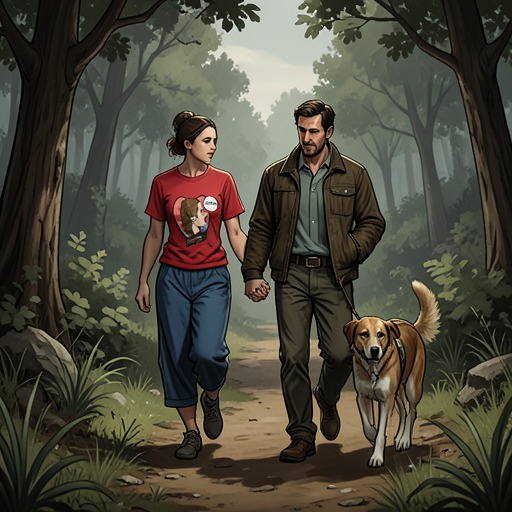
Ish Williams and Princess’s growing companionship
Earth AbidesIsh Williams and Princess’s growing companionship begins as an unexpected bond between a man resisting further attachment and a dog who keeps choosing his company. Their relationship changes Ish’s response to loneliness and danger: her persistence draws him into care, and her return from the desert helps him face the possibility of death with less fear. Later, Princess accompanies him as he watches the post-disaster world change around them.
An Encounter at the Station Wagon
As Ish prepared to leave in Ish's Station Wagon, he noticed a small hound waiting several feet away. The dog’s condition and uncertain manner recalled the many dogs Ish had seen since the disaster, but he had tried not to dwell on them or on what was happening to them. Her approach therefore met a deliberate resistance: Ish sharply told her to go away, aware that becoming attached to another living creature could mean another loss.
The dog did not leave. She came closer, lowered her forequarters, and looked up at him. When Ish smiled, she responded by rubbing against his leg, darting away, circling back, and repeating her appealing posture. Her energetic display changed the scene’s direction: Ish smiled again, this time broadly, and patted her when she returned to his side. The exchange is presented through action rather than any genuine conversation between them; Ish interprets her gestures, while the dog reacts to his changing manner.
Ish’s first impulse had been to defend himself against attachment, but he soon accepted that the dog had entered his life. He thought of himself as having acquired a dog, then revised the thought: the dog had acquired him. She jumped into the station wagon and settled on the front seat. At a grocery, Ish found dog biscuits and fed her. Her practical acceptance of the food did not resemble gratitude, but Ish treated her presence as a relationship already underway. He also discovered that the dog was female. The scene establishes the companionship not as a rescue Ish carefully planned, but as a mutual selection that he initially resists and then accepts.
A Test on the Desert Road
The bond was tested during Ish’s anxious night drive through the desert. He was preoccupied with the possibility of mechanical failure and the absence of help. When the dog began to stir and whimper, he stopped the car. She ran into the desert, baying as she set off, and ignored Ish’s calls to return. At almost the same moment, the idling engine stalled. Although he restarted it, the coincidence intensified his sense of vulnerability: with the lights off, he sat feeling exposed to dangers he could not see.
After roughly a quarter of an hour, the dog reappeared. Ish’s worry first became anger. Carrying the shotgun, he got out of the car, having considered ending the danger she seemed to create by leaving her behind. But the dog lay panting with her head between her forepaws and looked toward him. Ish understood that she had chased a rabbit and returned to the man who fed her and transported her through a landscape where rabbits could be chased. Instead of acting on his anger, he relaxed and laughed.
That laughter marks a change in Ish’s own state as much as a moment in their relationship. He felt a burden lift and questioned what he had been afraid of: death, he reasoned, had already taken most people, and nothing worse than his own death could happen to him. He strode down the road with renewed ease. Princess has not removed the danger or provided practical certainty; her return gives Ish a concrete occasion to release the fear that had been tightening around him. The dog’s independent excursion and his decision to welcome her back both matter to the scene: she is not simply an obedient safeguard, and he does not respond to her as a possession to control.
Companionship in the Changed World
Princess remains part of Ish’s life beyond the first journey. As he studies what happens after human controls have been removed, he drives through the city and nearby countryside and takes long walks in the hills with field glasses. Princess follows him, sometimes trailing behind and sometimes dashing away in pursuit of an unseen rabbit. The recurrence of that pursuit carries their desert encounter into the later pattern of their lives: the dog continues to act on her own attention and impulses, while remaining close enough to accompany Ish.
Their relationship therefore joins shared routine with difference. Ish’s interest is sustained observation of ecological change; Princess’s repeated chase is directed toward an animal he cannot see. The text does not make her merely an instrument of Ish’s research or a solution to his solitude. Her actions retain their own immediate purpose, even as her presence gives Ish a companion during solitary walks and drives. Their connection rests on this unspoken coexistence: Ish watches a transformed world, and Princess ranges through it beside him.
Significance of the Bond
The relationship begins at the point where Ish tries to refuse another attachment, then turns through small acts of response: a smile, a hand on the dog’s head, a place in the car, and food. Its decisive moment comes when the dog returns from the desert and Ish’s fear gives way to laughter. The change does not erase his awareness of mortality; it alters how he bears it. Princess’s companionship offers an immediate, living connection in a world from which Ish has lost human company, without making her behavior simply an echo of his thoughts.
The later image of Princess following Ish through the hills extends that bond beyond a single emotional crisis. She remains a recurring presence in his observations of the post-disaster landscape, moving between following him and pursuing her own quarry. The relationship thus connects Ish’s private recovery from isolation with the book’s broader attention to a world continuing beyond human systems: companionship persists, but it is shared with an animal whose purposes are not identical to his.