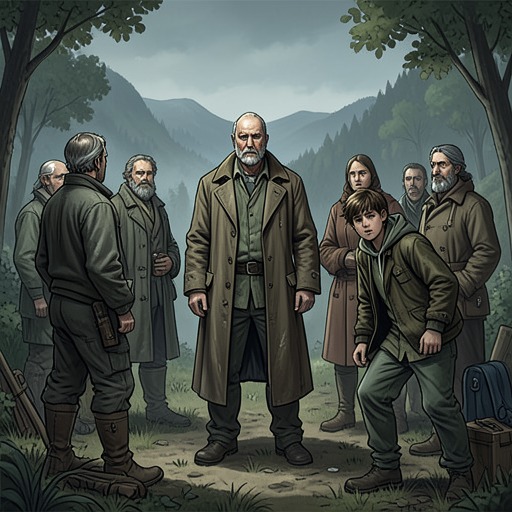
Ish and Charlie
Earth AbidesIsh and Charlie become rivals when Charlie arrives with Robert and Richard, bringing a new personal force into a community Ish had helped organize. Their conflict begins in Ish’s distrust of the stranger, intensifies when Charlie disregards Ish’s authority over Evie, and ultimately helps precipitate The Tribe’s first decisive exercise of collective power. The relationship matters not simply because the two men oppose one another, but because Ish discovers that his position has rested on custom and circumstance rather than a settled political order.
Arrival and First Impressions
Charlie returns with Robert and Richard in a travel-worn jeep, and the community rushes out to greet them. Ish is relieved to see the boys alive, but the reunion changes as Charlie emerges. He is large and powerful, and Ish immediately reads his presence as a challenge. Their handshake makes the difference in physical strength unmistakable to Ish, who senses that Charlie could hurt him if he chose. Ish nevertheless attempts to greet him cordially, while inwardly comparing the stranger’s strength and appearance with his own standing in the community.
Ish recognizes that his response may be unfair. He rebukes himself for resenting someone whose manners and ideas might differ from those of the established group, especially since he has argued that the community needs new ideas. His dislike, however, keeps returning, and he seizes on Charlie’s untidy appearance as a rational explanation for an antipathy he knows may be less rational. The self-correction does not resolve the suspicion; it makes Ish aware that prejudice and defensiveness may be entangled.
The returning travelers describe reaching Chicago but finding roads increasingly obstructed by fallen trees, washouts, and missing bridges. As the community questions them, Ish notices that Ezra is also watching Charlie warily. Ish takes Ezra’s unease as reassurance, because he trusts Ezra’s judgment of people, but then questions whether he is merely projecting his own apprehension onto his friend. That uncertainty becomes a recurring feature of the rivalry: Ish cannot always distinguish evidence about Charlie from his own fear of being displaced.
Attraction, Influence, and Rivalry
Charlie’s appeal is visible to others even when Ish cannot share it. Robert and Richard are loyal to him, George appears impressed, and the younger members gather around him. Ish sees Charlie display both strength and charm; at one moment he feels almost warm toward him, only to interpret that very combination as a threat to his own position. The dogs, initially curious about the stranger, soon relax around him. The welcome Charlie receives is therefore not merely Ish’s imagined danger: he is already forming connections within the group.
That evening, Ish realizes he has framed the situation as a personal struggle between himself and Charlie. The Tribe, he thinks, has not developed the firm organization or symbolic unity that could meet a powerful newcomer without reducing the encounter to a contest between leaders. Charlie has the younger people’s loyalty, George’s attention, and an influence Ish cannot explain. Ezra seems uncertain, but Ish recognizes that even this is not a settled alliance. He doubts whether his own intellectual leadership would be enough in a direct contest for power, and acknowledges that he may be too prejudiced to judge Charlie clearly.
The rivalry is thus sharpened by a difference between the authority Ish possesses and the authority he fears Charlie can command. Ish has been treated as a leader, but he begins to suspect that this role arose partly by default, because no one else had challenged it. Charlie’s arrival makes that vulnerability visible. Ish’s concern is not only that Charlie is strong; it is that the community’s loyalties could reorganize around him before Ish has established any common rule capable of holding them together.
Evie and the Open Defiance
Ish’s apprehension becomes immediate when he approaches the younger group and sees Evie beside Charlie. He had regarded her as familiar and had not fully considered her as an adult woman; now he sees that Charlie’s attention has changed the situation. The young people have gathered around Charlie, and Ish realizes they are looking to him for guidance. His arrival temporarily gives the moment an official character, but the group’s expectation also reveals how much of his authority depends on their willingness to recognize it.
Charlie makes his disregard plain by drawing Evie close to him while looking at Ish. Ish understands this as an open challenge. He sends the others away, including Ezra, though Ezra is the ally Ish would most want beside him. Keeping Ezra there, however, would have exposed Ish’s dependence in front of Charlie and the group. The two men are left alone, seated several feet apart, and Ish directly orders Charlie to stop pursuing Evie. When Charlie asks whose authority supports the demand, Ish can offer only his own.
Ish tries to explain that the community has treated Evie as taboo and that the boys had grown up without approaching her. He also argues that children like those she might have with Charlie would create a serious problem for the group. The exchange exposes the weakness of a prohibition that Ish has never converted into a clearly established communal law. Charlie challenges the history Ish invokes, and Ish cannot answer with an accepted institution, an enforceable rule, or a collective mandate. In choosing to argue rather than simply command, Ish recognizes that he has already allowed the encounter to become a contest in which Charlie can claim the stronger position.
Charlie’s casual handling of small stones as Ish speaks reinforces the disrespect Ish perceives. Ish eventually gets up and walks away. He is not afraid that Charlie will attack him; that absence of fear makes the defeat more humiliating, because Ish understands that Charlie has no need to treat him as a serious physical threat. The hammer he carries, previously associated with his authority, feels like mere weight. The encounter revives Ish’s memory of his less confident self before the Great Disaster and makes clear that leadership has not erased his old unease around other people.
Personal Motive and Collective Judgment
Back at home, Em’s embrace gives Ish renewed confidence, even though she does not always agree with him. The encounter with Charlie has left him asking whether he is defending the community or defending his own position. Later, Ezra reports that Charlie has several sexually transmitted diseases. The revelation shocks the adults, while the younger members do not understand its significance. Ezra’s information adds a public-health concern to the conflict, but it does not erase the personal rivalry that has already shaped Ish’s judgment.
When Ish later considers Charlie’s fate, he is conscious that the danger to The Tribe is real and that Charlie could continue to influence the younger people. At the same time, Ish questions whether he is still chiefly worried about losing leadership. The decision is not simply a private contest once it reaches the group: four slips are returned bearing the same choice, and the community acts together. Yet the collective result cannot make Ish certain that his own motives were pure. He remembers that Ezra’s report had strengthened his existing dislike and fear, including his apprehension that Charlie might replace him.
The aftermath makes the relationship a turning point in the community’s history. Ish walks with the others after Charlie’s burial, carrying the hammer, and understands that the previous years of life as an extended family have ended. The new order will be a state, imagined as a protective institution but begun through a decision to take a life. Ish believes the group faced a grave threat, yet he remains troubled by the possibility that personal resentment helped direct the outcome. His relationship with Charlie therefore leaves him with no clean separation between public responsibility and private rivalry: the community’s decision is shared, but the burden of having helped bring it about remains with him.