Ish and Charlie clash over Evie
Earth AbidesIsh and Charlie clash over Evie at a turning point in the Tribe’s life: Ish’s personal authority meets a challenge he cannot settle by command. The dispute begins as a confrontation over Charlie’s intimacy with Evie, but it exposes a larger problem. In a society without the police, courts, or government Ish once knew, neither his hammer nor his former leadership can by itself determine what the community must do.
The confrontation takes shape
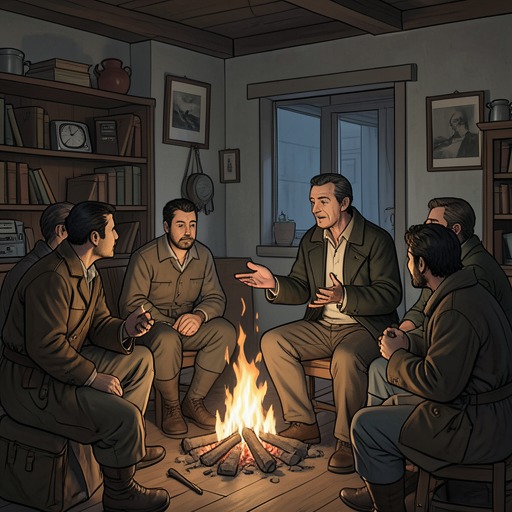
Ish approaches the younger members gathered around the ashes of a bonfire, where Charlie is telling stories and joking with them. Ezra is present, as are almost all the younger people. The sight initially seems to confirm what Ish expected, but then he notices Evie sitting close beside Charlie. Her attention, normally furtive and peripheral, is fixed on him; she appears absorbed by his words even though she does not understand much of what he says. The change in her attention, and the pair’s closeness, make the problem unmistakable to Ish.
The scene also changes how Ish sees Evie. Ezra had found her dirty and living in filth, able to open cans for food but not to cook or prepare it. The Tribe had cared for her over many years, though Ish had sometimes regarded that care as the lingering remnant of an older humanitarian standard. Now he recognizes her as a fully developed woman, strikingly blond and beautiful, while remaining aware of the vacancy in her expression and the strangeness of her eyes. His perception is entangled with his worry about what her relationship with Charlie could mean for the community.
A burst of laughter makes the new intimacy public: Evie giggles, and Charlie pinches her in the ribs, prompting a shrill scream. As Ish approaches, the group turns toward him. He realizes that the others have been waiting for his response, as though his presence should settle what to do. Charlie then puts an arm around Evie and draws her close. She seems surprised but yields comfortably. To Ish, the gesture is open defiance; the dispute is no longer only a concern he can hold privately.
Command, argument, and refusal
Ish orders everyone else to leave and sends Ezra to take Evie to Molly’s, saying she needs her hair combed. The group departs without arguing, apparently uneasy about what is coming. Sending Ezra away costs Ish his strongest ally, but keeping him there would make Ish appear unable to face Charlie without support. The choice shows Ish trying to preserve the appearance of authority even as he recognizes how exposed that authority has become.
Left alone, the two men sit six feet apart. Ish states his demand plainly: Charlie must stop pursuing Evie. Charlie does not accept the command as self-justifying. He asks who says so, then presses Ish to explain whether Evie is Ish’s girl or why Ish wants him to back off. Ish answers that the group is decent, if not especially intelligent, and does not want children like the ones he expects Evie would have. His stated concern is the possible future of their children and, by extension, of the community.
In answering, however, Ish changes the terms of the confrontation. He recognizes that he has begun arguing rather than commanding, thereby acknowledging that his order alone will not settle the matter. Charlie’s challenge has forced him to supply reasons, and the reasons reveal the uncomfortable substance beneath his protective language: Ish is judging Evie’s capacity for motherhood and treating the possibility of her children as a danger to the Tribe. The conflict is therefore not simply between an established leader and an unruly newcomer. It also tests the boundary between the community’s claim to protect its future and Evie’s place within that community.
Charlie answers by questioning Ish’s assumptions about Evie and the other boys, and by pointing out that he could have chosen another woman if he had wanted to. Ish can offer no further argument. Nor can he appeal to police, a district attorney, or a court: the institutions that would once have stood behind such a dispute are gone. Charlie has met his challenge directly, and Ish gets up and walks away.
Humiliation and a weakened symbol
Ish remembers an earlier moment after the Great Disaster when he had turned away from a man and feared being shot in the back. This time he is not afraid of Charlie, a difference that makes the defeat more humiliating rather than less. Ish understands that Charlie sees no need to shoot him: Ish has already come off second-best. His withdrawal marks a sharp reversal for someone accustomed to being the Tribe’s leader.
The hammer, which Ish has gripped throughout the confrontation, loses its force as a sign of command. On his walk home it is only weight. The change gives material form to Ish’s loss: the object remains in his hand, but it cannot make the others accept his decision or restore the legal order he once relied on. His humiliation also connects his present failure to the socially uneasy young man he had been before the disaster, the person who feared dances and never felt at ease with others. Leadership had changed him, but had not erased that earlier insecurity.
When Ish reaches the old house, Em is waiting. He lays down the hammer and takes her in his arms, or she takes him in hers; he cannot tell which. Her embrace restores some confidence, though she does not always agree with him. This consolation is distinct from the public question still facing the Tribe: personal reassurance cannot decide what rules should govern Charlie and Evie.
From personal dispute to communal decision
The conflict returns to the group when the boys arrive and settle around Ish. He understands that they expect him to speak, but the situation is moving too quickly for a formal founding document or a constitution. Instead, he puts the immediate question to them: what should they do about Evie and Charlie? The change from a private confrontation to an assembly makes the dispute a test of collective judgment as well as Ish’s standing.
The response is not unanimous. Ish feels that Ezra is the only man firmly on his side. The boys, including George, see Charlie as a possible source of new energy from outside the existing group, and some think his interest in Evie is an advantage rather than a problem. They nevertheless have enough loyalty to Ish to insist that Charlie should apologize for what happened that morning. At the same time, they believe Ish acted too quickly by confronting Charlie before consulting the rest of them.
That reaction exposes two separate questions that Ish’s original command had joined together: what the Tribe should think about Charlie’s conduct, and who has the right to decide such matters. The younger members do not simply endorse Charlie; nor do they simply ratify Ish’s authority. By bringing the conflict before them, Ish encounters a community whose members have their own judgments and expectations. The clash over Evie thus helps reveal the inadequacy of rule by personal prestige in a society without inherited institutions, and points toward the need for decisions made collectively.