Ish and Em
Earth AbidesIsh and Em’s marriage is one of the enduring sources of intimacy and steadiness in the novel’s changing community. Em does not merely affirm Ish’s ideas or ambitions: she questions his confidence in progress through communication, helps him recover from humiliation, and reminds him that the world exceeds any individual’s power. Their partnership lasts through arguments, political danger, and the end of their childbearing years, remaining warm even as the society around them changes.
A Marriage That Allows Disagreement
Ish and Em’s closeness is not founded on intellectual agreement. In one discussion, Ish argues that isolated communities become conservative and regress, while contact with other civilizations can loosen their habits and renew social life. He points to George and Maurine as examples of people gathering remnants of the past and freezing at the point they have inherited. Em’s silence signals that she does not wholly accept his argument; when he asks what is troubling her, she counters with the harms suffered by Indigenous people through contact with white colonizers and by her own people on the coast of Africa through contact with enslavers.
Ish answers that communities might be better prepared for such encounters if they had known about them in advance. He is pleased with his response and takes Em’s position to mean that she would rather let things slide and live in ignorance. That interpretation reveals a recurring difference between them: Ish turns questions into problems of knowledge, preparation, and collective progress, whereas Em’s counterexamples keep the human cost of contact in view. Her tentative “Yes, perhaps, perhaps” does not resolve the disagreement. Nor does Ish’s confidence in his reply establish that she has been persuaded. Their exchange matters precisely because intimacy does not require either spouse to surrender an independent judgment.
The argument also touches Ish’s long-standing dissatisfaction with the community’s scavenger existence. He recalls urging people to live more creatively, rather than simply opening cans, and says he was already making that case when they were expecting their first child. Em remembers that he has said it many times. Her response connects a lofty program for social change to the persistent ease of ordinary habits: even when Ish has imagined a more creative life, the community continues to rely on what is immediately available. She knows his convictions well, but familiarity does not turn them into shared certainty.
Em as Support and Corrective
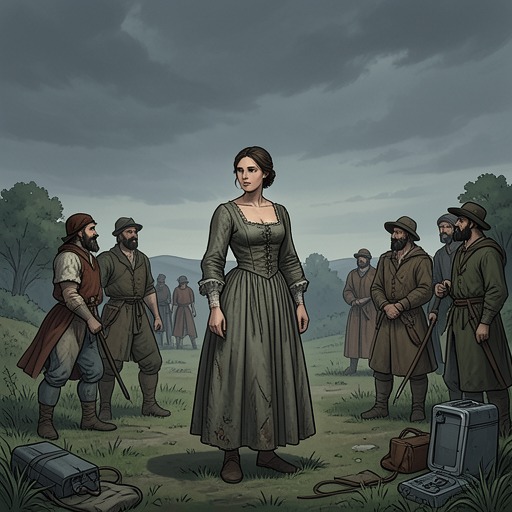
When Ish returns home humiliated after his confrontation with Charlie, the hammer he has carried as a sign of authority feels to him like mere weight. He has walked away from Charlie knowing that he has come off second-best, and the encounter revives his sense of himself as the awkward young man he had been before the disaster, not the leader he has become. Em is waiting in the old house. He lays down the hammer and takes her into his arms, though he cannot tell whether he or she first reaches for the other. The gesture marks a turn from isolation and shame toward renewed confidence.
Their support does not mean that Em tells Ish he was right. They had argued about Charlie the previous night, and she now tells him that he should not have confronted Charlie alone: the boys should have backed him, because Charlie might have shot him. She identifies Ish’s strengths as thinking and knowing, not meeting a man like Charlie in a direct contest. Her response is intimate but unsentimental; she recognizes both the danger Ish faced and the mismatch between his intellectual authority and Charlie’s capacity for violence. She then takes practical action, telling him to gather Ezra, George, and the boys. Where Ish has withdrawn with his humiliation, Em moves toward organizing a collective response.
Her influence is not confined to private counsel. During the community’s decision over Charlie, Em is not at the oak tree where the men gather, because that is treated as men’s work, but she has written her vote on the ballot. Ish understands that she will not dwell on the decision or worry over it as he does. Her participation nonetheless gives her a place in the community’s judgment, even within a process whose public gathering excludes her. The contrast between her absence from the oak tree and her ballot makes visible both the gendered boundary around the assembly and her agency within the decision.
The Long Continuity of Their Bond
In the aftermath, Ish takes Em’s hand and presses it to his cheek. Its coolness gives way to warmth against his flushed skin, and the present gesture recalls the beginning of their relationship: many years earlier, he had first seen her standing in a doorway’s light and heard her speak in quiet affirmation. The memory reaches across the years without erasing their differences. By then, twenty-one or twenty-two years have passed, and Ish believes there can be no question about the enduring quality of their relationship.
They will have no more children, but Ish does not treat that change as the end of their closeness. He reflects that some might see Em as more his mother than his wife, and accepts that description rather than making it an accusation or a complaint. She is ten years older than he is; their attachment has developed through a life in which care and marital companionship are not easily separated. The warmth he recognizes is not dependent on another child or on uninterrupted agreement. It persists in the ordinary physical contact of hand against cheek and in Em’s continued presence when his confidence falters.
The relationship also gives Ish a place to speak without first shaping his thoughts into a plan. After the Charlie crisis, he pours out his account to Em and feels her sympathy enfold him before he hears her judgment. Later, when he worries over the chain of consequences set off by the water failure, the expedition, and Charlie’s arrival, Em tells him not to think or worry about it then. Ish knows that he will go on worrying because he takes pleasure in looking ahead and trying to see what may come. She neither converts him to her temperament nor asks him to become someone else.
A Shared Life Within Forces Neither Can Govern
Ish’s reflections on the future often measure him against founders and rulers. He wonders whether events would have unfolded differently if he were a lawgiver such as Moses, Solon, or Lycurgus, and doubts his own capacity to shape the community’s fate. Em answers that she does not want him to be different. She then challenges the premise beneath his self-reproach: even a great founder could not control the whole world pressing in around the community. Her reassurance does not deny Ish’s responsibility or his habit of trying to anticipate danger. It places those efforts beside the limits that neither a marriage nor a leader can remove.
This exchange brings their differences into their closest form. Ish is drawn to speculation, historical comparison, and the possibility that foresight might alter the future; Em answers from attachment and a steadier acceptance of what cannot be mastered. Yet her affection does not reduce her to a soothing presence. She has challenged his theories, warned him about Charlie, and participated in the ballot; when she comforts him, she does so as someone who has already disagreed and acted. Ish receives her words as comfort partly because they are not automatic agreement.
Across these scenes, the marriage functions as a counterweight to Ish’s solitary sense of responsibility. His ideas repeatedly reach beyond the household toward the future of the community, but Em brings him back to the limits of individual power and to the relationship they have built in the present. Their bond does not solve the political or practical crises around them. It gives Ish a trusted person with whom he can be uncertain, corrected, and still accepted, while allowing Em to remain a judgment-bearing partner rather than a mere audience for his plans.