Ish and Em meet
Earth AbidesIsh and Em meet after a storm, when a faint sign of human presence draws Ish out of the solitude he has endured since the disaster. The encounter begins with his uncertainty and ends with the prospect of a bond: a woman’s welcome, Princess’s happy commotion, a handshake, and food shared together turn a possible sighting into what Ish recognizes as a decisive beginning.
Smoke, hesitation, and a second chance
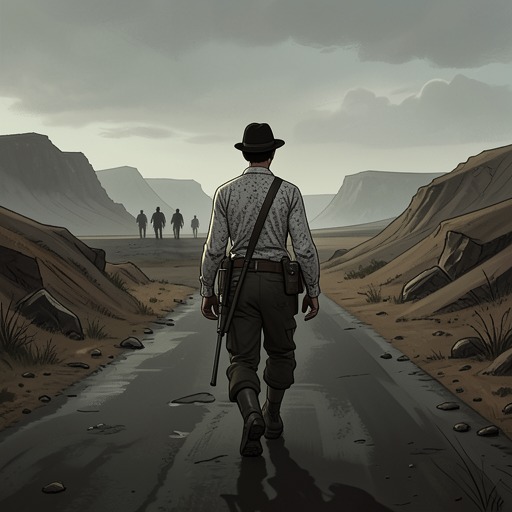
After breakfast, Ish looks out from his porch into the clear air left by the storm. The red towers of the Golden Gate Bridge stand sharply against the sky, and when he turns toward Mount Tamalpais he sees a thin column of smoke rising between him and the mountain, on the near side of San Francisco Bay. Its small, steady appearance suggests a domestic fire rather than a blaze in the open. Ish knows that smoke can mislead him: he has investigated many such signs without finding anyone. But the rain makes a naturally started fire less likely, and the smoke becomes a possible sign of another survivor.
The possibility does not immediately make him act. When he looks again, the smoke is gone; relief comes first, then disappointment. Ish recognizes the painful reversal: while the chance was present he did not dare seize it, and once it vanished it became precious. He imagines that whoever made the smoke might have been passing through and might never be found. The scene makes isolation more than an absence of company: it has trained Ish to hold back even when companionship may be within reach.
After supper, he sees a faint but unmistakable light and responds differently. He calls Princess, gets into his car, and drives toward it instead of putting off the decision. The light disappears as soon as he leaves home. Its visibility from the porch depended on the house’s windows facing him, and fallen leaves after the storm may have opened the view. Ish spends half an hour driving back and forth through the streets before locating the light again. He passes the house, then finds the right street and approaches slowly. Light shines through the drawn shades, bright enough to illuminate the street a little; he judges it likely to come from a gasoline lamp.
A welcome instead of a challenge
Ish enters with his hammer, expecting the guarded response that a stranger approaching at night might provoke. Instead, after a pause, a woman says, "That's a beautiful dog!" Her attention to Princess breaks the expected standoff. She neither demands an explanation nor treats Ish as an immediate threat; the dog supplies a point of contact before either human being has introduced themself.
Em is a brunette, above middle height, and a mature woman rather than a girl. She laughs at Princess’s scampering, and the sound releases something in Ish: a barrier inside him gives way, and he laughs with her. When she says, "It's good to see someone," Ish can only apologize for the hammer dangling from his hand. He sets it on the floor, its head down and its handle sticking upright. The awkward object makes visible how much he has relied on a weapon-like reassurance in his lonely life.
Em does not shame him for carrying it. She says she understands the need to have something nearby for comfort, comparing it to a pocket-piece or rabbit-foot, and remarks that survivors are still about the same as they used to be. The exchange establishes an immediate likeness between them: each has needed a familiar object to manage fear, and neither must explain that need from the beginning. Em’s gentle, unhurried manner differs sharply from Ish’s imagined commands to surrender or raise his hands.
The first shared meal
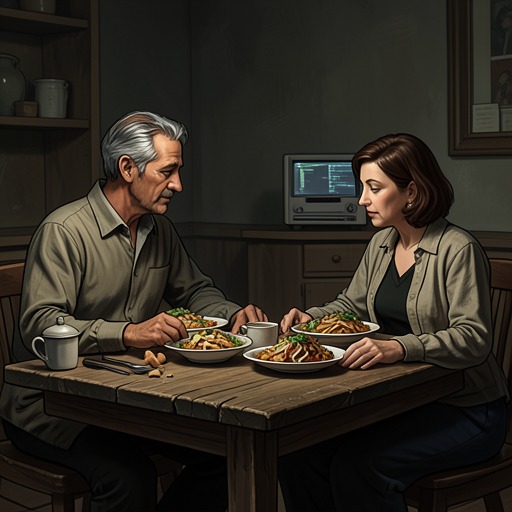
After the laughter, Ish trembles and feels his body weakening as the defenses built through months of loneliness and desperation begin to break. He reaches out for a handshake, an ordinary social gesture made newly significant by the deprivation that precedes it. Em takes his hand, notices his trembling, draws him toward a chair, and lightly pats his shoulder as he sits. Her touch and practical care answer his vulnerability without requiring him to ask for help.
Em offers to get him something to eat. Ish has already eaten well, but he does not protest: the meal matters not as a response to hunger alone but as a shared human ritual. Sitting at one table and breaking bread together makes their meeting something more than an exchange between two people who happen to be alive. Food gives their recognition a concrete form, joining the bodily need for sustenance to the social act of welcoming a stranger.
Recognition and the promise of a future
As they talk, Ish shows Em the scars from the rattlesnake’s fangs on his hand and the larger marks left when he cut himself to apply suction. He recounts his fear, his flight, and the Great Loneliness he had never quite dared to face or imagine. Em encourages him to continue, answering that she knows and remembers, while speaking little about herself. She has seen the catastrophe itself and, Ish realizes, has faced more than he has; nevertheless, she seems to have come through it better than he did.
The contrast is not simply between one survivor’s story and another’s. Ish has encountered men and women since the disaster, but no one before Em has held him in this way. He wonders whether time has healed him, but considers it more likely that Em herself is different. He understands the meeting as no casual encounter or passing moment, but as the beginning of a future. The scene thus changes the meaning of survival: another person is not merely evidence that humanity persists, but someone capable of receiving Ish’s account and returning recognition.
That recognition carries an attraction Ish increasingly feels in Em’s presence. For Ish, eating together answers the human need for fellowship, but the difference between man and woman suggests a further kind of sharing, at once physical and symbolic. The passage presents this not as a settled relationship but as a new possibility taking shape. At its close, they realize that neither knows the other’s name, although each has been calling the dog Princess. The small omission leaves their introduction unfinished even as Ish has already felt its consequence: after the Great Loneliness, he can imagine a future that includes another person.