Ish discovers the disaster and searches for his family
Earth AbidesIsh’s discovery of the Great Disaster begins with signs that ordinary life has quietly stopped and ends with the most personal absence: his family is not at home. In Hutsonville, a body beside the road and empty streets undermine his expectation that familiar civic authorities can explain what has happened. A newspaper reveals a rapidly spreading disease and the scale of the losses; when Ish reaches his house on San Lupo Drive, its unmade beds and still-running appliances make the catastrophe intimate without telling him where his parents have gone.
The road into Hutsonville
Ish is approaching Hutsonville when he notices a fully clothed man’s body beside the road. Ants are crawling over the man’s face, and the body appears to have been there for at least a day or two. Ish turns back to look, but does not examine it closely. His first response is procedural: he should reach town and inform the Coroner. Even as he sets off again, however, he doubts that the situation belongs to a Coroner at all. He has seen nobody at the Johnsons’ or at the power-house, and no other car has passed him. The power-house’s lit windows and the generators’ steady hum are the only signs of the old world’s systems still operating.
The approach to town briefly offers reassurance in small, untroubled forms of animal life. A hen scratches in a vacant lot beside her chicks; a black-and-white cat crosses a sidewalk. Yet Ish sees no people in the heat of the afternoon. He tries to explain the empty streets as an ordinary pause in the day, then recognizes that this explanation is serving to steady his courage. At the business center, the car stops and the emptiness becomes unmistakable. A restaurant door is open, but no one answers when he calls inside. The silence is not simply a lack of help; it leaves Ish without the ordinary human response that would confirm his assumptions about the town.
The newspaper and the scale of the disaster
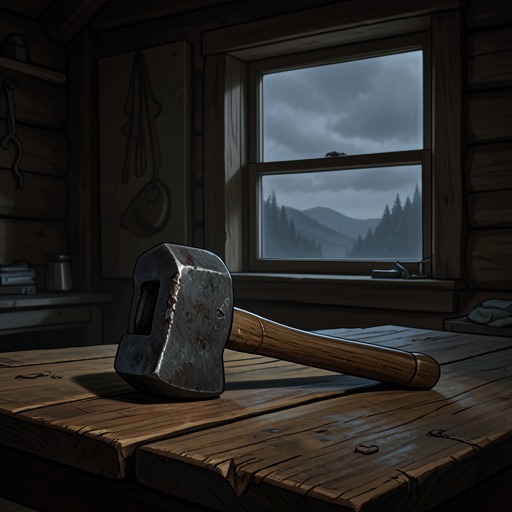
A locked pool-room window gives Ish his first material evidence of the crisis. Newspapers remain visible in the rack, and one bears a headline announcing an acute crisis. He takes up Ish’s One-Handed Sledgehammer and raises it toward the door, but the habits of lawful life initially hold him back. He has been taught that a citizen does not break into a store. With the street empty and no authority in sight, panic overcomes that restraint. He strikes the lock, breaks the door open, and enters.
The paper he finds is unlike the substantial Chronicle Ish remembers. It is a single folded sheet, closer to a small local weekly, dated Wednesday of the preceding week. Its compressed form reflects the disruption around it: the information that reaches Ish is fragmentary, yet sufficient to overturn his understanding of what is happening. Across the United States, a new disease of extraordinary speed and fatality has overwhelmed the population. Estimates for some cities suggest that 25 to 35 percent of residents have already died; Boston, Atlanta, and New Orleans have supplied no reports, an indication that their news services have failed. The disease has appeared almost simultaneously in major centers of civilization, and air travel has helped it outrun quarantine. Its symptoms resemble a kind of super-measles, but its origin is unknown.
The accounts also show that the disaster has not immediately erased organized response. Doctors and nurses remain at their posts, thousands of volunteers have joined them, and parts of cities have been designated as hospital zones and concentration points. Ordinary business has stopped, while food continues to be handled on an emergency basis. In many cities telephone service, water, lighting, and power are still functioning despite the deaths. Authorities require immediate mass burials to prevent conditions that could further destroy morale. Ish reads the paper once and then reads it again more carefully. Its reports describe people facing the emergency with discipline, but they cannot tell him what has happened in Hutsonville or whether his family is safe.
The search at home
Ish returns to the house where he has lived for a long time, on San Lupo Drive. The street retains its respectable appearance, though its sidewalks are less well kept than before. A familiar gray cat sleeps on a porch and stretches when the car passes. The ordinary details are recognizable, but they cannot answer the question driving Ish’s return. He stops outside his house, sounds the horn twice, and waits. No one comes out. The front door is unlocked.
Inside, the rooms appear orderly, and Ish searches the living room for a note explaining where his family has gone. There is none. Upstairs, the house also seems much as usual, but both beds in his parents’ bedroom are unmade. That detail precipitates a physical reaction: Ish feels dizzy and sick, then leaves the room unsteadily. He turns toward the kitchen because the thought of doing something definite gives him a momentary focus. There, the electric clock’s moving second hand and the refrigerator motor starting up are motions without human company. The functioning appliances briefly make the house seem occupied, but their activity only sharpens the difference between mechanical continuity and the missing people.
After recovering, Ish sits in the car. A thorough search of cupboards and drawers might yield more information, but he sees no purpose in forcing himself through the house in search of evidence that cannot change what is already clear. There are no bodies inside, at least; nor does he believe that the house contains ghosts, although the clock and refrigerator seem almost ghostlike in their persistence. He initially thinks he cannot go back in. Then he recognizes that his parents, if they are still alive, might return to the house looking for him, just as he has returned looking for them. After half an hour, he overcomes his reluctance and goes back inside. The search therefore remains open: Ish has found neither his family nor a definitive account of their fate, but he chooses not to abandon the place where they might still meet.
From private loss to survival
The discovery establishes the distinction between the disease’s immediate toll and the later dangers Ish calls Secondary Kill. He comes to understand that people who survive the initial catastrophe may still die from accidents, untreated illness, violence, suicide, or the psychological shock of isolation and readjustment. His own circumstances spare him one particular source of that shock: he did not have to live through the disaster while watching his family and other people die. That does not resolve the uncertainty of their absence, but it helps explain why his response can move from panic toward practical judgment.
The opening sequence repeatedly sets inherited systems against the evidence that they no longer suffice. Ish first thinks in terms of a Coroner, property, newspapers, and civic order; then, with no people available to perform those roles, he breaks a door with his own hammer and uses a week-old local paper to reconstruct the crisis. The empty town and the still-operating appliances give the collapse two different tempos: public life has vanished, while familiar mechanisms continue for a time without anyone to maintain or interpret them. His return to San Lupo Drive makes the larger emergency a search for particular people, and its unresolved ending begins the solitary work of adapting to a world in which the old explanations and safeguards can no longer be relied upon.