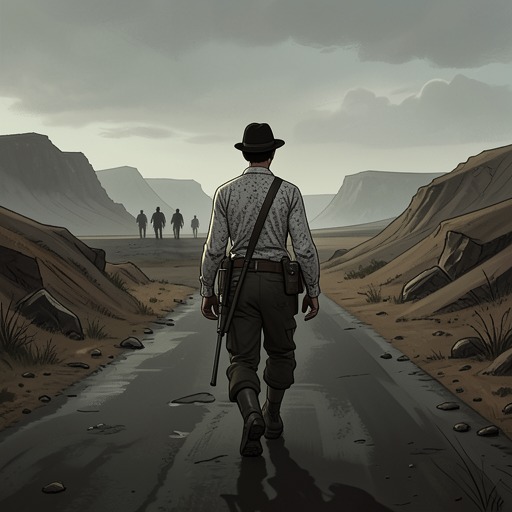
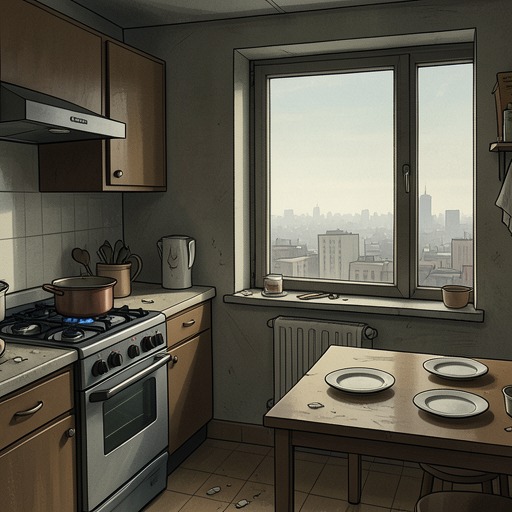
Ish meets and leaves Milt and Ann
Earth AbidesIsh’s meeting with Milt Abrams and Ann on Riverside Drive is a brief encounter with companionship and a stark lesson in how closely survival depends on adaptability. Their apartment preserves fragments of an ordinary urban life—cards, drinks, music, and conversation—but their world has contracted to a few walkable blocks. Ish likes them and nearly stays; instead, he continues west, leaving behind a couple whose ease in the present cannot disguise their lack of hope or their vulnerability to the coming winter.
A Chance Meeting on Riverside Drive
After crossing parts of New York City, Ish turns north along Eleventh Avenue and then into Riverside Drive. The sun is sinking over the smokeless stacks on the Jersey shore when a voice calls to him. Princess barks furiously from the car as Ish stops and goes to meet the man emerging from an apartment-house entrance. The man introduces himself as Milt Abrams.
Milt’s appearance and manners seem reassuringly conventional: middle-aged, overweight, clean-shaven, smiling, and still wearing a tropical-worsted suit coat. He takes Ish inside to a pleasant second-floor apartment. There Ann, a blond-haired woman of about forty, offers him a warm martini and makes light of New York City’s lack of ice. Their banter immediately restores the rhythms of social hospitality, but it also reveals how much of their old world has disappeared: even a familiar drink is now defined by the absence of something once taken for granted.
The introductions carry a private awkwardness. Milt presents Ann as his wife, but his hesitation tells Ish that the title covers an embarrassment: the catastrophe left no opportunity for a ceremony. Ann identifies herself by her own name. Ish also has to fumble for his own, having gone so long without thinking of it. The meeting thus begins with small dislocations in identity and custom, softened by the couple’s effort to receive a stranger as they would have before.
The Apartment’s Preserved Routines
The evening proceeds through an assortment of ordinary pleasures. By candlelight, the three play bridge; they drink liqueurs and listen to records on a portable phonograph that works by hand winding rather than electricity. Ish has brought Chateau Margaux, which they drink with cold canned corned beef. The wine and the game make for an agreeable evening, but the scene’s domestic normality is partly an act: the couple behave as if a world still exists beyond the windows and as if the evening were simply a pleasant one among friends.
In the course of cards and incidental talk, Ish pieces together their past. Milt had been part-owner of a small jewelry store. Ann had previously been married to a man named Harry, and had once worked briefly selling perfume during the Christmas rush; she and Harry had been prosperous enough to spend summers on the coast of Maine. Now she and Milt occupy an apartment finer than the one Harry could provide. Their circumstances have changed radically, yet their habits remain attached to the social world that formed them.
They have found ways to fill their days. They play cribbage and two-handed rummy for imaginary stakes, with Ann supposedly owing Milt millions. They listen to jazz, folk songs, and dance music, and borrow mystery novels from Broadway circulating libraries, leaving the books scattered around the apartment. Ish guesses that they find one another attractive. These routines keep boredom at bay, but they do not amount to a renewed sense of purpose. Under the familiar diversions, he perceives a vacancy: Milt and Ann have endured the catastrophe without developing an interest in what lies beyond their immediate present.
A World Measured in Blocks
Their comforts rest on a narrow and precarious geography. The electricity failed almost immediately because New York’s dynamos had been steam-driven, but the water supply apparently continued, preventing the sanitary crisis Ish might have expected. Food and liquor remained available in shops along Broadway. Yet Milt and Ann had never owned a car, neither could drive, and automobiles were mysteries to them. With public transportation gone, they were stranded on foot, and walking was not suited to their age, temperament, or physical condition.
The River marked one edge of their world; Broadway, with its stocked shops, marked the other. They wandered perhaps half a mile north and south along Riverside Drive. Within those limits, they did not think anyone else remained alive. The East Side seemed as remote to them as Philadelphia, and Brooklyn as distant as Saudi Arabia. Their isolation was not simply a matter of miles: without transport or knowledge of the wider city, nearby places had become practically unreachable.
Ish tries to tell them what has happened elsewhere in the United States, but the larger disaster does not take hold in their imagination. To them, the loss of New York is the loss of the world. They are not especially bored, and the evening has been pleasant, but neither quality restores hope. They seem to move through life in a haze of shock, inhabiting the present because the vanished past cannot return and the future offers them nothing they can picture.
The Departure and Its Cost
The next morning, Ann is drinking another warm martini at breakfast and still complaining about the absence of ice. Milt and Ann urge Ish to stay longer, even permanently. They propose that he find a woman in New York who could make a fourth for bridge. They have been the pleasantest people he has encountered since the catastrophe, and Ish is tempted by the welcome. Nonetheless, he decides to turn back west rather than settle into their small circle.
As Ish drives away, Milt and Ann stand at the apartment-house entrance and wave. He almost turns around. He likes them and pities them, imagining the cold ahead: no central heating, snow filling the deep canyons between buildings, and north winds running down Broadway. Their fireplace might be fed with broken furniture, but Ish doubts they will survive the winter; an accident or pneumonia could kill them. The city that once sustained their specialized way of life has become a trap, and the skills and habits that suited them to it offer little help outside it.
Ish’s comparison is with highly bred city dogs at the ends of their leashes: dependent on the environment that once contained them. He sees Milt and Ann as equally specialized, in contrast to people who could return more readily to living on the land. As the Drive curves and carries them out of sight, his sympathy becomes grief. The encounter’s turn is from the comfort of an evening among companions to the knowledge that companionship cannot by itself make their isolated way of life durable. Ish keeps going west, while his final farewell acknowledges both his affection for them and the likelihood that he cannot save them simply by staying.