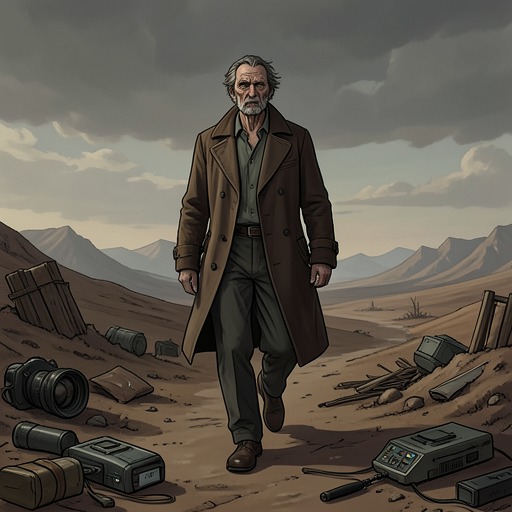
Ish returns to San Lupo Drive
Earth AbidesIsh returns to San Lupo Drive at a threshold between searching and settling. The familiar street and house have survived the disaster physically intact, but their stillness confirms that they cannot restore the people or former life he hoped to find. By burning the note he had left behind and beginning to secure food the next morning, he marks a quiet transition from waiting for the old world to resume to establishing a life within its absence.
The delayed return
After the forest fire, Ish considers how it may have damaged the power lines locally and made the routes out of California more difficult. The Sierra Nevada Mountains seem likely to remain impassable, blocked by fallen trees and by landslides or washouts on slopes stripped of vegetation. He nevertheless sees a possible route south through the desert. The prospect of being trapped feels less absolute in daylight: California is large enough that, even if he cannot cross the mountains, he can still imagine moving through it.
He is ready to leave when Princess suddenly gives tongue and disappears along a trail. Ish waits, but when she does not come back, he changes his plans. Instead of setting out, he spends most of the day resting in the shade and starts late. This interruption makes the return less like a planned destination reached on schedule than a journey redirected by the surviving companionship at his side. Princess’s presence shapes his movements even when her actions frustrate him; by the time they reach San Lupo Drive, she is with him.
At twilight, Ish reaches a hilltop overlooking the Bay cities and is startled to see that many street-lights are still burning. He has been without electric lights for so long that he can scarcely remember where he last saw them. The sight briefly makes the disaster feel reversible: he can almost imagine that he has returned to a normally functioning city. Yet the empty highway ahead contradicts that impression. Some areas have gone dark since his departure, and the lights on the Golden Gate Bridge are either out or obscured by smoke over San Francisco Bay. Ish’s local pride in the remaining lights is therefore inseparable from his recognition that they may be among the last still shining.
A familiar place without its former life
Ish turns onto San Lupo Drive and finds that the street looks much as it did when he last left. The familiar address offers a point of orientation in a landscape transformed by disaster. He recognizes that returning to a particular home is not unique to him: the other survivors, too, seek familiar places after going away. The street’s apparent permanence is a comfort, but not proof that the past has endured.
Inside, Ish opens the front door and switches on the lights. Nothing has changed in the house. That sameness had been a hope as well as an expectation, and its confirmation does not bring active grief so much as a dull, muted response. He recalls a line about a withered leaf and an irrecoverable time, though he cannot identify the play from which he heard it. The fragment gives expression to loss without making the house itself a scene of dramatic change: its rooms remain, while the life that gave them meaning is gone.
Princess breaks the stillness by dashing into the kitchen, slipping on the linoleum, and recovering. Ish is grateful for the interruption. She sniffs along the baseboard, but he cannot discover what drew her attention. The small, unexplained activity contrasts with the weight of the empty house: it gives Ish something present to follow, even though it cannot answer what has happened to his former life. He also recognizes that, without another person to whom he must pretend, he need not perform a feeling he does not have. He treats his numbness as part of what he is going through rather than as evidence that the loss has ceased to matter.
Burning the note and beginning again
The note Ish had left on the desk is still there, undisturbed and remarkably fresh. He crumples it, throws it into the fireplace, strikes a match, hesitates, and then sets the paper alight. The sequence turns a small object into the clearest action of closure in his return. He does not explain the note’s contents; what matters here is that he had left it behind, found it waiting, and deliberately destroys it. His hesitation gives the act a pause, but once the paper burns, he regards that phase as finished.
The passage sets this private ending against the larger break in human continuity. The next generation, Ish imagines, will have neither the familiar ties of parents, spouses, children, nor friends in the old sense; people will meet as strangers, as in ancient stories of a new people raised from stones or dragons’ teeth. This image broadens the meaning of his return. San Lupo Drive may remain recognizable, but a recognizable place cannot by itself preserve the social world that once occupied it.
Establishing a life amid the remnants
The next morning, Ish settles down to establish his life. His first practical concern is food, which he already believes will not be a problem. In the nearest business district, he begins examining store windows. Rats and mice have damaged goods and scattered food across floors, evidence that abandoned supplies are exposed to the consequences of human absence. One display seems miraculously fresh, its bright piles of fruit and vegetables intact behind dusty glass. Ish then realizes that the oranges, apples, tomatoes, and avocados are papier-mâché models from the store’s old permanent display. What first appears to be preserved abundance is only a remnant of the commercial world’s representation of abundance.
He eventually spots a grocery whose interior is not littered and concludes that it must be rodent-proof. He carefully forces a window and enters. The return to San Lupo Drive thus leads directly from emotional reckoning to practical adaptation: Ish has found no restored household or functioning city, but he can search the remains for resources and begin arranging his existence. The episode ends not with a complete account of what he finds inside the grocery, but with the decisive change already underway: after returning to the place he knew, he starts building a life in the conditions that remain.