Ish’s elevation to divine oracle and authority
Earth AbidesIsh’s elevation to divine oracle and authority is a late, uneasy transformation: The Tribe turns an old man’s remaining knowledge and the force of his past into a sacred office he neither sought nor can reliably perform. Younger men come to him with offerings and questions, while his hammer gives their reverence a visible focus. Yet the authority is not simply honor. When Ish cannot or will not answer, they pinch him until he speaks; at the end, they press him to designate a successor to the hammer. His status joins care, belief, need, and coercion in a single relationship.
From Elder to Oracle
For years, younger men had sought Ish’s advice. In his old age, their approach changed: whether he sat outside in the sun or indoors during rain and fog, they brought him small gifts before formally asking their questions. The offerings might be ripe berries he liked, or a bright stone or piece of colored glass. Some stones were sapphires or emeralds taken from a jewelry store, but Ish did not value them for their material worth. He appreciated that the young men gave him things they themselves would have enjoyed receiving. Their giving established a deliberate pattern of approach, making an ordinary request resemble an act of deference.
The change in how they treated him accompanied a change in what they thought he was. Ish had seen the old world collapse and go under, yet his personality had endured; he remained, in the narrator’s account, the person he would have been as Professor Emeritus, even as age and mental fog overtook him. The young men’s visits made the gulf between his remembered identity and his new social position increasingly stark. He was no longer approached only as a knowledgeable survivor: they treated him as a source of answers whose authority exceeded what he could actually know.
The Limits of His Knowledge
Some questions did have answers Ish could provide. When the young men asked about the weather, he could consult his father’s barometer and judge whether low clouds would clear in the sun’s heat or signaled an approaching storm. The instrument preserved a small, useful fragment of the knowledge he had inherited from the pre-disaster world. In this instance, the young men’s belief in his judgment coincided with evidence and practical competence.
Questions about hunting exposed the boundary. Ish knew nothing about where game would be plentiful, and he did not want to pretend otherwise. But silence displeased the young men, who pinched him roughly. In pain, he called out directions such as south or beyond the hills, although he knew the answers were guesses. The men accepted them and went away pleased; Ish sometimes feared they would return to punish him if the hunting proved poor, but they never did. Their conduct made his oracle’s authority both effective and hollow: they required an answer, not necessarily knowledge, and Ish’s involuntary performance satisfied that need without establishing that his advice was true.
His awareness of the role came during one of the days when his mind was clear, after a period in which other days seemed clouded. He understood that he must have become a god, or at least an oracle through whom a god spoke. That realization connected the young men’s treatment to an older pattern: he remembered children fearing to carry the hammer and nodding as if they understood when he said he was an American. Ish had never wanted to be a god. The status was not a deliberate claim he made for himself, but an interpretation The Tribe placed on the remnants of his identity and on the object he carried.
Reverence and Mistreatment
The Tribe’s treatment of Ish combined attentiveness with force. They cared for him as an old man, brought him a breakfast of braised beef bone and cornmeal mush, and let him have the relatively rare cornmeal. Someone carried his hammer and helped him outside so he could sit on the hillside in sunshine; Jack was often the one who assisted him. This care was real, but it did not cancel the rough pinching. The younger men could be respectful and friendly, yet when they wanted a response or action from the figure they revered, they used pain to compel it.
Near the end, Ish could see the young men gesturing but could no longer hear them. He understood that speech had also become difficult for him, and that he could not make himself understood by talking or writing. Their gestures toward the hammer were unclear at first, and he did not consider it worth the effort to work them out. When they grew insistent and pinched him, he cried out, with tears in his eyes, ashamed that this seemed unfitting for the last American. He understood the contradiction plainly: they worshipped him, but mistreated him when he resisted what they wanted. His oracle status gave him a place above ordinary life in their imagination, not protection from their immediate demands.
The Hammer and Succession
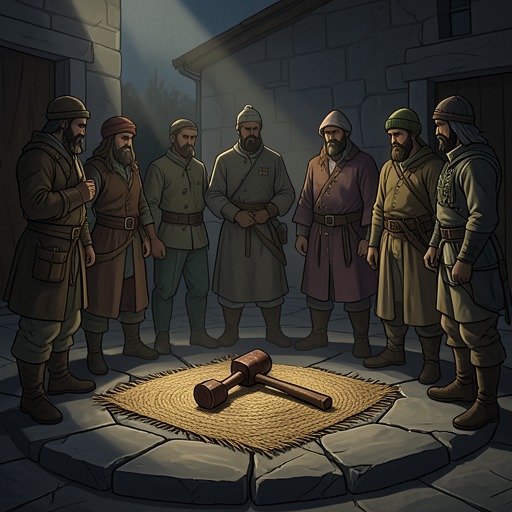
The hammer was central to that contradiction. It had belonged to Ish for a long time, and no one had previously suggested that he give it to another person. By the late years, however, he recognized it as the symbol of a tribal god: it remained with him even as the people and old companions around him disappeared. Its physical weight had also changed in meaning. The tool he had once carried as a single-jack was now too heavy for him to lift with one hand, even though it retained the authority others attached to it.
When Ish finally deciphered the young men’s gestures, he realized they wanted him to indicate who should receive the hammer. He did not care to keep it and wished above all for the pinching to stop, so he used the arms he could still move to choose Jack. Jack took it in his right hand, letting it dangle, while the other three drew back. Ish felt a pang of sorrow for the young man to whom the hammer had descended. The group, meanwhile, seemed relieved that its inheritance had been settled and stopped troubling Ish. The exchange transfers more than a tool: the object that had helped make Ish an oracle now passes to another member of The Tribe, while Ish’s authority is revealed as bound to an inherited symbol and to the people who interpret it. His elevation brings him reverence, but its final act is not a command; it is a pressured gesture that closes his possession of the hammer and makes Jack its bearer.