Ish’s status as the last American from the pre-Disaster world
Earth AbidesIsh’s status as the last American from the pre-Disaster world marks the point where personal survival becomes a living link to a vanished society. As the years pass, the Americans around him die, leaving him first with Ezra and then alone among a younger generation. His distinction brings care and comfort, but also deepens his isolation; at the end, he can see himself as the last of the old without believing that the new must follow the old’s path.
Identity and the narrowing circle
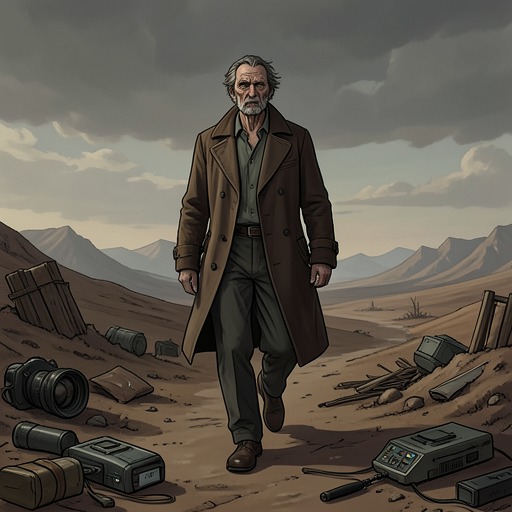
The status takes on its starkest meaning as the older survivors disappear. In the late years, only Ish and Ezra remain among the Americans. Ezra is already a frail, coughing old man, while Ish has turned wholly gray-haired; he is thin-legged, paunchy, and still suffers pain where a mountain lion clawed his side. The description makes survival no triumph over time: Ish has outlived his generation, but his body bears the years and injuries that separate him from the vigorous young people around him.
The shrinking circle is also a change in what Ish represents. He is not simply an older member of the Tribe. His memories reach back to a society that the younger generation cannot know firsthand, and his presence makes that past tangible even as its people vanish. Ezra’s survival briefly gives Ish a companion who shares that history. Once Ezra, too, is gone, Ish’s claim to be the last American is no longer a comparison between two old men; it names his solitude within a world whose human future belongs to others.
Family, aging, and the passing years
Ish’s later family life does not replace the companionship he has lost. He takes a young wife because, as an old man, it is better not to be alone and the Tribe needs more children. He feels no love for her, though she comforts him through the long nights and bears his children. Those children seem scarcely his to him because they are not also Em’s. The distinction shows that biological descent and emotional belonging have come apart: Ish can father another generation without feeling that it continues the family life he shared with Em.
A child is born to him in Year 42, by which time he also has great-grandchildren, but he is not greatly interested in the new child. The expanding family therefore runs alongside, rather than undoing, his inward retreat. His young wife and descendants belong to the Tribe’s future; the attachments that defined his own past remain with the people who are gone.
The physical and communal signs of age converge when Year 43 ends. Ish no longer feels able to walk to the flat rock where the numerals are carved, and Ezra is too frail to go either. They put off recording the date or naming the year. The moment gives the old men’s failing bodies a direct consequence for the Tribe’s calendar: a custom they have maintained is interrupted because its surviving custodians can no longer make the journey. Ish’s reflections elsewhere that time makes things clearer offer a counterpoint. The years are harder to mark, but the meaning of what has happened seems more legible to him than it once did.
The Americans as remembered lives
Ish and Ezra’s conversations about the other Americans keep the lost generation distinct from an abstract category. They remember George with laughter, recall Maurine and her radio that would never play, and smile at Jean’s refusal to go to church. These memories preserve a mixture of affection and everyday inconsequence: the radio’s failure and Jean’s refusal are not grand achievements, but particular details through which the dead remain recognizable.
Such recollection also underscores the distance between Ish’s remembered world and the Tribe’s present. Those who shared the old society are no longer present to answer, argue, or add to the stories. Ish can remember them with Ezra while Ezra lives; after Ezra’s death, even this shared act of remembrance has lost its partner. The title of last American thus describes a cultural as well as demographic condition: Ish is the final living witness to a world whose ordinary people and ordinary habits survive only in memory.
Care, authority, and isolation
The status also shapes how the young treat Ish. After the flight from the wildfire, he reflects that Jack has chiefly taken care of him since they first spoke about arrowheads, and believes that the Tribe’s meeting must have ordered Jack to do so. Ish considers whether he is important enough to be a god, rejects that idea, then rejects the thought that he is a god’s mouthpiece. What remains is more modest and more concrete: the Tribe gives him care, and he takes comfort in being the last American.
That comfort does not erase his separateness. After a young man gives him the breast of a quail, Ish eats it politely and is glad to have teeth left; he finds the smoky taste delicious. He thinks that life is still good and that he is the last American, yet he does not comment on events or ask what the Tribe will do that day. He is conscious of the world but feels drawn away from it. The paired facts matter: his reason for living is not merely a symbolic title, but the small continuing pleasures of food and company; still, he no longer participates as an active decision-maker in the community’s immediate affairs.
The last of the old, the first of the new
At the end of his life, Ish lies among the rocks as the wildfire burns around him, then later reaches the Bay Bridge. On the bridge he knows he is dying. Two dogs and four young men watch him, three apart from the fourth, while his failing sight leaves a mist before his eyes. He measures the young men not just against his own age but against the cycle of humanity: he is the last of the old, and they are the first of the new.
The recognition does not lead him to celebrate a simple return of civilization. He wonders whether the new will follow the course of the old and realizes that he does not even desire that cycle to repeat. His thoughts turn to what built civilization, including slavery, conquest, war, and oppression. The judgment complicates his identity as the last American: he carries the memory of the old world, but does not treat its survival as an unquestioned good or its history as a model for the young.
As death approaches, Ish feels more like a companion of the bridge than of the men gathered around him. The bridge, too, had belonged to civilization, and it outlasts the society that built it long enough to become the setting of his final separation from that world. Ish dies as the last American, but the young men remain present as the first of a different human era. His ending leaves the past remembered, the future uncertain, and the repetition of the old civilization no longer an unquestioned hope.