Mojave Desert
Earth AbidesThe Mojave Desert is both a practical danger and a measure of human smallness in Ish Williams’s journey. Before crossing its long, sparsely served stretches, Ish prepares against breakdown and thirst; during the dark passage, Princess’s sudden dash after a rabbit and return to him precipitate a release from his fear of death. At dawn, the narrative widens from that private crisis to the desert’s immense timescale, in which human roads and rails are only temporary marks on a landscape that changes slowly.
Setting and Route
After leaving Bakersfield, Ish turns onto the winding road over Tehachapi Pass. The slopes rise through scattered oaks to open stands of Coulter pine; on the far side, he looks toward the reaches where the desert begins. The country feels empty, but not wholly in the same way as the inhabited places he has searched: this had always been sparsely settled land. Even before the crossing, however, the view intensifies his apprehension, and he stops in the town of Mojave while the sun is still above the horizon to prepare.
The desert crossing is about two hundred miles. In the Old Times, travelers had carried water across it because a breakdown could leave them walking for a full day before reaching even a roadside stand. With no one available to rescue him, Ish treats that precedent as immediate practical knowledge rather than an obsolete travel warning. The distance, the gaps between services, and the prospect of being stranded make the desert a test of self-reliance.
Preparation for the Crossing
In Mojave, Ish first forces his way into a strongly locked hardware store by smashing a window with his hammer. He fills three large canteens from a faucet still running feebly, then adds a gallon jug of red wine taken from a grocery store. Even this supply does not satisfy him: the thought of the desert continues to weigh on him, and he drives back along the main street, still uncertain what further safeguard he needs.
He sees a black-and-white Highway Patrol motorcycle. Taking it troubles him because it belongs to a traffic officer, yet the thought of stealing it seems almost absurd beside the circumstances in which he finds himself. He later carries the motorcycle as insurance during the drive. Its presence records both sides of his preparation: he calculates for mechanical failure, but his scruples and anxiety have not simply vanished because ordinary law and assistance have disappeared.
The Night Journey and Its Turning Point
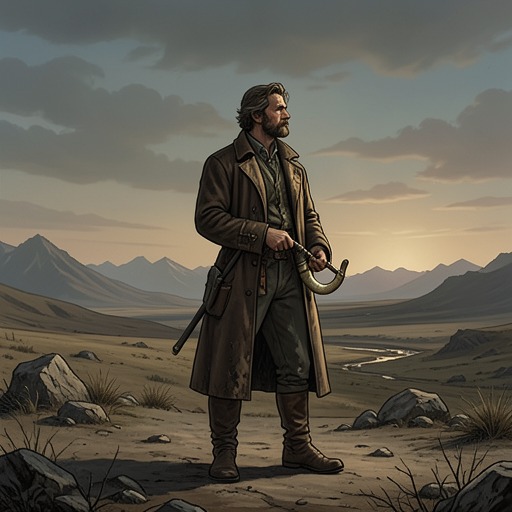
Ish spends the day restlessly in Mojave, trying to think of additional precautions. Near sunset he starts across the desert with the dog beside him. The low sun throws long shadows from the Joshua trees; then twilight erases them, and the headlights reveal a road that remains empty. In the rear-view mirror, Ish sees no approaching pair of headlights. As darkness deepens, his thoughts fix on possible failures—blown tires, an overheating engine, or oil that stops flowing—and even the motorcycle he has brought for emergencies no longer reassures him.
He passes a small desert station where he might have expected fuel, a spare tire, or something to drink, but by then he knows that help will not come. After traveling farther, he stops when the dog whimpers and stirs. She runs briefly, then bays and races into the desert. Ish calls after her without success. In the sudden quiet that follows, he realizes that the car engine has stalled too. He leaps back inside and restarts it; although it runs steadily again, he feels exposed in the darkness and turns off the lights.
When the dog returns, Ish sees that she has been chasing a rabbit. His first response is to take the shotgun from the car, intending to end what he sees as the danger of her foolishness. But the dog lies panting with her head between her forepaws and looks up at him; she has come back to the person who has fed and transported her. Ish relaxes and laughs. The moment breaks the hold of his fear: he recognizes that death is the worst that can happen, and that it has already come to most people. Rather than merely endure the desert, he feels he has challenged the fate that had been governing his thoughts.
Dawn and the Desert’s Timescale
Ish pulls out his sleeping bag and lies on the sand under a mesquite bush, with Princess beside him. He wakes once in the night and finds himself calm; the dog sleeps, briefly twitching as if still running after the rabbit. At dawn, the desert hills are yellow with the rising light. Ish is cold, and Princess has moved close against his sleeping bag. The passage’s small details—rest, warmth shared with the dog, and the return of morning—follow the night’s fear without turning the crossing into a simple triumph over physical danger.
From this dawn scene, the narrative expands into a history of the desert. People first camped at springs, leaving stone chips and faint trails among the mesquite. Later generations laid railroads, strung wires, and built long, straight roads, but the open land remained dominant; a short distance from rail or pavement, it was much as before. People eventually went away, leaving these works behind. The desert’s transformations are slow: sand drifts, gravel moves in high winds, cloudbursts can send water through dry streambeds and roll boulders, and volcanic fissures may open again only after immense spans of time.
The Mojave thus makes the difference between human urgency and geological duration tangible. A failed engine or an empty water supply can become an immediate crisis for a traveler, while the landscape changes by increments measured in centuries. Even after a thousand years, the narrative imagines, stone chips and a road reaching toward a gap in the hills may remain; the traces of people last, but their presence does not define the desert. The crossing joins Ish’s altered response to mortality with this larger perspective: his danger is real, yet it occurs within a world that preceded human construction and will outlast it.