Post-human ecological readjustment
Earth AbidesPost-human ecological readjustment is the prolonged, uneven reordering of living systems after the human population collapse. In Ish’s observations, ants and rats surge and then recede, neglected infrastructure redirects water, and drought, cattle, and grasshoppers briefly make the landscape seem exhausted before rain brings new growth. These episodes resist a simple story of nature returning to a pristine condition: human absence removes old controls, but the consequences unfold through new imbalances, thresholds, and adjustments that the survivors can observe without fully directing.
A world no longer held in place by maintenance
The Great Disaster begins with a disease whose origin remains uncertain. A bacteriologist proposes that it might have come from an animal reservoir, a mutated microorganism, or a laboratory; the disease is thought to spread through the air, and isolation appears ineffective. The newspaper account describes a rapid catastrophe in which ordinary business ends, while doctors, nurses, emergency food distribution, and other services continue for a time. Even with a large share of the population dead, water, light, power, and telephone service remain in many cities. The initial collapse is therefore not an instantaneous erasure of the built world. It is the removal of the people and institutions that keep that world functioning.
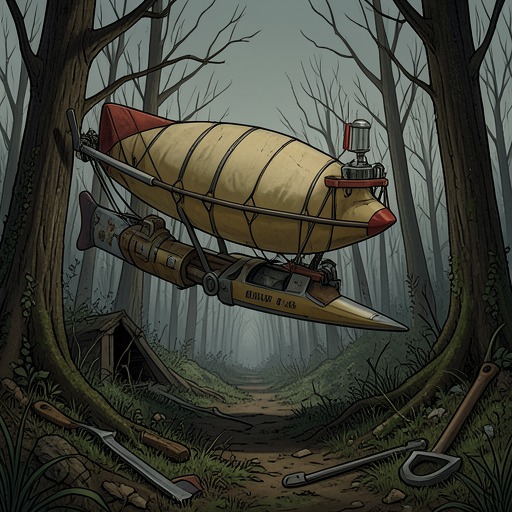
On San Lupo Drive, a clogged drain makes this dependence visible on a small scale. Unswept leaves block a drain-pipe; water crosses the street, floods over the curb, runs through the overgrown Harts’ lawn, and cuts a small gully through the rose-garden before reaching a storm sewer. Ish recognizes that he could clear the obstruction quickly, but that a single repair would mean little among the thousands of similar failures taking place elsewhere. Roads, drains, and walls had seemed durable because people continually repaired and cleared them. Without that maintenance, weather turns minor blockages into landscape change.
The same dependence shapes the forests. In the third year, smoke hangs over the area for three months, and the babies wake coughing. Ish connects the fires to forests altered by logging and human-caused burning: much of the growth is dense second-growth, made more vulnerable by slash piles and brush fields. Fire suppression had helped sustain this arrangement; once the hoses and the people responsible for using them are gone, that human-shaped landscape behaves differently. The wildfire is not simply nature reclaiming an untouched forest, but an ecological consequence entangled with the earlier management of the land.
Surges, collapse, and population thresholds
The ant outbreak first appears to promise that a small, once irritating animal might inherit the city. Ish watches the ants closely and finds that their range does not extend far beyond the urban area. Their dependence on human activity gives him reason to stay and observe. Then the signs change: a piece of food left on the floor draws no ants, turned soil yields no swarm, and only a few stragglers remain. He finds no bodies. He never solves the mystery, but suspects that the ants’ extraordinary concentration exhausted their food supply or left them vulnerable to disease. A faint, pervasive odor in the following days seems consistent with vast numbers having died out of sight.
The Rats produce a larger and more alarming wave. They spread through the city and beyond its built-up edges, appearing in such numbers that Ish and Em feel besieged. Their changing condition reveals the pressure beneath the spectacle. As food stores dwindle, they grow thinner, forage more frantically, dig up bulbs and roots, search trees for insects and remnants of seeds or fruit, and eventually gnaw bark. Ish and Em guard the house; one rat gets into the kitchen and bites at a broom before Ish kills it. The danger they fear is not only the animals’ presence. Ish worries that bubonic plague among rats might pass through fleas to people, and begins using DDT on the house and their clothing. This is a feared transmission route, not proof that the rat surge causes an outbreak among the survivors.
The decline becomes an ecological process of its own. Ish sees larger rats pursue smaller ones and groups attack individuals. He reasons that the stored human food has become a reservoir of rat flesh, and that cannibalism, however disturbing, may allow some rats to survive while the population as a whole contracts. As numbers fall, the animals retreat into holes, narrow passages, and brush-filled gullies; their apparent disappearance from open spaces does not mean the species is gone. Unlike the ant die-off, the decline leaves few bodies, and Ish thinks the rats may also have helped remove human remains left by the original disaster. The episodes make population visibility itself part of the story: a species can seem to vanish when it has ceased to spill beyond its refuges.
Food, disturbance, and recovery
Ish’s first garden, planted in the spring of the second year, is an attempt to replace dependence on stored food with cultivation. The work gives him satisfaction, but the harvest proves uncertain: scarce, old seed germinates poorly, snails and slugs attack the plants, and a buck breaks through the fence and damages the lettuce. The garden makes survival depend on more than human effort. Seeds, pests, and larger animals all participate in what can be grown, and the survivors’ former expectation of control gives way to repeated adjustments.
The sixth year brings those pressures together. Drought leaves little grass, and an overabundance of cattle drives thin, hungry animals across the area. They break through the strong fence around the vegetable plot and trample it in the confusion, ruining the garden without eating its produce. Grasshoppers then consume what the cattle have not reached, stripping leaves from trees and eating the flesh from ripening peaches. Afterward, the grasshoppers die, and cattle are found dead in dry streambeds and waterholes. The land looks stripped and unrecoverable; Ish explains the sequence as part of the disturbance following the loss of human controls, but the visible devastation makes his account difficult for the others to trust.
Rain changes that judgment. Two weeks after the first rain, the hills are faintly green with sprouting grass, and the group’s despair gives way to relief. Ish, too, had begun to doubt whether seeds remained. The recovery does not undo the losses or establish a permanent balance. Instead, it marks a threshold the survivors could not see while the ground appeared dead. The contrast between drought and renewed growth gives the ecological narrative its recurring shape: a population can rise beyond available resources, a landscape can be badly damaged, and recovery can begin in signs too small to promise it in advance.
Ecology, disease, and the survivors
The survivors’ health is also bound to ecological and sanitary conditions. Years after the initial catastrophe, Charlie’s arrival is followed by a typhoid outbreak. A week into the epidemic, Dick and several members of The Tribe, including Ezra and five children, are ill. Ish suspects the disease is typhoid and recognizes that adult inoculations from the Old Times would no longer protect them; the children have no such protection. Charlie had eaten with two boys for more than a week, and poorly constructed outhouses and flies provide an evident route for infection. The group boils drinking water, burns old latrines, fills their pits, and sprays the new ones against flies, but these precautions come too late to prevent exposure. The episode links human disease not just to an individual carrier but to shared habits, sanitation, and the environment in which infection can spread.
Ecological adjustment also changes the community’s decisions about contact with other people. In the thirty-fourth year, a messenger from another group proposes a union. Fear of disease and unfamiliar customs weighs against joining, while the need for more people and future marriage partners weighs in favor; Ish also worries that intermarriage within the small group has become unavoidable. Em argues that life cannot be protected by refusing every risk, and The Tribe votes to admit the newcomers. The Others contract measles but recover. The episode does not make contact risk-free; it shows the community trying to live with uncertainty rather than treating isolation as a lasting guarantee of safety.
Across these episodes, Ish’s attention turns natural change into a subject of observation: he compares successive outbreaks, notices the hidden dependencies of infrastructure, and distinguishes a species’ disappearance from its retreat into less visible habitat. Yet understanding does not give him command. Ants vanish without a solved cause, rats fall back into refuges, and the garden and cattle remain vulnerable to conditions beyond the group’s control. The survivors’ knowledge matters chiefly as a way to interpret change and adapt to it. The resulting ecology is neither a simple restoration of the pre-disaster world nor a landscape emptied of human consequence; it is a shifting order in which animals, weather, disease, neglected structures, and human choices continue to affect one another.