Quick Years
Earth AbidesQuick Years is the title of two interchapters that make the passage of years itself part of the story. By moving rapidly between seasonal anniversaries, named years, births, deaths, and changing customs, they show the Tribe becoming a community across generations—and show Ish’s place in it changing from active founder to elder witness.
Placement and narrative design
The first Quick Years follows the end of Part I after a one-year interval. Its opening returns to the hillside near the house on San Lupo Drive, where Ish and Em mark the completion of their first full circuit of the sun. The second follows the end of Part II without a time interval. Though separated in the book, the interchapters perform a related task: they compress years that ordinary scene-by-scene narration would take much longer to cover, preserving a few telling events as landmarks in the Tribe’s development.
This is not a bare list of dates. The selected incidents show what the community remembers and what changes beneath its repeated seasonal rhythms. A numeral cut into stone gives the first span a durable beginning; later year names register earthquakes, deaths, and small discoveries. In the later span, annual observances and meetings demonstrate that social practices have taken root, even as authority and knowledge pass toward the young. The pace quickens, but the accumulated details make clear that change is still happening.
The first years: marking time and discovering a future
The first interchapter begins at a former small public park near San Lupo Drive. Its rocks preserve traces of much older inhabitants, who pounded acorns on a smooth stone surface. Against this deep human past, Ish makes a new mark with his hammer and chisel. Em sits in the sun nursing their baby, while Princess runs after a rabbit. Ish cuts a single numeral into the rock, shaping it like the printed number he remembers, and calls the completed year Year One. Em gives it a more personal name, the Year of the Baby. The contrast establishes two ways of carrying the past forward: an abstract count and a memorable family event.
The sequence then leaps across years but pauses at events that alter the community’s sense of itself. Year 20 is remembered for an earthquake along the San Leandro Fault. The houses in which the group lives withstand the shaking because George has kept them in repair; other structures, weakened by termites, water, or rot, collapse. The debris is visible across the streets, and the damage accelerates the area’s deterioration. A brief annual marker thus connects a sudden shock with the slower loss of the built environment.
For Year 21, Ish expects the name to mark the group’s coming of age. They number thirty-six: seven older people, Evie, twenty-one members of the second generation, and seven children in the third. Instead, the year takes its name from Joey, a nine-year-old twin who has received little particular notice in such a large family. The children discover that he reads quickly, accurately, and with evident pleasure, beyond the halting ability of the others. Ish feels renewed warmth toward his youngest son, and the children choose the name Year When Joey Read. The small discovery matters because Ish recognizes in Joey an intellectual capacity that he fears might not survive in the new generation.
Customs, authority, and generational change
The later Quick Years shows everyday practices becoming durable institutions. The Tribe grows a modest quantity of corn—enough for a small harvest and to keep the seed stock alive. Each autumn, with the first rain, children take up bows and arrows for a time before losing interest in the game. Adults periodically gather in conferences resembling town meetings, and decisions made there bind everyone. These recurring actions suggest a community learning to preserve food, skills, and collective rules rather than relying only on what remains from the old world.
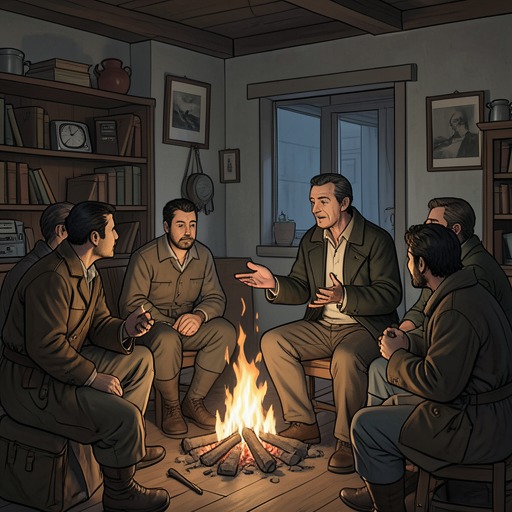
Ish considers these continuities things he has secured for the future. Yet the meetings also reveal the limits of his influence. He still presides, seated before the group with his hammer in hand or beside him; people who wish to speak address him respectfully. When two young men argue too heatedly, a strike of the hammer brings them to silence. But the younger men increasingly speak and act, and although they listen closely when Ish offers an idea, they often do not follow it. The hammer can still command attention in the meeting, while Ish’s practical authority over the Tribe’s direction diminishes.
The annual names preserve moments even as the years begin to blur together. Year 23 is named for a mad wolf, Year 24 for blackberries, and Year 25 for long rain. In Year 26, George dies after falling from a ladder while painting; no one knows whether he fell because his heart stopped or died from the fall. The houses are never maintained as well afterward, and their trim is no longer painted. Maurine, living on for a time in her neat house among objects and appliances that no longer function, dies before that year ends. The year is named for both deaths. Later, years 27 through 30 pass, but their names become difficult to recall. The rapid chronology registers not only the loss of individuals but also the fading of the habits and knowledge they sustained.
Old age and the work of remembering
As the years continue, Molly dies suddenly, and Jean dies after a rapidly developing illness. Ish recognizes the dwindling of the people who came from the old world, even as he sees children playing, young men calling to one another, and mothers nursing babies. The interchapter holds these facts together without treating the Tribe’s future as a simple repetition of the past: Ish grieves the decline of his generation, while the surrounding community remains young and lively.
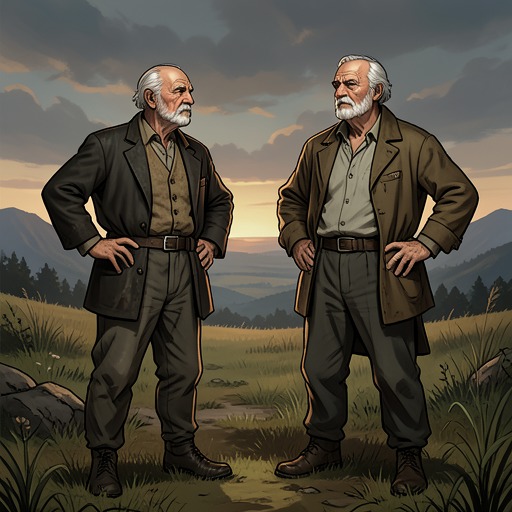
At the end of the later sequence, Ish has entered the last stage of his life. He and Ezra increasingly sit together as two old men, unusual figures in a community where births outnumber deaths and nearly everyone else is young by comparison. They have little to say about the recent years, whose good and bad seasons seem less distinct with distance, so their conversations turn chiefly to the past and sometimes to life in general. Ish continues to find wisdom and help in Ezra. His comparison of a tribe to a child expresses the limit he has reached: elders may point out a way and guide growth to some extent, but the Tribe will ultimately follow its own course. The years are still carved into the rock, but the interchapter’s final emphasis is no longer on Ish directing the future; it is on his witnessing a future that belongs increasingly to others.