Robert and Richard's Expedition
Earth AbidesRobert and Richard’s expedition is the Tribe’s first deliberate attempt to look beyond its isolated community for surviving groups and ways of rebuilding life after The Great Disaster. Its ambitious eastward journey ends in a retreat before the great cities Ish hoped they might reach, but the travelers bring back something more consequential than a completed map: evidence of other post-disaster societies and a small box of viable corn seeds.
Decision and Selection
The proposal grew from Ish’s renewed doubt about whether the United States Government had truly failed. It might have been reconstituted in a smaller, weaker form, he reasoned, without yet restoring contact with the West Coast. The Tribe might be able to make that contact itself. The possibility turned a question about the vanished government into a practical one: whether survivors elsewhere had organized, and what they were doing to solve the problems facing them.
Nearly everyone wanted to go. Ish regarded that widespread eagerness, especially among the men, as evidence of a persistent appetite for travel and novelty. Choosing the travelers therefore meant ruling out candidates. Ish’s old injury from a mountain lion’s attack, sustained far back in the Year of the Lions, made him unable to go. George was too old. Ezra argued vigorously, but was disqualified because he was the community’s worst shot and was considered least able to look after himself in the open. The younger men were also judged to have responsibilities to their wives and young families. In the end, the meeting chose Robert and Richard: young enough for the undertaking, yet thought capable of managing it.
Their mothers, Em and Molly, looked doubtful, but the meeting’s enthusiasm outweighed their objections. The choice thus expressed both the expedition’s communal purpose and its personal cost: the community wanted knowledge from beyond its borders, while two mothers faced a long separation from their sons. Robert and Richard, by contrast, were delighted to be chosen.
Preparation and Departure
The Tribe could not simply rely on the abandoned automobiles. In recent years nobody had driven one; cars along San Lupo Drive stood ruined on flat tires, and children used them as playhouses. Fallen trees and earthquake-toppled chimney bricks clogged the roads. Keeping a car running would have demanded work with little practical return, and the younger men had never experienced driving under pre-disaster conditions. The journey therefore depended on making one vehicle usable rather than on a functioning transport system.
The travelers tested The jeep by driving it every day. Blowouts became a process of elimination: replacing failed tires until they had a set that seemed likely to endure some wear. On the fourth day, they left with the vehicle packed with an extra battery, spare tires, and other equipment. The preparations could not settle every uncertainty about the roads ahead, but they gave the travelers essential replacements for predictable failures. Their excitement, their mothers’ near-tears, and Ish’s own nervous wish to accompany them gathered at the point of departure, where his injured body set a limit on his participation even as his imagination ranged ahead.
Route, Encounters, and Retreat
Ish had planned an eastward route from old maps, weighing what might remain passable against what only travel could reveal. The desert roads might still be open; the bridges over the Colorado River might be standing or fallen. He expected difficult country beyond the river, then the Rio Grande near Albuquerque, followed by the Sandia Mountains and open plateau. Farther east, he hoped, there would be more routes to choose from. Gasoline might still be found in drums, and the high steel bridges over the Missouri or Mississippi might have survived, as the Bay Bridge had. His excitement was not only about reaching a destination: he urged the young men to search for communities, not merely isolated people, and to learn how different groups were getting started again.
The reports brought back by the travelers showed both the reach and the limits of their journey. On the highway to Los Angeles they encountered only minor washouts and landslides, negotiable in four-wheel drive. In Los Angeles they found a religious group calling itself the People of God, whose members wore white nightgowns. Ish inferred that their intense religious focus might have grown under the influence of a strong surviving leader; by contrast, the Tribe had developed little interest in religion in the absence of such a figure.
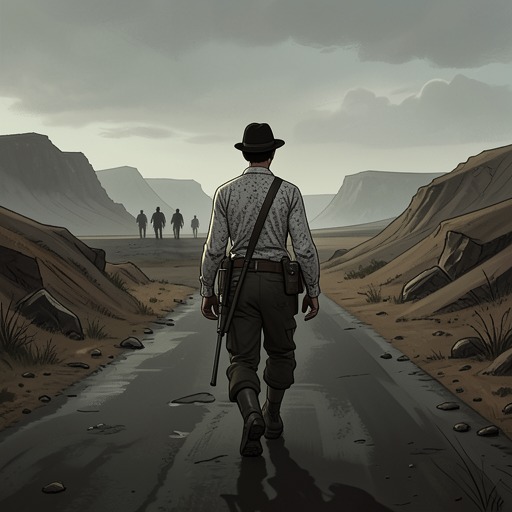
From Los Angeles, Robert and Richard took U.S. Route 66 east. The desert highway was open apart from occasional drifts of sand, and the Colorado River bridge, though shaky, remained passable. Near the Rio Grande, they encountered another small community at an old pueblo. Its few dozen people based their lives on growing corn and beans, following a pattern Ish associated with Pueblo Indian cultivation. Most did not speak English; only some older people did. They kept to themselves, viewed strangers with suspicion, owned horses, and rarely went into town or drove automobiles.
The travelers then swung north to Denver and continued east across the plains. The farther they went, the more difficult travel became. Fallen trunks sometimes forced them to clear a passage with an axe or shovel, and the repeated labor wore them down. Loneliness joined physical exertion as a pressure on the journey. Somewhere probably near Toledo, they turned back. Panic accompanied the reversal; heavy rain flooded roads, and they feared that larger-river bridges might be swept away and cut them off from home. They retraced their own route rather than trying the southern passage Ish had wanted, and the ground they already recognized gradually reassured them. They returned having learned little about the country beyond what they had seen on the outward journey.
Return and Consequences
The expedition’s return was announced not by a messenger but by a familiar sound. While Ish was teaching Joey history and old economics with collected money, a horn sounded, then sounded again closer. Ish recognized it, called to Em that the travelers were back, and jumped up so quickly that the bills scattered across the floor. The family and children rushed outside amid running and barking dogs. The jeep arrived dirty, battered, and travel-worn, but it had made the journey home.
Ish did not blame Robert and Richard for turning back. He judged their decision intelligent and determined, and instead questioned his own route planning. He wondered whether a southern route toward Houston and New Orleans might have served them better, while also recognizing its disadvantages: floods would have been worse east of Houston, and Arkansas and Louisiana would have returned to impassable wilderness more quickly than Iowa and Illinois. The expedition thus exposed the difference between an old map’s apparent choices and the realities of a landscape without maintained roads.
Its most tangible result emerged later, when Ish opened a small cardboard box the young men had brought from the pueblo community. Inside were small, pointed kernels, red and black rather than the large yellow or white corn he had expected. He recognized them as a more primitive variety than the highly developed, perhaps hybridized corn of the old agricultural system. The Tribe had delayed planting for so long that Ish had been unable to find living seed among its own supplies; these kernels offered another chance. He shared them with Joey, and the two carefully sacrificed only two dozen to parch in a frying pan over a gasoline-stove burner. The journey had not reached its intended eastern extent, but it had returned a resource with consequences for the community’s future: in the seeds from another people’s fields, Ish could see the possibility of life and renewed cultivation.