San Francisco Bay Area Water-System Collapse
Earth AbidesThe San Francisco Bay Area Water-System Collapse is the slow failure of the engineered network that once carried mountain water to the cities. Its decisive cause is not a single disaster but a chain of unattended weaknesses: a defective aqueduct section leaks for years, its surroundings erode, the pipe tears open, and water continues escaping from reservoirs through numerous other breaks. When Ish’s community confronts the empty reservoir, the collapse makes plain that infrastructure can outlast the people who maintain it only temporarily; survival now depends on finding water in the landscape itself.
A flaw inside the water network
The water supply had depended on an immense system of dams, tunnels, aqueducts, and reservoirs. One steel section of the main aqueduct carried a defect from the outset. Imperfections had been apparent when it was made, but the section passed inspection at the end of a workday, when the inspector’s judgment was impaired. The pipe was installed and initially functioned without difficulty, so its weakness remained concealed within a system that appeared reliable.
Shortly before the Great Disaster, a foreman noticed a small leak in the section. A welded patch could have strengthened it, but the narrative then follows the pipe through years in which no one passes that way to maintain it. The initial defect and the missed repair become an example of how large systems can depend on small, nearly invisible acts of inspection and upkeep. The conduit does not fail all at once: its deterioration proceeds beyond routine human attention.
From seepage to rupture
At first, the leak leaves only a small green patch beneath the pipe, even in dry summers. Birds and small animals come to drink there, while rust advances from the outside and water corrodes the metal from within. The leakage grows incrementally. After five and then ten years, numerous fine jets spray from the surface; cattle gather at the resulting puddle. In time, the seep becomes a small stream, the only summer stream in that dry foothill region, even as the pipe’s structure grows increasingly weakened by rust.
The water also changes the ground supporting the conduit. The soil beneath the pipe remains soft and muddy, and animals’ repeated passage helps form a gully. Eventually erosion triggers a mudflow around the concrete pier bearing the heavy water-filled pipe. As the pier settles, the load shifts onto the weakened steel and opens a long tear. Water pours into the gully, further undermining the pier; the support shifts again, the pipe tears further, and the escaping flow grows to the scale of a small river. The rupture is therefore both the result of accumulated damage and a force that accelerates the damage around it.
Reservoirs drain away
The broken pipe sends water out for weeks instead of carrying it onward to the reservoirs. Meanwhile, stored water escapes through thousands of leaks that develop over the years, faucets left running when the Great Disaster occurred, and major breaks associated with an earthquake. The reservoir levels steadily fall. Heavy rains after New Year slow the decline, but a midwinter dry spell arrives earlier than usual, and the losses resume. A gauge that had recently shown a depth of twenty feet now stands above only a thin covering of water at the reservoir bottom.
The aqueduct rupture is the central failure, but the dwindling supply reflects a wider network of openings, damaged joints, and unattended pipes. The reservoir is not simply emptied by one dramatic break: it is depleted through many concurrent losses, while the inflow that should replenish it has been cut off. That distinction gives the collapse its drawn-out character. For a time, the system’s remaining water can disguise the failure of the system that delivered it.
Life after the supply fails
When Ish and the others reach the reservoir, they see its exposed outlet pipe and only a few shallow patches of water. The sight confirms that the stored supply is gone. The immediate response is practical rather than restorative: some of the young people set out with dog teams and five-gallon cans to fetch water from the nearest spring, while older members begin digging holes and setting up outhouses. The work lasts for hours, although steady pick-and-shovel labor is unfamiliar to them.
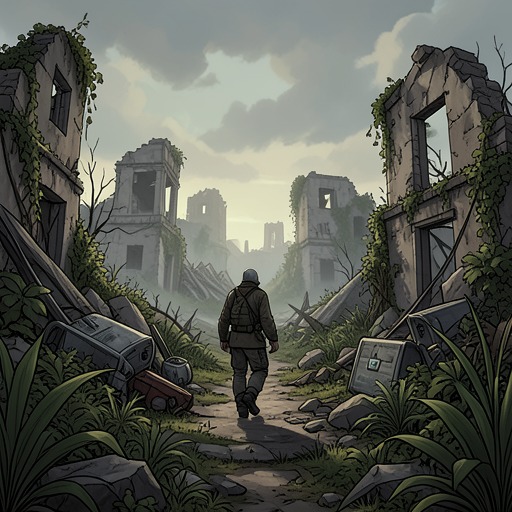
The crisis also exposes a difference between generations. Ish can still orient himself by streets and intersections, but he does not know where the dependable local springs and seasonal streams are. The younger people know the terrain through its water: Ish’s son Walt identifies a running stream in a gully that Ish had barely noticed because it passed beneath San Lupo Drive through a storm drain. Knowledge of the old street grid no longer suffices; finding water requires attention to the living landscape and the seasonal behavior of its streams.
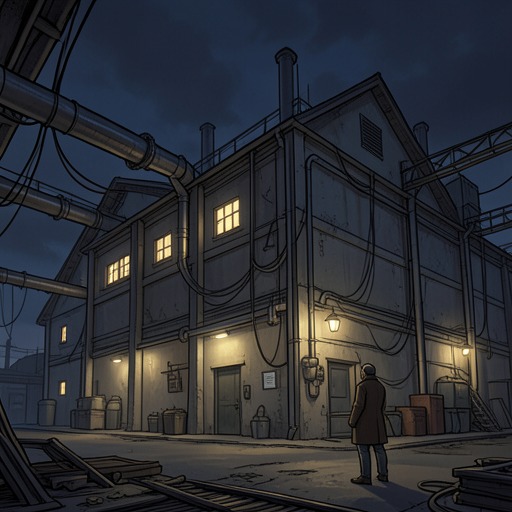
The collapse belongs to a broader pattern of maintenance failures. Power-and-Light continues operating after the human catastrophe because generators remain carefully coordinated, but its governors require periodic oil inspections and replenishment. As those tasks go undone, generators fail one by one. On San Lupo Drive, a drain clogged by unswept leaves sends water across the street and through the Harts’ former lawn, illustrating on a small scale how roads and drainage structures also depend on regular care. Together, these failures show the difference between a structure’s apparent durability and its actual dependence on continuing human work. The water system’s collapse changes the community’s daily means of survival: water is no longer an invisible service delivered through a network but a resource to locate, carry, and manage locally.