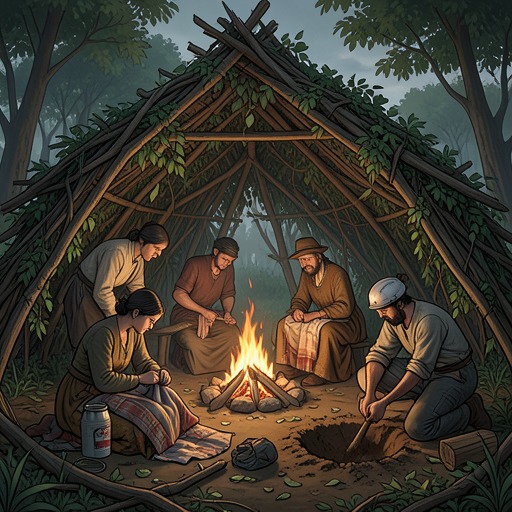
The First Ones
Earth AbidesThe First Ones are the older clan within the post-disaster community formed around Ish and his household on San Lupo Drive. Their importance lies not in a formal institution or fixed set of offices, but in the way a small survivor group became a continuing social branch: even after it joined with The Others, clan identity and inherited customs still shaped family belonging.
Founding Community
The survivors began speaking of themselves as The Tribe after Ezra returned with Molly, Jean, Ralph, Evie, and household goods, and after the community grew to seven adults and four children, with Evie counted separately. The name began as a joke, but it described a group whose continued existence depended on making family and community life out of a handful of survivors. Later, the name The First Ones distinguished this original branch from newcomers rather than replacing the broader identity of The Tribe.
The circumstances of the group’s formation made kinship practical as well as personal. Ezra arrived with two women whom he introduced as his wives. Ish was surprised by the arrangement but considered plurality of wives potentially workable in a world with very few survivors and fewer opportunities to form households. His response registers a larger shift: social customs inherited from the Old Times could be reconsidered when survival and the size of the population set different conditions.
Kinship and Population Pressure
Marriage within the community likewise reflected its restricted choice of partners. Mary, Ish and Em’s eldest daughter, married Ralph, Molly’s son, in the first marriage of the group. Their families had long assumed they would marry because there was no one else available for either of them. Ish and Em privately doubted whether the two were especially fond of one another, and Ish recognized that romantic love might not survive unchanged under the new conditions. The match thus made the community’s demographic constraint visible in a domestic decision.
By the time a smaller group living north of the Bay proposed union, population pressure had become an explicit argument for admitting outsiders. Some young men had no prospective wives within The Tribe, and the community’s members had become related to one another to the point that everyone faced marrying a cousin. Ish also worried that such close interrelationship could be dangerous. The debate was therefore not simply between familiarity and novelty: it concerned the risks of disease and strangers, the need for more members, and the long-term consequences of a narrow marriage pool.
Union with The Others
Ish and Ezra opposed the proposed union, as did Jack, Ralph, and Roger, who remembered the earlier Year 22. Fear of disease and distrust of unfamiliar people and customs weighed against the appeal of increasing the group’s numbers and finding spouses. The younger, unmarried men were especially eager for union. Despite the opposition, the community voted unanimously to admit The Others; the newcomers contracted measles but recovered.
The union did not erase the First Ones’ identity. The enlarged community continued to be understood as two clans, The First Ones and The Others, even as their members intermarried. Children belonged to their father’s clan, preserving a patrilineal rule that Ish understood as a surviving American tradition. He wondered whether maternal descent might instead become the rule, as it had among some other peoples, but the inherited custom held. Clan affiliation therefore persisted not through separation, but through the everyday assignment of children and the organization of family ties.
Continuity and Change
The distinction between the two branches did not prevent relationships from crossing it. After Molly’s and Jean’s deaths, Ezra urged Ish to take a younger woman from The Others as another wife: Ish should not remain alone, and the community needed more children. Ish accepted, though he felt no love for her. She comforted him and bore children, but he found them emotionally less fully his because they were not also Em’s. The episode shows that intermarriage could extend the community and meet practical needs without making older attachments or clan boundaries disappear.
Disease remained part of the conditions under which the community organized itself. Ish feared that fleas from dead rats could spread bubonic plague to living people, and later a severe suspected typhoid outbreak struck the settlement, leaving Ezra and five children ill. These events do not define the First Ones as a separate governing body; they show the vulnerability shared by the wider community and help explain why contact with outsiders could provoke such strong caution. Across generations, the First Ones endured less as an isolated founding household than as one continuing branch of a population forced to revise its family practices while carrying some older rules forward.