The Old Times
Earth AbidesThe Old Times is the name Ish and the survivors give to the civilization that existed before the Great Disaster. At first, it means a concrete world of roads, electricity, public services, national belonging, and remembered habits. As the years pass, however, the phrase marks a growing divide: Ish can still compare the present with a society he experienced, while younger people inherit only fragments of that experience. The term thus records not only a vanished era but the gradual loss of any common measure by which its disappearance can be understood.
Meaning and Boundaries
The Old Times is not a precise historical period so much as a name produced by life after the catastrophe. Ish remembers that the label itself belongs to the new world: there had been an earlier time before even the era now called the Old Times, when a simple people lived near the future site of his home. Their stone-working marks remain on a hillside rock, where small holes show that they pounded acorns into meal. The distinction makes the name relative. Every society inherits a past, and what seems ancient to one generation may once have been ordinary life to another.
The phrase also gathers together things that had once been so familiar they went largely unexamined. Early after the disaster, even while frightened and depressed, Ish feels qualms about taking a black-and-white Highway Patrol motorcycle. The hesitation exposes the force of old rules: a traffic officer’s property still seems to belong to an ordered public world, though that world has ceased to function. The vehicle is at once useful transport and a remnant of obligations that have lost their institutions.
On the empty U.S. Route 66, Ish recognizes the famous highway as a route once associated with migration to California. The road remains, but the traffic that gave it social purpose is gone: no buses, trucks, tourists, or migrant families pass. The contrast turns infrastructure into a record of absent activity. The pavement can still direct a traveler across wide spaces, but it no longer carries the national movement Ish remembers.
The Lived World and Its Remnants
Ish’s memories of the Old Times include not only disaster and loss but ordinary comforts. He considers the life he now leads freer than the clock-governed routine of his former society: he can remain in bed after waking, and no train requires him to catch the 7:53. This comparison complicates simple nostalgia. The old world had schedules and work discipline; the present offers a freedom from them, even as it has lost the systems and security that made much of modern life possible.
The contrast between work and leisure becomes, in Ish’s reflections, one of civilization’s defining changes. Earlier ways of life had not divided the day so sharply into work and play. Civilization made that distinction increasingly consequential: time clocks and whistles regulated labor, while workers struggled over which hours counted as work and which as leisure. As work grew more burdensome, recreation became more artificial. The Old Times therefore represents not only material plenty but a particular organization of time and human effort.
That organization survives unevenly in the household objects that later residents acquire. George, who had been a carpenter, and Maurine, who had belonged to a socially and financially comparable household, furnish their home with bridge lamps, electric clocks, radios, and other signs of prosperity. The things remain available to be collected, but their former relation to work has changed: whether they function as intended is secondary to possessing the signs themselves. The old objects preserve the appearance of affluence after the social arrangements that produced it have weakened.
For Ish, bridges carry a more powerful charge. The children regard them much as they regard hills or trees, simply as features of the landscape. He sees them instead as daily witnesses to civilization’s power and glory, comparable in his mind to the Roman remains an earlier tribesman might have encountered. Yet the analogy fails for him: the old tribesman belonged securely to a confident new culture, whereas Ish looks at monuments to a world whose knowledge and institutions he fears will not return. The bridge is simultaneously a surviving structure and a measure of historical distance.
Memory, Time, and Collective Continuity
The Old Times also gives Ish a vocabulary for thinking about history as a social inheritance. When Em proposes keeping track of time, he comes to see the idea as fundamental: time can become history, and history can become tradition. The family marks its first full circuit of the seasons at a smooth rock near San Lupo Drive. With his hammer and chisel, Ish cuts a numeral 1, adds a serif and hook to make it resemble the printed figure he remembers, and names the year. A practice that draws on his old knowledge becomes the beginning of a new community’s own calendar.
The annual ceremony persists, but its meaning and authorship shift. In the tenth year, the adults have no settled name for the year. Children suggest the Year of the Fishing because they have discovered abundant striped bass in the Bay and enjoyed catching them. The name arises from shared experience rather than from Ish’s private recollections. By the end of the twenty-second year, the entire community gathers at the rock; Ish cuts 22 beneath 21, mothers bring even the youngest babies, and those old enough to speak greet the new year. The ceremony preserves a form inherited from his effort while making the Tribe’s own sequence of years visible.
Old customs also survive selectively. The winter holiday near the sun’s southern turning combines elements of Christmas and New Year with practices distinctive to the community. Thanksgiving remains a big dinner, while patriotic holidays have lapsed. George continues to mark Labor Day by stopping work and wearing his best clothes, although nobody else joins him. The contrast shows how tradition is not transmitted as a complete package: a custom can persist through one person’s attachment even after its shared context has disappeared.
A Past Growing Distant
The Old Times becomes harder to explain as the generations change. Ish can see that his family’s household resembles a familiar social arrangement, with parents and children together, but kinship does not erase the gap between experience. Ralph, Jack, and Roger are still called boys although they are married and have children; Ralph is Molly’s son and Ish’s son-in-law, while Jack and Roger are Ish’s sons. Though Ish is only about twenty years older, he feels separated from them by centuries because they did not know the world he remembers.
That distance shapes Ish’s anxiety about the Tribe’s future. After the disaster, he expected surviving people to restore some systems and gradually rebuild civilization; he had even imagined electric lights coming on again. Instead, the community remains dependent on the leavings of the past. When Ish argues that people in the Old Times thought about the future, he points to civilization’s construction as evidence of that orientation. His unease is not simply that the old world is gone, but that its successors may no longer imagine large, cumulative projects.
The loss of national belonging gives the phrase particular emotional weight. Remembering what it had meant to be an American, Ish recalls a sense of confidence, security, and fellowship with millions. In the present, he hesitates to speak of that identity as current. He also recognizes, in retrospect, how little people had noticed the protection surrounding them when a functioning nation and its rules seemed as constant as air. After that framework vanished, Ish, George, and Ezra acted from day to day without a battle-tested symbol of unity; their years of comfort may have rested partly on good luck.
The Old Times becomes newly urgent when illness appears. Bob has a headache and general discomfort, and Ish finds his temperature just under 101 degrees before prescribing sulfa pills and water. Bob gags on the medicine, unused to swallowing pills. Ish recalls that disease was frightening even when doctors and public-health services were available, and that he had never studied medicine because he had expected few diseases to remain. Remembered medical infrastructure now sharpens, rather than eases, the danger: the old world had offered forms of protection that the community cannot readily replace.
The Fading of Historical Meaning
The Old Times persists in objects and gestures after it ceases to be a shared explanation. At a funeral, Maurine stands in solid black with a veil, preserving an old propriety while the rest wear the comfortable, haphazard clothing left behind by civilization. After Joey dies, Ish accepts the fact without fleeing from it and holds to the existence of a future, even as his own hair has turned gray. The past supplies forms for grief, but it cannot prevent loss or make the new generation live within Ish’s memories.
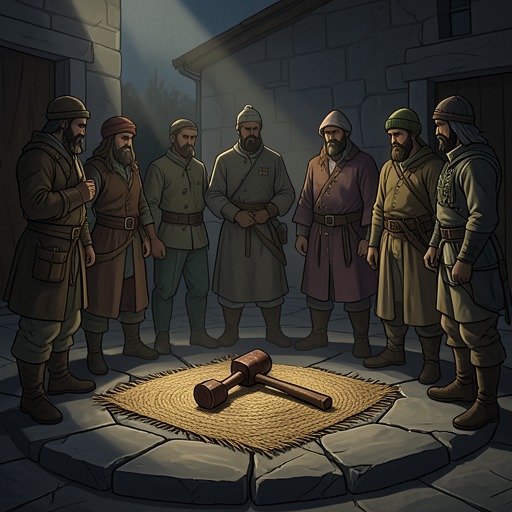
Ish’s changing response to the hammer shows a related accommodation. He once resisted the Tribe’s elevation of it into a symbol, but after tragedy he recognizes that the community draws strength and unity from it. He is humbler about the possibility that rationalism, like other luxuries, depended on civilization. This does not restore the world that formed his beliefs; it shows him adjusting to a society whose needs and meanings are no longer governed by the assumptions of the Old Times.
In old age, even a familiar sensation becomes a faulty bridge to the past. Ish flips the electric-light switch in the bathroom and hears its click; for a moment he seems to see the room brilliantly illuminated. The light has not actually come on and has not done so for years. He recognizes the familiar misperception as something that has happened before, a small recurrence in which bodily memory briefly supplies what the broken system cannot.
The distance is greater still when Ish considers a piece of salmon eaten by the young men. It may have been caught off Alaska, more than a thousand miles away, but the scale of that journey is beyond what they can understand; they have no conception of a great ship crossing the ocean or of the distance Ish describes. The food has survived as a material trace of far-reaching transport, while the knowledge that would make its journey intelligible has not.
At the end of his life, even the phrase The Great Disaster seems to have lost its force. Those who died in the catastrophe would, Ish reflects, have died with time in any case; it seems less consequential whether they all died in one year or gradually over many. He has also come to doubt how much the loss of civilization means in itself. The Old Times does not disappear in a single act of forgetting. Its signs remain, but the living context that once connected them thins, until the catastrophe that made the phrase necessary becomes almost as remote as the world it destroyed.