The Tribe’s Anarchic Period
Earth AbidesThe Tribe’s Anarchic Period was the twenty-one-year interval Ish later described as a life without a strong force capable of protecting individuals against threats. Its end came with the execution of Charlie, a decision Ish viewed as both the first act of a new State and a wrenching break from the community’s earlier, apparently peaceful life. The period’s central contradiction was that the Tribe had known comfort without having built reliable protection: what felt like an idyll in retrospect might, Ish recognized, have depended on luck.
Conditions Before the State
Ish looked back on the years before Charlie’s execution as a time when the Tribe had been little more than an overgrown family. It had experienced troubles and deaths, but, in retrospect, those hardships seemed simple beside what had just happened. The community had lived comfortably and pleasantly, yet it possessed no battle-tested symbol of unity binding its members together. Ish’s distinction was not between a wholly peaceful past and a violent present, but between familiar hardship managed day by day and a collective authority able to act in the name of everyone’s safety.
The weakness of that earlier arrangement became clearest in Ish’s recollection of arriving in Hutsonville. He had come down from the mountains, paused in the town street, and understood that he was about to do something illegal and irrevocable. He deliberately drew back Ish’s hammer and smashed the flimsy door of a pool-room so he could enter and read a newspaper. The act gave him access to a remnant of the old world, but it also revealed how much depended on his own decision: there was no functioning public authority to make the ordinary rules of access real or to prevent him from breaking them.
The Missing Protection
Ish remembered that before the collapse, the United States had seemed as ever-present as the air. People could complain about income tax and regulations while feeling themselves to be strong individuals, without noticing how much their security depended on the surrounding order. After that order vanished, individuals confronted one another without the protection it had quietly supplied. Ish recalled the old saying that each person’s hand would be against every other person’s, and recognized its force in the world left behind.
Even close cooperation with George and Ezra did not amount to a durable public safeguard. They had acted from day to day, and the fact that life had remained pleasant did not prove that their arrangement could withstand a serious threat. Ish’s retrospect therefore revises the apparent ease of the Tribe’s early years: the absence of a crisis demanding common power could look like social stability, but it could not demonstrate that individuals were protected when such a crisis came. The period’s anarchy was not defined only by open disorder; it was also an untested dependence on personal ties and favorable circumstances.
Charlie’s Execution and the Founding of Authority
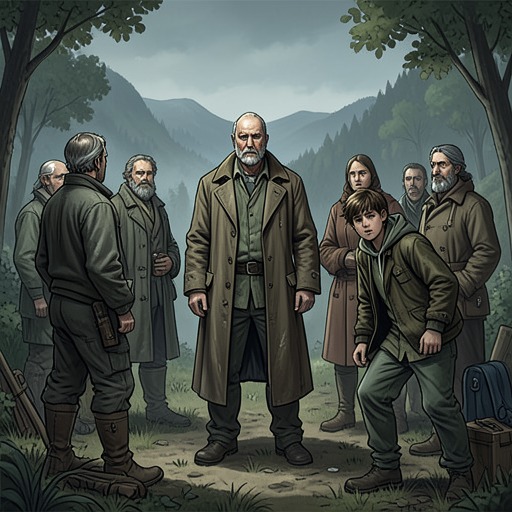
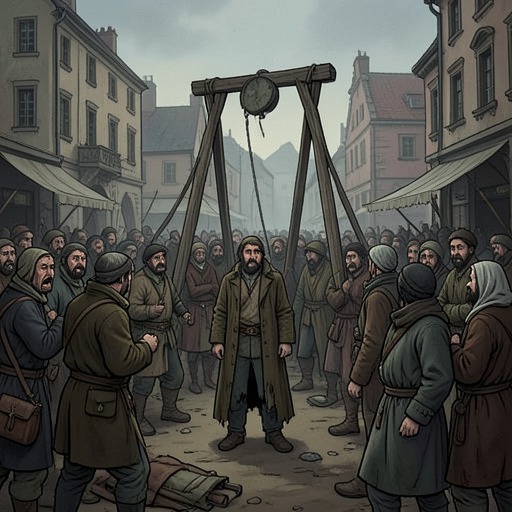
The execution of Charlie made the change impossible for Ish to treat as merely theoretical. With boys’ rifles leveled nearby, Ish spoke the words that set the act in motion; Charlie began to curse. George, using practical skill, knotted the rope and set up the ladder. Ish felt physically sick when he thought about what had happened, and expected he would never want to revisit it. Yet he also understood it as an ending and a beginning: the end of the Tribe’s earlier life and the start of a long road toward the State.
That beginning carried an irony Ish could not resolve away. A State should nourish and protect people in their weakness, making fuller lives possible; here, its originating function had been to bring death. Ish could justify the decision as necessary for the safety and happiness of the Tribe, hoping that one decisive act would prevent a longer chain of harm. But justification did not make the act gentle or erase its cost. The new collective power appeared first not as an established system of protections, but as the capacity to impose a consequential decision in the community’s name.
Memory and Significance
Afterward, the walk from Charlie’s new grave beneath an oak tree back to the houses on San Lupo Drive seemed to Ish longer than any mile he knew. At home, he placed Ish’s hammer head-down on the mantelpiece, handle upright, and its familiar presence recalled the earlier moment when he had first used it. The object linked private initiative in the old period to the difficult emergence of collective authority: the hammer had once broken a door so Ish could act alone, while the execution made him confront the limits and dangers of a community acting together.
Ish alone among those around him dwelt on what the change meant; George returned to his woodwork, and Ish expected Ezra and the boys to think about it less. His reflection preserves the cost of crossing from a loosely organized family into a State. The Tribe’s earlier comfort had not guaranteed safety, but the power created to address that vulnerability began in lethal force. The period thus ends not with a clean triumph of order over chaos, but with Ish’s uneasy recognition that protection and coercion can arise together, and that the founding of a political community may be both a safeguard and a wound.