The Tribe’s binding-assembly rule
Earth AbidesThe Tribe’s binding-assembly rule is the custom that decisions made by the community’s assembly bind all its members. It gives collective deliberation practical authority beyond the meeting itself: even those who disagree, or who were not consulted at first, are expected to follow what the group has decided. The rule helps the scattered survivors act as a community, while the changing influence of Ish shows that its authority does not rest solely on his personal command.
Development and Practice
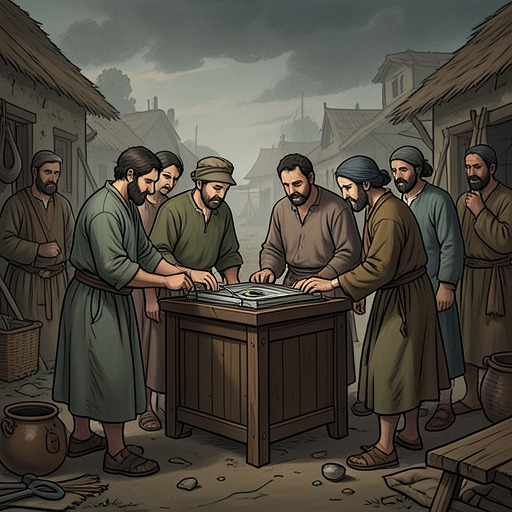
The rule becomes explicit during the Quick Years, when the adults gather from time to time for conferences described as resembling town meetings. What the assembly decides, everyone understands, is binding. This is more than a forum for exchanging opinions: agreement creates an obligation that continues after people leave the meeting.
The custom develops alongside a gradual transfer of practical initiative to younger members. Increasingly, young men speak and act at the conferences, while Ish presides with his hammer. He can still quiet an argument by striking it, and the others address him respectfully; yet listening to his ideas does not mean that they will follow them. The assembly’s authority and Ish’s ceremonial position therefore coexist, but they are not identical. His presence gives the gathering continuity, while the decisions belong to a community whose active leadership is passing to a new generation.
The rule is distinct from the Tribe’s earlier, improvised cooperation. When the water supply fails, alarm gives way to immediate efforts: younger people fetch water in five-gallon cans, and others dig and prepare outhouses. The labor soon flags, though the water gathered is enough for immediate drinking and cooking. This episode shows people responding together to necessity, but it does not describe a binding assembly decision. The later custom supplies a more durable principle for collective action than a burst of shared effort alone.
Decisions, Disagreement, and Consent
The proposed union with a smaller community across the Bay tests the Tribe’s capacity to deliberate over serious risks. A messenger brings the proposal, and Ish calls a meeting after questioning him. Members weigh fear of disease and unfamiliar customs against the need to increase the Tribe’s numbers and find wives for young men. Ish and Ezra oppose the union; some older young men support them, recalling the earlier crisis associated with Charlie, while unmarried men press for admission. Em’s appeal to face the risks of life helps the group find courage, and the vote to admit the newcomers is unanimous.
The episode presents collective authority as something sustained not just by a decision, but by discussion that allows competing fears and needs to be voiced. In this instance, the vote produces no recorded dissent. The rule’s more exacting test comes later, when the whole Tribe decides to move to a safer place after a fire. Three young men traveling with Ish initially object because they were not consulted. They yield when told that the matter was put before the assembly and decided there, recognizing that the decision binds them too. The custom thus answers a practical question that unanimity alone cannot settle: whether a decision remains authoritative for members who were absent from its making or unhappy with the process.
Scope and Social Meaning
The assembly rule does not mean that every important arrangement originates in a vote. Earlier, Ezra arrives with two women whom he introduces as his wives, and the surrounding community adjusts to a family structure that Ish understands as potentially practical in the changed conditions. The rule’s clearest evidence concerns the authority of community decisions, not a claim that the assembly regulates every household relationship. Its reach is collective, but its documented operation should not be mistaken for a complete code covering all of the Tribe’s customs.
The rule also gives the Tribe a way to manage growth and risk without making Ish’s judgment the sole source of order. At the union meeting, fear of disease is weighed against the danger of too few marriage partners and the close blood relationships within the existing community. The decision to admit the newcomers expands the Tribe, while the later division into The First Ones and The Others preserves a distinction between its branches even as they intermarry. Collective decisions can therefore change the community’s composition without erasing all of its internal identities.
Legacy and Significance
Near the end of Ish’s life, the rule’s durability is demonstrated in a seemingly modest disagreement over where the Tribe should go. Ish is too weak to take part meaningfully in the discussion, and the younger men initially resist the relocation because they were not consulted. Once they learn that the assembly decided the matter, they accept the decision as binding. Ish takes particular satisfaction in this response because it shows that a principle he taught has survived beyond his ability to direct events; remembering Charlie at the same time brings sorrow and embarrassment.
The custom is therefore both an instrument of coordination and evidence of a generational change. Ish’s authority remains visible in his place at the meetings and in the hammer he holds, but the Tribe no longer depends on his personal judgment to settle every question. Its members have learned that a decision made together carries an obligation beyond the preferences of any one person. In the relocation episode, that inherited practice enables the Tribe to act as a body even as Ish himself is being carried by its younger members.