The Tribe’s post-Disaster society of hunting, farming, and shared decisions
Earth AbidesThe Tribe’s post-Disaster society of hunting, farming, and shared decisions is a community built amid the collapse of the systems that once made ordinary life possible. Its defining tension is between the immediate security of scavenging and the difficult work of learning how to live without inherited supplies. Over generations, the group develops shared decision-making, keeps a small crop of corn alive, and adopts new ways to make tools; its future remains uncertain, but it does not simply repeat the Old Times or vanish into the past.
From emergency to “Secondary Kill”
At first, the disaster is not understood as the instantaneous end of every human community. Reports Ish reads describe people leaving cities, medical workers remaining at their posts, and emergency arrangements continuing even as a third of the population has died. Civilization, in his account, has retreated while carrying its wounded and facing the crisis. Yet the surviving infrastructure and emergency response cannot remove the dangers that follow the initial catastrophe.
Ish calls those later dangers “Secondary Kill”: the deaths that the disaster’s survivors may suffer because the protection of civilization has disappeared. Isolation, illness, accidents, and the psychological shock of readjustment become threats in their own right. Ish’s own capacity to continue is partly shaped by what he did not experience: he did not live through the deaths of his family and the people around him, and so avoided what he understood as the worst of that shock. His observation makes the community’s later formation more than a matter of finding food. Survival also depends on whether people can bear isolation and establish ties strong enough to outlast it.
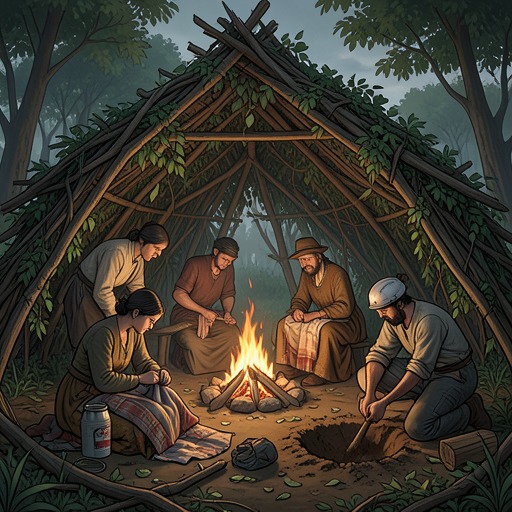
The society that develops around Ish begins with practical dependence on what remains. For a time, scavenging offers a comparatively easy life: stored food, ammunition, and matches can be used without being produced anew. But this apparent abundance has a limit. Ish recognizes that supplies will fail, while even ammunition can deteriorate. A community that consumes its inheritance without learning how to replace it risks losing both civilization and the basic skills needed to live without civilization’s tools.
Improvisation, knowledge, and ecological pressure
The effort to preserve a future begins with knowledge as well as food. When Ish visits the University Library after learning that he will become a father, its books appear to him as stored knowledge through which civilization might be rebuilt. He imagines a child who will not have to remain a scavenger, but sees that books alone cannot do the work: people must know how to read and use them. He also identifies seeds as essential, because the disappearance of domestic plants would close off another route to a sustainable life. Earlier, in a period of apathy, he had broken into a public library and taken books, an act that shows how scavenging can also mean gathering cultural material, even when the books themselves do not give him the guidance he seeks.
The community’s dependence on its surroundings makes that long-term project vulnerable to ecological change. Cattle become numerous enough to be both a source of meat and an everyday hazard. In the Year of the Bulls, people learn to step aside from charging bulls and turn the practice into a game called bull-dodging. A later drought leaves too little grass, and hungry cattle break through the fence surrounding the vegetable plot. The men fire at the herd, but the garden is ruined by trampling before the animals can be driven off. Grasshoppers then consume what the cattle have not reached. This sequence shows how a community can possess food in abundance and still lose the cultivated resources on which a different future might depend.
The recovery is not permanent mastery over nature but a reprieve that allows life to continue. After the first rain, the hills turn faintly green with new grass. The sight restores the group’s spirits and relieves Ish, whose confidence in the earth’s ability to recover had been shaken. In later years, the community grows only a modest amount of corn, but harvests enough to keep the seed supply alive. That small crop matters less as an immediate replacement for all scavenged food than as a practice that can be repeated and passed on.
Shared decisions and a growing community
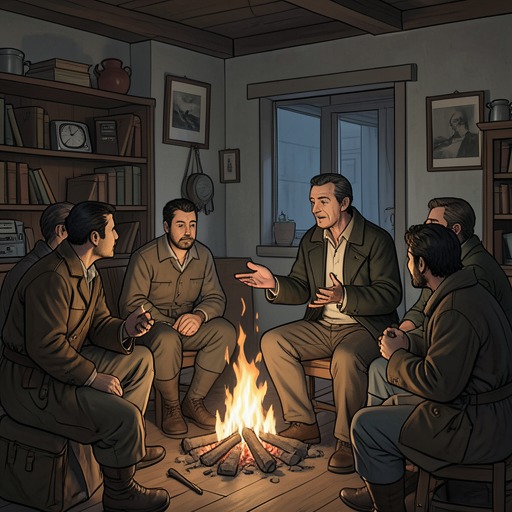
The Tribe’s common life takes shape through recurring acts of cooperation as well as responses to danger. In the Quick Years, adults gather in conferences resembling town meetings. Decisions made there bind everyone. This is a meaningful change from dependence on Ish’s individual authority: he presides, and members address him respectfully, but increasingly the younger men speak and act. They listen when Ish offers his views, yet do not necessarily follow them. The meetings preserve a shared process even as the older survivor’s influence becomes less decisive.
The society also learns that a community’s vulnerability can be collective. During a later epidemic, Ezra and five children fall ill, and the outbreak is understood as typhoid. With no effective remedy once the disease has taken hold, those who remain well face the work of caring for the sick while fearing that more will succumb. The danger is not only the possible loss of individuals: Ish worries that a large number of deaths could break the community’s will to live. The epidemic reveals the limits of their medical knowledge and the cost of living in a world without the protections once supplied by organized public health.
By Year 34, the question of survival becomes a question of whether the group will join with another community living north across the Bay. The newcomers send a messenger proposing union. Fear of disease and of unfamiliar customs weighs against the proposal, while the need for more people, potential marriage partners, and protection against inbreeding weighs in its favor. Ish and Ezra oppose union, as do some older younger men who remember the earlier epidemic. The younger unmarried men are more eager. Em argues that life cannot be lived by denying it, even though accepting the others may bring danger. The group votes unanimously to admit them; the only epidemic the newcomers bring is measles, from which they recover. The decision shows the community choosing connection without being able to guarantee safety.
Skills, change, and the uncertain future
The society’s transition away from scavenging does not happen all at once. Each autumn, children take up bows and arrows for a time before tiring of the game. What begins as play keeps a practical skill in view, while the small corn harvest maintains seeds for another planting. These practices do not amount to a restoration of the old industrial world; they are narrow, repeatable forms of learning that fit the resources and experience of the new community.
A later exchange about arrowheads gives Ish reason to revise his fear that the Tribe is moving steadily toward savagery. He had once expected people to return to stone arrowheads, but learns that they can find abundant coins and, if those run out, copper telephone wire. They have taken a different path, using recoverable metal rather than simply reproducing the tools of an earlier age. Ish sees this as evidence that his descendants may have passed a turning point: they may no longer be forgetting more than they learn. His reassurance is qualified, but it marks a change from imagining only decline to recognizing adaptation.
The narrative finally looks beyond the Tribe’s own settled practices to a future of multiple, distinct communities. Geography, survival, language, food, skills, and belief will make groups diverge. Some will live by fishing and gathering; others will grow corn, keep animals, or hunt with bows. One imagined community loves assembly and debate and treats a hammer as a divine symbol, though without great reverence. These differences are not presented as a single planned reconstruction of civilization. The tribes will eventually meet and influence one another, and new civilizations and wars will emerge without anyone directing the process.
The Tribe’s history therefore holds progress and fragility together. It begins among the debris of a civilization whose remaining supplies promise temporary comfort but cannot secure a future. Shared decisions, seed-keeping, cultivation, and practical invention offer ways to adapt, while disease and ecological shocks expose how much remains beyond the community’s control. The society’s achievement is not a return to the old order, but the creation of practices that can be continued, changed, and carried into a future its members cannot fully foresee.