The formation of new beliefs and superstitions after the disaster
Earth AbidesThe formation of new beliefs and superstitions after the disaster is a consequence of more than ignorance: it grows from a break in the ordinary means by which communities transmit, compare, and revise their ideas. In The Tribe, the hammer becomes an object of apparent power, small customs take on supernatural weight, and the Americans of the vanished world become creators in the children’s account of history. Ish sees that the same cultural openness which makes new learning possible also leaves the community vulnerable to beliefs he cannot control or honestly endorse.
The hammer and the making of taboo
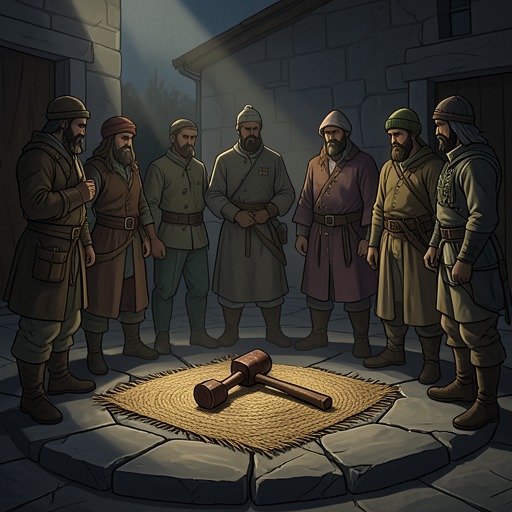
The change becomes unmistakable when Joey takes Ish’s hammer from the mantelpiece in front of the other children and returns it to him. The room has gone quiet; a younger girl gives a small cry. Once Joey sits down again, Ish breaks the tension by using the hammer to crack a nut. Only after school has ended does he understand that the children’s stillness was not simply surprise: they believed the hammer dangerous for anyone but Ish to touch.
The object had acquired the conditions of a relic. It was kept by itself on the mantelpiece, used on state occasions, and ordinarily handled only by Ish. Even Bob had been reluctant to touch it when the dog-teams set out. Ish reasons that a half-serious game could, over a few years, harden into serious belief: the hammer’s ordinary function receded behind its special place in communal life. Joey’s act complicates the taboo. Ish suspects that Joey may have imagined himself entitled to touch the object because he was Ish’s child, an unusually capable reader, and in some sense a Son of the Blessing. In Ish’s uncertain reconstruction, Joey may also have helped strengthen the belief himself. The episode shows superstition not as a doctrine imposed from outside but as a meaning built and repeated within a group.
A break in inherited tradition
The hammer is only one sign. Ish remembers the children repeating a rhyme about stepping on a crack and breaking their mother’s back, a saying that in the Old Times had been treated as childish nonsense. He also thinks of Ezra’s old Victorian penny and Molly’s habit of knocking on wood; the children, too, knock on wood. These gestures once belonged to a wide world of shared customs in which their lack of literal meaning could be learned. In The Tribe, the gestures remain, but the interpretive community that might explain or dismiss them has thinned.
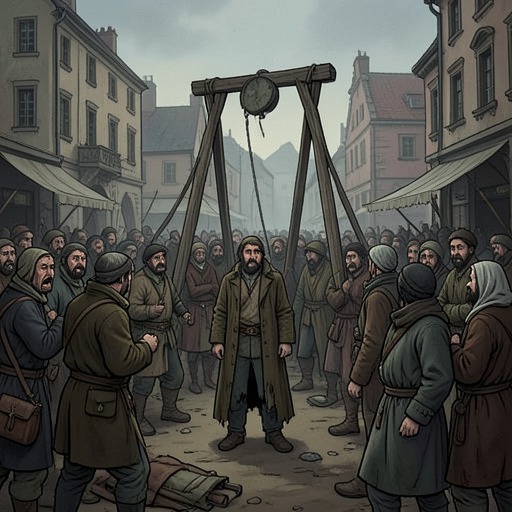
Ish understands the scale of the loss by contrasting the children’s small community with the older cultural inheritance. Before the disaster, children growing up among even a few families would encounter other beliefs and have opportunities to adjust their own. Beyond the family stood the accumulated traditions of Christianity, Western civilization, Indo-European folkways, and Anglo-American culture—an immense body of practice and ideas that could absorb, challenge, or reshape local beliefs. The Tribe has lost much of this inheritance: in Ish’s reckoning, seven survivors could not preserve and transmit all of it, and for a long period there were no older children to pass customs to the younger ones. The oldest children learned games from their parents rather than from older companions.
That interruption makes the community unusually open to change, but openness has two faces. Ish sees an opportunity to shape a new culture and a responsibility to do so carefully; he also fears the danger that a demagogue could exploit a population without robust traditions. His difficulty teaching the children to read offers a counterpoint: they are not simply receptive to whatever an adult tells them, because the surrounding environment itself works against his efforts. Yet their beliefs can still take shape through ordinary repetition, objects, and explanations.
Ish’s religious dilemma
Ish considers whether the children’s supernatural beliefs answer a need left unmet by the adults. Perhaps, he thinks, the absence of anyone in The Tribe who is creatively religious has left a vacuum in children’s minds; perhaps their beliefs express a deeper effort to explain the basis of life. The community once organized church services and discontinued them as meaningless. Ish wonders whether stopping them was a mistake, but recognizing a need does not tell him what he could responsibly put in its place.
He knows that as the children’s teacher he could make almost any account endure through insistence and repetition. He could present the Christian creation story or a local Indian account involving Old Man Coyote; he could also offer one of several cosmogonies remembered from his studies. He fears that whatever he taught could become a religion, regardless of the qualifications or uncertainty with which it began. For Ish, the prospect is not an invitation to invent a comforting certainty. He recoils from founding a faith because he values the honesty of his skepticism and does not want to teach an account he cannot affirm.
His anxiety is concrete rather than abstract. He imagines his descendants, several generations on, practicing incantations, fearing witchcraft, or developing rites around taboo. Then he recognizes the irony: beliefs already approaching taboo exist in The Tribe, and he himself has helped author them, most visibly through the hammer and the exceptional status attached to his household. His authority as teacher and survivor gives his conduct a force he never intended; the children can turn circumstance into sacred meaning without his consent.
The Americans as creators
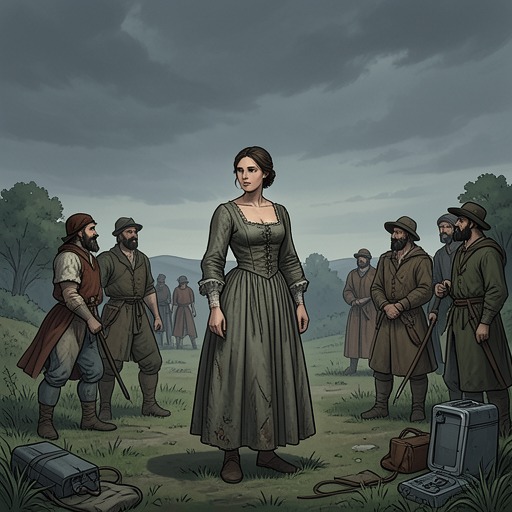
A classroom question exposes how far that process has gone. When Ish asks how the world came to be made, Weston answers for the children that the Americans made everything. The answer follows from their experience: older people have explained that Americans built houses and streets and made canned food. A causal account of particular objects has expanded into a story about the origin of the whole world.
Ish tries to correct the misunderstanding by explaining that he is an American and that Americans were ordinary people, not supernatural beings. The children, however, interpret his explanation through the very framework he is trying to undo. To them, his reading and writing, his knowledge of the world’s shape and of numbers, and his possession of the hammer confirm that he belongs to the vanished Old People who made everything. When Ish looks around, Joey’s knowing smile suggests a special kinship: Joey can read and handle the hammer without being hurt, so he too seems to share something with those survivors of the former world. The effort to demystify the Americans thus supplies further evidence for the myth. Ish’s identity is not enough to displace the children’s account, because his practical knowledge and symbolic objects already appear to validate it.
Knowledge, objects, and cultural transmission
The book’s contrasting account of knowledge clarifies what is at stake. Earlier, trying to shake off his apathy, Ish breaks a lock at the Public Library and leaves with Robinson Crusoe and The Swiss Family Robinson; neither book holds much interest for him. Later, knowing that he will become a father, he enters the University Library with a new sense of awe. He sees its stored knowledge as a resource from which civilization might be rebuilt, and does not want his child to grow up merely scavenging. But books alone are insufficient: people must be able to read and use them, and seeds must also be saved. Preservation depends on transmission and practice, not simply on the survival of objects.
Ish’s later work with bows makes that distinction tangible. In preparing a bow, he rejects nylon fishing line in favor of materials The Tribe can obtain for itself, shaping a cord from calf skin. The children quickly imitate the activity: before dinner, every child is whittling a bow. Within a week, badly aimed arrows fill the air around the houses, and the mothers worry about eyesight; two children are struck, though the weak bows and headless arrows cause no serious harm. Ish has to establish rules about where not to shoot. This is not a cure for superstition, but it shows a different route by which culture can take hold: a reproducible skill, learned by watching and doing, followed by practical norms shaped by its consequences. Against beliefs that gather around mystery and unexamined repetition, such knowledge can be demonstrated, shared, and adjusted.
The Tribe’s emerging beliefs therefore register both cultural loss and cultural creation. The hammer, the penny, the rhyme, and the Americans acquire meanings because inherited explanations have weakened and familiar practices continue without the old framework that once contained them. Ish can recognize the process, but recognition does not give him a neutral position outside it: he is already teacher, father, bearer of books, and the figure around whom some of the new mythology forms. The problem is not merely how to keep the past intact, but how to pass on knowledge without turning uncertainty into imposed doctrine.