The hammer as a tribal symbol
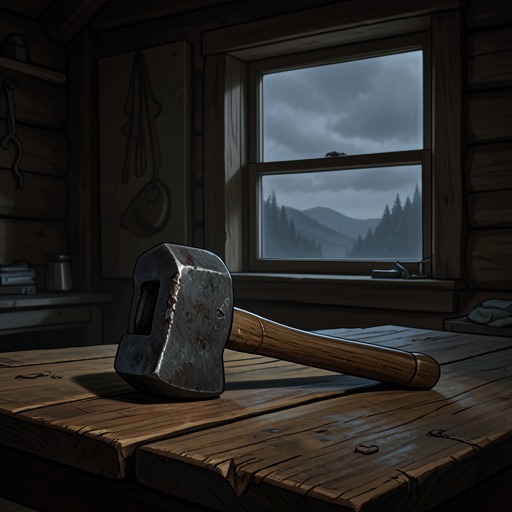
Earth AbidesIsh's hammer becomes the central emblem through which The Tribe turns one survivor's past into a shared source of strength, authority, and continuity. Ish resists the younger generation's reverence even as he begins to draw comfort from the object himself; by the end, its inherited meaning outlasts his own life, passing to Jack as Ish dies on the bridge.
From tool to communal emblem
At the funeral for five people, the hammer's place in the gathering makes visible a change in both the object and Ish. The loss is a catastrophe for a community so small, and the survivors assemble in family groups around the graves. Ish had begun without the hammer, but Josey reminded him to bring it, assuming he had simply forgotten. For the younger people, its presence marks a formal occasion. Ish carries it in his right hand, feeling its weight pull him toward the earth.
That gesture would once have been an occasion for Ish to challenge superstition. A few months earlier, he would have refused to accommodate the hammer's ceremonial importance and would have made a point of explaining himself to Josey. Now he accepts its place in the funeral. The change is not a sudden conversion to the beliefs of the children: Ish remains aware that their reverence rests on a meaning he does not share. But he recognizes that The Tribe needs a sign of strength and unity, and that people take comfort in gathering around the hammer. He also admits that he is comforted by it. Rationalism, he reflects, may have been one of civilization's luxuries. The object thus becomes a measure of how much Ish's inherited certainty has yielded to the needs of life after civilization.
The funeral's arrangement sharpens the contrast between old custom and the new community. The survivors stand in an irregular half-circle, with each family together. George wears the dark-gray suit associated with his former life as a deacon, while Maurine stands beside him in black and a veil; their dress preserves some old funeral proprieties. The others wear practical clothes left over from civilization. Against this improvised mixture of continuity and loss, the hammer supplies a different kind of ceremony: not a return to the old order, but a symbol the younger generation can recognize as theirs.
Ish's uneasy attachment
After the service, Ish leaves alone because the funeral has stirred him deeply and he wants solitude. He takes no lunch and leaves his pistol belt behind, although he would ordinarily carry a weapon away from the houses. At the last moment he takes the hammer from the mantelpiece. Its selection troubles him. The house contains older possessions from his boyhood, yet he associates this one especially with surviving the first days after the disaster. He still does not believe what the children believe about it, but he notices that it is beginning to loom large in his own thoughts. As he walks with it dangling from one hand, it irritates him; he wonders whether it, too, is becoming a superstition for him.
That ambivalence matters: the hammer's power does not depend on Ish's wholehearted belief. He can question the children's ideas while finding reassurance in the object and accepting its usefulness to the group. The hammer is at once a material remnant of his own survival and a focus for meanings generated by people who did not experience the world before the disaster. The difference between his explanation and theirs does not prevent the symbol from working.
The hammer and Ish's oracle status
In his later years, younger men come to Ish bearing small gifts: ripe berries he likes, or bright stones and colored glass. He values the gesture because the young men are offering things they themselves would prize, even though he cares little for the glass and stones. They formally ask their questions while he sits holding the hammer. Ish can answer some questions about the weather by consulting his father's barometer, a remnant of practical knowledge that the young men do not possess. When they ask where to hunt, however, he knows he has no answer. If he refuses, they pinch him until he cries out a direction. Their relief at receiving an answer, and the fact that they never return to punish him when the hunting is poor, make the ritual's logic plain: the hammer and Ish's position authorize answers even when he does not know the truth.
On a clear-minded day, Ish recognizes that he has become a god, or at least an oracle through whom a god speaks. He remembers the children who had once been afraid to carry the hammer and their knowing response when he called himself an American. The hammer has connected the old reverence for the object to Ish's identity as the last American, turning survival and memory into a sacred authority he never sought. Yet that authority remains uneasy and physical. The young men sometimes force him to answer by pinching him, and he feels the pain and shame even as he understands their expectations. Their worship does not make him master of the ritual.
The realization comes into focus after Ezra is gone. Sitting alone on the hillside, Ish notices the absence beside him and understands that his old friend will never sit there again. He grips the hammer, now too heavy for one hand, and recognizes that it has become the symbol of a tribal god. The object has changed in two directions at once: it has become harder for the aging Ish to lift, while its collective meaning has grown beyond his private possession. His awareness of Ezra's absence briefly clears his mind, but the ruined house, overgrown garden, and his confusion about the sun and season reveal how far time has passed beyond his grasp. The hammer remains with him as familiar weight and public symbol amid a world he can no longer measure reliably.
Retrieval, inheritance, and continuity
During the approaching fire, Ish realizes that he has left the hammer behind and cries out for it. He immediately feels ashamed: in an emergency it should be a trivial concern. The three young men, however, react as if the loss threatens something essential. Jack runs back toward the smoking garden to retrieve it, despite Ish calling him back. He returns with his lion-skin cloak singed and burns from sparks, while the others show unmistakable relief that he has the hammer. Their response demonstrates how completely the object has become bound to the group's security, even when Ish himself calls its importance into question.
The fire also reveals how the hammer's symbolic authority shapes practical decisions. As the flames bear down, one of the young men asks Ish which way they should go. Ish considers that the younger men can outrun the fire but that he cannot, and he thinks intensely about finding a way to save them as well as himself. The question recalls the hunting consultations in which the young men treated his directions as authoritative. In this emergency, the hammer accompanies a genuine demand for leadership, though Ish's place in the group is not founded on reliable knowledge of the land. Reverence places responsibility on him as well as granting status.
Near the end of his life, the young men press Ish to indicate who should receive the hammer. They pinch him when he does not respond, and he works out from their gestures that they want him to choose an heir. He has owned the hammer for a long time, but he does not resist transferring it; he wants the pinching to stop. Still able to move his arms, he indicates Jack. Jack takes the hammer in his right hand, and the others draw back, relieved that the inheritance is settled. Ish feels a pang of sorrow for the young man to whom it has descended. The transfer is therefore both a practical end to the group's demand and a succession ritual: the community's symbol is not simply taken but bestowed by the figure around whom its meaning has formed.
Ish then rests on the bridge, aware that he is dying and remembering that many others have died there. He feels he has made his peace, while the hammer has passed out of his hands and into the life of The Tribe. Its trajectory—from a reminder of Ish's solitary survival, to a ceremonial focus, to the attribute of an oracle, to Jack's inheritance—gives the object a continuity that the individual owner cannot possess. The hammer preserves neither civilization's rational authority nor Ish's private control; it carries forward a meaning made and remade by the people who gather around it.