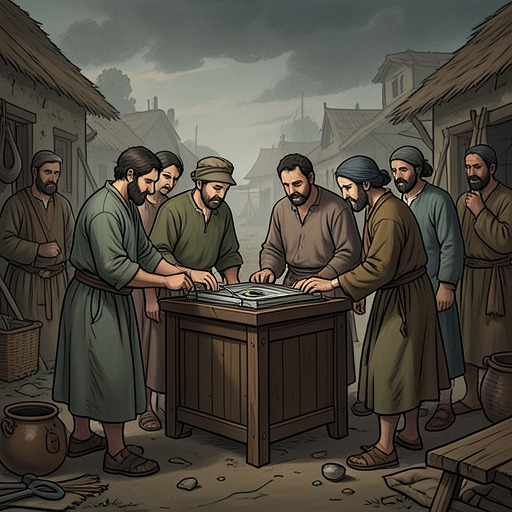
The hammer is passed to Jack
Earth AbidesThe transfer of Ish’s hammer to Jack is the closing act of Ish’s life on the Bay Bridge: a decision made without words, under pressure, and received as an inheritance by the young man he chooses. The scene turns a familiar object into the focus of a final exchange between Ish and the younger generation. Once Jack has the hammer, the others are relieved, and Ish can rest with the sense that he has done what remained for him to do.
The Crisis and the Unspoken Question
Ish comes back to consciousness seated on the pavement at the edge of the bridge, propped against its railing. His hammer lies in front of him, its handle pointing upward. Two young men are beside him, each chafing one of his hands, while two others remain nearby. The group is disturbed; Ish, as his thoughts clear, understands that he has suffered a serious medical episode, perhaps a stroke or a heart attack. He is also aware that his lower legs have gone cold and that his body is failing him.
At first Ish sees Jack moving his lips but hears nothing. He then realizes that he cannot hear, and that he cannot control his speech. The loss of hearing does not distress him in itself, but the inability to communicate does: he recognizes that speaking will no longer work and that the others cannot understand what he writes. The transfer therefore begins inside a newly severe communication barrier. Ish must infer what the young men want from their expressions and gestures, while they cannot simply ask him and receive an answer.
The Choice of a Successor
The four young men had been respectful and friendly throughout the day. Now they become insistent, gesturing toward the hammer and trying to make Ish understand that they need him to act. They are frightened that he may be unable to do so. Ish initially does not consider it worth the effort to decipher their request. Their persistence eventually reaches him, however, and he understands that they want him to indicate which of them should receive the hammer.
No one had previously suggested that Ish give the hammer to anyone else. It had been his for a long time, and its transfer was not an arrangement he had prepared in advance. Yet Ish does not feel attached to keeping it. He can still move his arms, and he gestures toward Jack. His choice is both clear and practical: he gives the group the decision they are demanding and hopes their prompting will stop. The scene makes the succession an act Ish performs with a gesture rather than a speech, at the point when speech and hearing have ceased to connect him to the people around him.
The Hammer Changes Hands
Jack picks up the hammer and lets it hang from his right hand. The others draw back a little. That small movement marks the decision as completed: Jack has received the object, and the group no longer needs Ish to clarify what should happen to it. The young men appear relieved now that the inheritance has been settled, and they leave Ish alone.
Ish feels a pang of sorrow for Jack, the young man to whom the hammer has descended. The feeling complicates what might otherwise look like a simple appointment of a successor. Ish has not resisted giving up the object, but seeing Jack hold it makes the transfer consequential to him. The evidence does not specify what Jack will do with the hammer; what it establishes is that Ish selects him, Jack accepts it, and the others recognize the matter as settled.
Finality on the Bridge
After the transfer, Ish rests quietly. He understands that he is dying and thinks of the many others who have died on the same bridge. He reflects that he might have died there years earlier in an automobile crash, but instead lived beyond the world he came from and is now dying on the bridge all the same. The transfer comes at the end of that long survival: Ish has no further task to perform in this scene, and he is content with the outcome.
The hammer’s passage is therefore at once personal and collective. Ish makes the choice, but the young men’s urgency shows that they regard the inheritance as something that requires his decision; their relief confirms that his gesture has settled it for them. For Ish, the object’s departure brings sorrow without a struggle to retain it. Jack’s receipt of the hammer closes the exchange, while Ish’s quiet recognition of his approaching death gives the handover its finality.