The state as a collective force of protection
Earth AbidesThe state as a collective force of protection becomes a defining idea in Ish’s community when the survivors confront a danger they cannot manage through individual action or informal custom. The State is imagined as a protective structure, capable of securing a fuller life for its members; its birth, however, comes through the decision to kill Charlie. That contradiction—protection founded in violence—forces Ish to recognize that a small, comfortable community is not yet a political order able to defend itself.
From improvised cooperation to a need for order
Before the community takes shape as a State, its members already act together when common needs demand it. When the water supply fails, the adults and children gather at Ish’s house to hear the news. The prospect of unusable toilets initially weighs more heavily on many than immediate thirst, exposing how much their familiar way of life depends on infrastructure they can no longer maintain.
The response is practical and collective rather than governmental. Young people take dog-teams and five-gallon cans to fetch water from a nearby spring; older members dig holes and set up outhouses. Their first burst of labor subsides under blisters and fatigue, and by lunchtime many have found other tasks to do. Yet even a limited supply of water in a can by the kitchen sink eases the sense of crisis. The episode shows both the strength and the limits of self-help: people can coordinate quickly around an immediate need, but cooperation alone does not yet amount to a durable institution capable of protecting the whole group.
The community’s earlier customs also provide a form of continuity without constituting a State. Ish and Em begin keeping time by cutting a numeral into a smooth rock near San Lupo Drive, marking the first full circuit of the sun after the disaster. The annual gathering and naming of years turn shared memory into a repeated public practice. Ish comes to understand time as connected to history, tradition, and civilization: losing that continuity risks losing something that may never be recovered. Such rituals bind people across time, while the later crisis over Charlie will force them to decide how they are bound to one another in the present.
Charlie and the political crisis
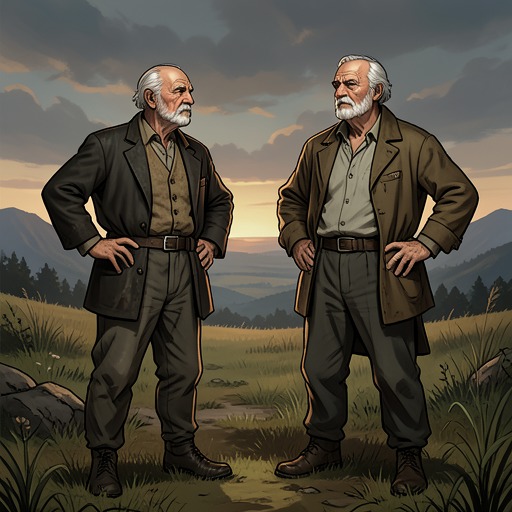
The prospect of Charlie’s arrival as a powerful stranger makes Ish recognize the community’s vulnerability. He fears a personal contest with Charlie, who has already won the loyalty of Dick and Bob and impressed George. Ish suspects that Ezra is uncertain as well. In his private reckoning, the group lacks the solidarity of a State: without a shared political body, any struggle for power might remain a contest between individuals or opposing factions.
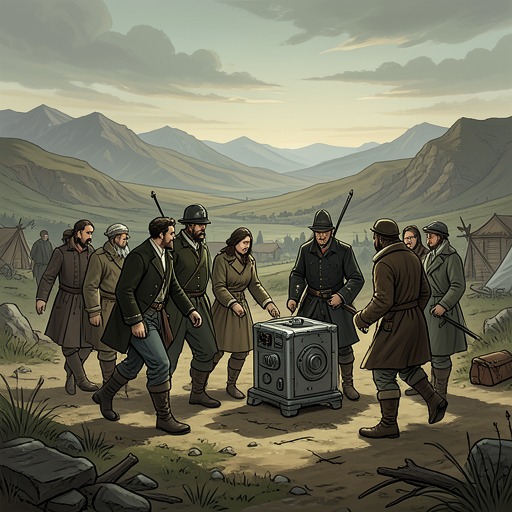
When the community assembles to address Charlie and Evie, Ish sees that they cannot begin with an abstract constitution. A particular and urgent problem has brought them together, and they must act before they can devise a general framework. The deliberation shifts the issue from Ish’s personal rivalry with Charlie to the community’s right to protect itself. Ish, Ezra, George, and Em agree that self-defense applies to the community as well as to an individual.
They also reject remedies that might appear less severe but cannot reliably protect anyone. A warning would offer no sure safeguard. Punishment after the harm was done would amount to social vengeance, not prevention; and the small group has no practical means to imprison Charlie or to keep an improvised jail securely staffed indefinitely. Their reasoning turns on the danger they believe Charlie poses and on the absence of institutions that could contain him. The decision is therefore presented not as the routine enforcement of an established law, but as a foundational choice made where law and capacity are both lacking.
A founding act and its cost
The execution makes the State’s protective claim inseparable from its violence. After the act, Ish is physically sickened by the memory. He knows he will not want to think about it again, yet understands that it has divided the community’s history into a before and an after. The group had lived, in retrospect, like an overgrown family in an almost idyllic condition. Now, Ish thinks, a State has begun to take shape, and a long road lies ahead.
The irony is stark: a State ought to act as a nourishing mother, protecting individuals in their weakness and allowing them to live more fully, yet this State’s originating function has been to bring death. Ish considers that primitive political power may arise in troubled times through the crystallization of force, and that its earliest expression may be lethal. He justifies the decision by the safety and happiness of The Tribe, hoping that one irreversible act will prevent a continuing chain of harm. His justification does not erase the cost. The act is necessary in his reasoning and terrible in its consequence; the new collective authority protects the group by doing what Ish cannot regard as ordinary communal life.
The vanished state and the years of anarchy
The execution also changes how Ish interprets the community’s earlier years. At home, he puts his hammer on the mantelpiece and recalls his first arrival in Hutsonville. In the vanished world, he had deliberately used the hammer to break into a pool-room and read a newspaper, knowing he was doing something illegal. The act had seemed possible within a world where a national order surrounded him, even when he resented its taxes and regulations. With that order gone, the individual no longer enjoys its often-unnoticed protection.
Ish remembers that the survivors had previously acted from day to day. They had George and Ezra, and their life had often been pleasant, but no tested symbol of unity bound them together. What he had called a kind of Garden of Eden can also be understood as years of anarchy: there had been no strong force to protect the individual against whatever might arise. The State is thus not merely a new authority placed over an otherwise unchanged society. It answers a protection that the old order supplied without making its presence continually felt, and whose absence becomes visible only when the community faces a threat it cannot contain by goodwill alone.
Collective decisions after the founding crisis
The later development of the community gives the political idea a less singular form. In subsequent years, adults gather in conferences resembling town meetings, and decisions made there are understood to bind everyone. Ish presides, holding or balancing his hammer; when arguments between young men grow heated, he pounds with it and they fall quiet. Yet the authority of the meeting does not mean that Ish’s ideas prevail. The young men increasingly speak and act, and although they listen to him, they often do not follow his proposals. Collective order has outlasted the moment when Ish could simply assume that his own judgment would lead the group.
The decision to admit The Others shows this shared authority in a different crisis. Ish and Ezra oppose the union, as do Jack, Ralph, and Roger, who remember the deaths associated with the earlier decision about Charlie. Younger men press for it. Em argues that life cannot be lived by denying life and that their sons and grandsons will need wives, even if accepting the newcomers carries a risk of death. The community votes unanimously to admit them. The Others contract measles but recover, and the combined people thereafter retain a division into The First Ones and The Others, with children assigned to their father’s clan.
The State’s meaning therefore lies neither in protection without force nor in force as an end in itself. It begins when The Tribe recognizes a shared right and obligation to defend itself, then develops through binding decisions that can include disagreement, risk, and consequences no individual can control. Its founding violence remains a warning inside its promise: collective protection may be necessary where isolated people are exposed, but the authority that protects the community is also capable of imposing a cost that cannot be undone.