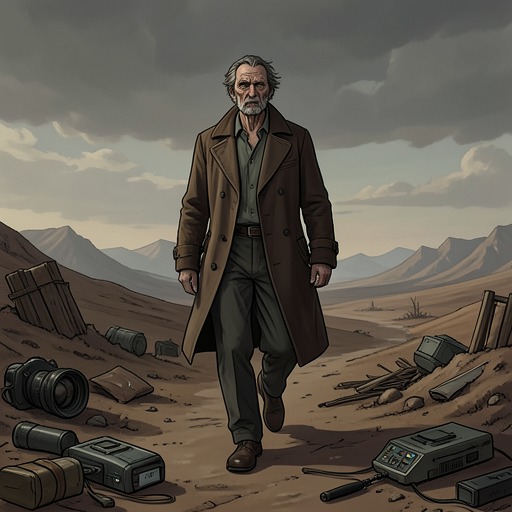
U.S. Route 66
Earth AbidesU.S. Route 66 is both a famous route across the pre-Disaster United States and a measure of how quickly human infrastructure becomes fragile when no one remains to maintain it. During Ish’s journey east, its emptiness and a fallen tree turn the highway from a familiar artery of movement into a sign that the old world’s connections are already coming apart.
The highway in the Old Times
The road carries a history Ish remembers: U.S. Route 66 had been a great highway, associated with the westward migration of the Okies to California and with a popular song. Its former traffic is evoked through what is now missing. No bus bound for Los Angeles, truck, migrant’s jalopy, tourist car, or Navaho wagon passes Ish as he travels. The road remains legible in its signs and pavement, but the movement that once gave it purpose has vanished.
That emptiness is not confined to the highway. After crossing the Rio Grande and passing through Albuquerque, the largest town he has seen since leaving California, Ish honks his horn and waits for an answer. There is none. The deserted highway and the silent town together make travel a passage through spaces still shaped by human activity but no longer joined by living communities.
The fallen tree and the change of direction
As Ish follows Route 66 toward Chicago, a poplar blown down in a sudden windstorm lies across the pavement. It has fallen from beside a farmhouse and covered the highway with leaves and branches. Cutting even a narrow passage through the tangle would take half a day; the sod beside the road is too soft and muddy from recent rain to offer an easy detour. Ish consults his road map, turns the station wagon around, and takes another paved road that leads east.
Once he reaches the alternative route, he sees no compelling reason to return to Route 66. The fallen tree has not merely delayed him: it has redirected his journey, and he considers how that small accident may alter what happens next. Had he continued toward Chicago, events might have unfolded one way; now, he imagines, something different will happen. The highway’s obstruction gives physical form to a larger uncertainty: history’s course can turn on an ordinary event rather than on a plan or a landmark decision.
A road without its keepers
The blockage also lets Ish glimpse the road’s likely future. A person could cut through the fallen tree, but more storms will bring mud across the pavement and earth down from the cuts; a bridge may be lost to a summer freshet. Over the years, these small failures would accumulate until driving from Chicago to Los Angeles on Route 66 became the task of a pioneer in a covered wagon. The road is not destroyed in a single catastrophe. Its usefulness recedes through successive obstructions that no one clears and damage no one repairs.
Elsewhere, the novel makes the same dependence on maintenance visible in less dramatic infrastructure. On San Lupo Drive, leaves clog a drainpipe; water spills across the street, floods a lawn, and cuts a small gully through a rose garden. Ish recognizes that a person could clear that particular drain in minutes, but that countless similar blockages are occurring across the country. Route 66’s fallen tree is the more conspicuous obstruction, while the clogged drain shows how the same process begins in small, local failures.
Narrative significance
Route 66 concentrates the novel’s contrast between the apparent solidity of civilization and the ongoing labor required to keep it working. The highway once carried mass movement across the country, yet a single tree can stop Ish on its pavement, and weather promises to undo the road in stages. The novel’s broader account of infrastructure makes the principle explicit: interconnected systems may continue functioning for a time after disaster, but they remain vulnerable at points that depend on human attention. The empty highway is therefore not simply a remnant of travel. It is a landscape in which the absence of people becomes visible through stalled movement, accumulating damage, and a route that no longer leads reliably to its former destinations.