Boston
East of EdenBoston is the hidden headquarters of a carefully organized vice empire and the first urban stage on which Cathy Ames tests her powers of deception. In the novel's geography, the city stands opposite the rural Salinas Valley: where the valley represents openness, family, and the possibility of moral choice, Boston is the place of concealment, of respectable facades that mask systematic exploitation, and of a young woman's calculated entry into a world she intends to master.
Mr. Edwards's Boston Operation
Mr. Edwards, the whoremaster who controls a circuit of prostitutes through small New England towns, maintains his family home in a good neighborhood of Boston. He lives an "amazingly domestic life" there with his wife and two well-mannered sons, who are entered on the books at Groton as infants. Mrs. Edwards keeps a dustless house and controls her servants, and she believes her husband is in the importing business. The city is the administrative center of his operation: from Boston he recruits girls, dispatches them on two-week rotations through mortgaged hotels in villages, collects his percentages, and disciplines any who break his rules. He runs his business "with a public accountant's neatness and accuracy," and by the time of his death at sixty-seven he has groups of four girls in each of thirty-three small towns across New England. Boston is thus the nerve center of a system that depends on the anonymity of the city to conceal the respectable man behind the trade.
Cathy's Arrival and Recruitment
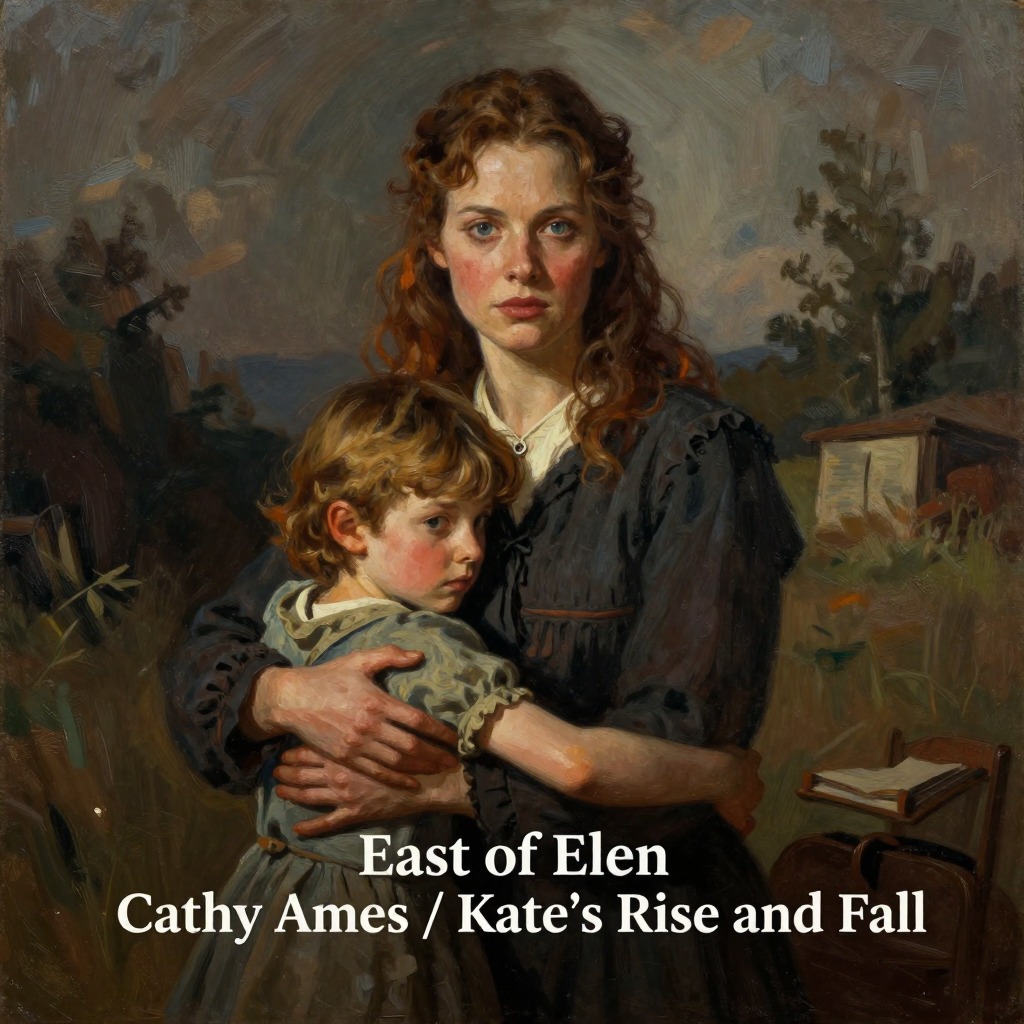
After Cathy Ames stages the fire that kills her parents and steals the tannery payroll, she takes the early morning train from her Massachusetts hometown to Boston. Her father, William Ames, follows her there, telegraphs the Boston police, and catches the nine-fifty train himself, but he fails to find her. Cathy, now calling herself Catherine Amesbury, presents herself at Mr. Edwards's office. She is "far too pretty for his business," and if he had not been weakened by a bout of food poisoning he would have rejected her instantly. Instead, something in his body begins to feel her, and she tells him a story about needing money to save her mother's farm from the bank. Mr. Edwards, who has made it an unvarying rule not to believe anything his girls say, falls into "the oldest conviction in the world—that the girl you are in love with can't possibly be anything but true and honest." Boston is thus the place where Cathy's calculated performance of vulnerability meets a man whose professional cynicism is disarmed by his own desire.
The House in Boston and Its Consequences
Mr. Edwards rents a "sweet little brick house" for Cathy in Boston and then gives it to her, filling it with every imaginable luxury. He keeps it overwarm, with carpeting too deep and walls crowded with heavy framed pictures. Cathy begins to steal from him systematically—taking large bills from his pockets, selling the jewelry he gives her, padding the grocery bills, and mortgaging the house for every penny she can get. When Mr. Edwards finally discovers an old newspaper clipping about the Ames fire and realizes who she is, he packs his suitcase with the heavy quirt he uses on disobedient girls and goes to the brick house. He takes her to a private place between a stone wall and a fringe of cedars in a small Connecticut town, beats her nearly to death with his fists and a stone, and leaves her for dead. Boston is thus the origin point of the violence that sends Cathy crawling to the Trask farm, where she will begin the next phase of her destructive life. The city's role in the novel is that of a respectable shell containing a predatory core, a place where identities are manufactured and destroyed, and where the distance between domestic propriety and commercial cruelty collapses into a single address.