Cathy's suicide
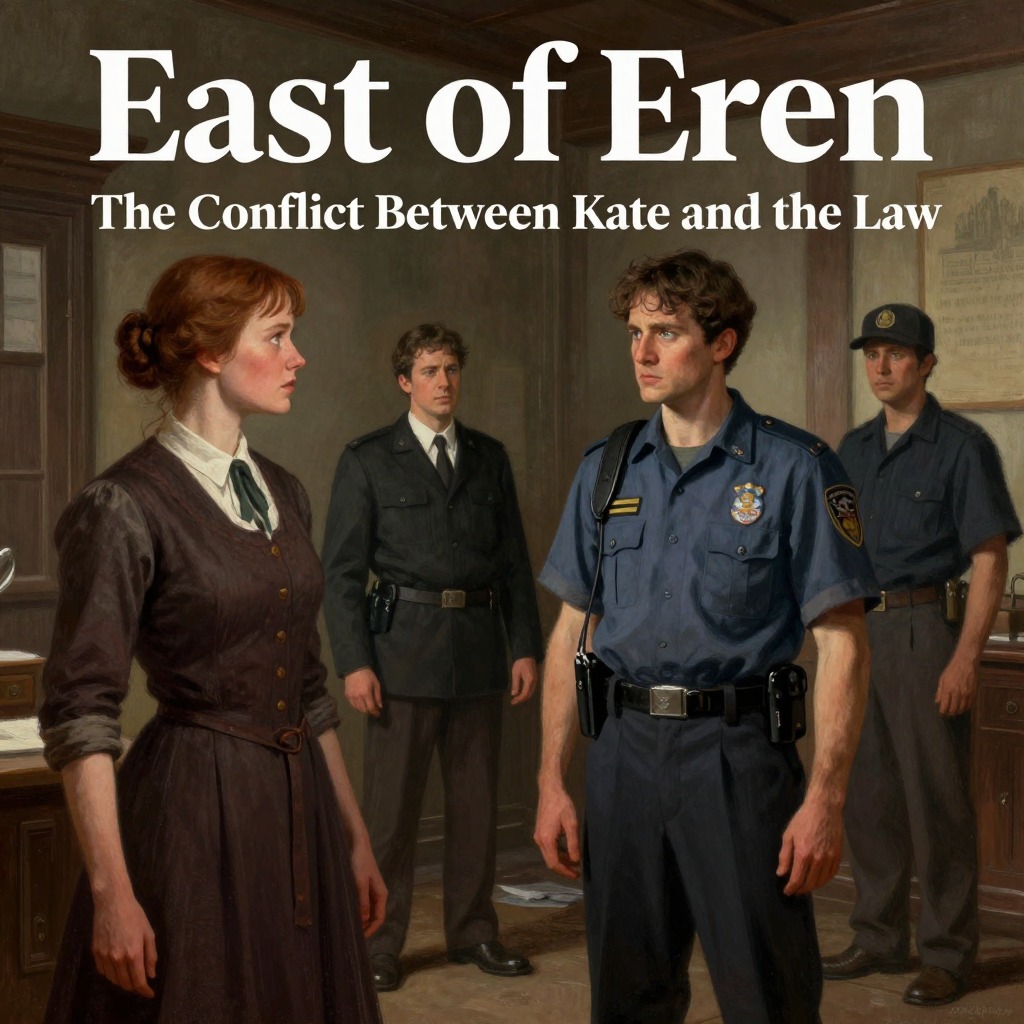
East of EdenCathy Ames Trask, who for years had operated under the name Kate as the madam of a notorious Salinas brothel, died by her own hand in the late afternoon or evening of the day after Thanksgiving, 1917. Her suicide was the culmination of a life built on manipulation, cruelty, and the systematic exploitation of human weakness, but its immediate cause was a convergence of threats she could no longer control: the exposure of her identity to her son Aron, the blackmail attempt by her employee Joe Valery, and the creeping physical decay of arthritis that had begun to erode even her formidable will. The death was not a sudden impulse but a calculated act, carried out with the same cold precision that had marked her entire existence.
The Immediate Circumstances and Method
Kate had spent the previous night sleepless, sitting motionless in her gray windowless lean-to, a room she had built specifically to shut out the world. Her employee Joe Valery, whom she had sent to find the former prostitute Ethel—a woman who possessed evidence linking Kate to the murder of the previous madam, Faye—returned with a fabricated story that Ethel was still alive and trying to contact her. This lie, combined with Kate's growing certainty that her crimes were about to catch up with her, pushed her past the point of endurance. On the morning of her death, she wrote a brief holographic will leaving everything to her son Aron Trask, signed it "Catherine Trask," and left it face-up on her desk. She then prepared herself with deliberate ritual: she combed her hair, applied rouge and powder, put on pale lipstick, and filed and cleaned her nails. In the gray room, she arranged the pillows in her deep chair, sat down, and fished from around her neck a chain that held a small steel tube. From the tube she shook out a gelatine capsule containing six grains of morphine—a "good, sure margin." She smiled at the capsule, said "Eat me," put it in her mouth, then picked up a cup of cold tea, said "Drink me," and swallowed. As the drug took effect, she forced her mind to stay on the image of Alice in Wonderland, the childhood story that had once taught her she could shrink and disappear. Her heart beat solemnly, her breathing slowed, and she "grew smaller and smaller and then disappeared—and she had never been."
The Psychological and Thematic Context
Kate's suicide was not merely an escape from legal consequences but a final assertion of the control that had defined her life. Throughout the novel, she is portrayed as a "monster"—a person born without kindness or conscience, who used her understanding of human weakness to manipulate and destroy. Yet in her final hours, a rare moment of vulnerability surfaced. She recalled the childhood fantasy from Alice in Wonderland of drinking a potion labeled "Drink me" to become tiny and invisible, a game that had once given her a sense of safety. But now, the fantasy failed her. As the morphine took hold, other faces pressed in—her father and mother, Charles, Adam, Samuel Hamilton, and finally Aron and Cal. Cal's eyes seemed to say, "You missed something. They had something and you missed it." This recognition—that others possessed a quality she lacked—was the final defeat. She had always believed herself smarter and stronger than everyone else, but in the end she understood that her difference was a lack, not an excess. The suicide became an admission that her lifelong war against the world had been lost.
The Aftermath and Discovery
Kate's body was discovered the next morning by Joe Valery, who entered the gray room to find her "bloodless lips and eyes shining dully between half-closed lids." He quickly searched the room, stealing the chain with its safe-deposit keys, a small gold watch, and the will from her desk, along with a packet of incriminating photographs. The will, stained with Joe's blood after he was shot by a deputy sheriff later that day, eventually came into the hands of Sheriff Horace Quinn. Quinn, recognizing the destructive potential of the photographs, burned them all in his office stove, along with the negatives. He then delivered the will to Adam Trask, informing him of Kate's death. Adam, who had never stopped loving the woman who shot him and abandoned their twin sons, wept when he heard the news, crying out, "Oh, my poor darling!" The will left everything to Aron, who by then had already enlisted in the army and would soon be killed in France. Kate's body was taken to Muller's Funeral Chapel, where formalin was injected into her veins and her stomach was placed in a jar in the coroner's office—a clinical end for a woman who had spent her life trying to remain untouchable.
Narrative Role and Significance
Kate's suicide is the final act of a character who functions as the novel's embodiment of pure evil, a figure against whom the themes of free will, moral choice, and the possibility of redemption are measured. Her death does not bring catharsis or resolution; instead, it leaves a legacy of pain that continues to reverberate through the remaining characters. The money she accumulated through blackmail and prostitution becomes a poisoned inheritance that Aron never lives to claim. The photographs she used to control powerful men are destroyed, but the damage they represent cannot be undone. Most significantly, her suicide occurs immediately after Cal, in an act of jealous revenge, revealed her identity to Aron—a revelation that drove Aron to enlist and ultimately to his death. Kate's death thus becomes inextricably linked to the destruction of her own son, completing the cycle of cruelty that defined her life. In the novel's moral framework, she represents the ultimate test of the principle Lee articulates: that every person has the choice, the "timshel," to overcome their inherited nature. Kate, who never believed in that choice, chose instead to disappear.