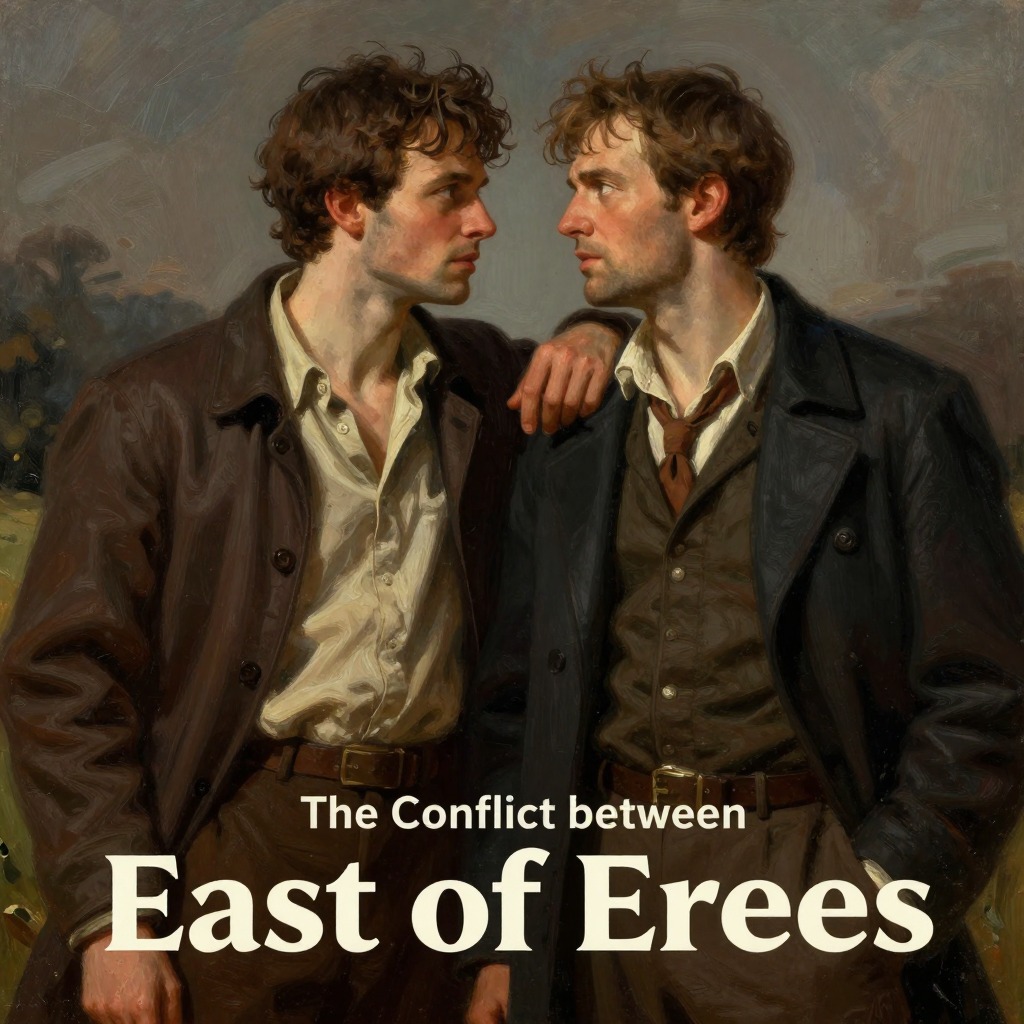
Charles Attempts to Kill Adam
East of EdenCharles Attempts to Kill Adam is the pivotal event in which Charles Trask, after a violent beating of his brother Adam, returns with a hatchet to finish the murder, only to fail when Adam hides in a roadside ditch. This episode crystallizes the Cain-and-Abel pattern that haunts the Trask family, exposes Charles's murderous jealousy over their father Cyrus's love, and forces Adam into a lifelong awareness of his brother's capacity for cold-blooded violence.
Causes and Background
The attack follows directly from a trivial game of peewee in the dooryard. Adam, by an accident of eye and timing, beats his brother four times in a row, a rare victory that produces a wild flush of pleasure in Adam and a corresponding hatred in Charles. Adam immediately senses the danger and tries to retreat, saying, "I guess it was just an accident," but Charles moves toward him with cold, noncommittal eyes. Charles strikes Adam in the face with the bat, knocks the wind out of him with a blow to the ribs, and then knocks him unconscious, afterward kicking him heavily in the stomach. The beating itself is savage, but the deeper cause is Charles's conviction that their father Cyrus loves Adam more. Charles later confesses this directly: he had bought Cyrus a pearl-handled German knife for six bits, while Adam gave a mongrel pup he found in the woodlot, yet Cyrus kept the dog in his room and trained it, while the knife was never even honed. Charles's rage is not about the game but about the accumulated rejection he feels from his father.
What Happens
After the beating, Adam lies unconscious on the ground. When he comes to, he hears quick footsteps on the road and, acting on instinctive fear, crawls into the roadside ditch, hiding in a foot of water among tall grass. Charles returns, striking a sulphur match and peering around, and Adam sees the hatchet in his brother's right hand. Charles searches the road for signs, striking match after match, but Adam remains hidden in the water. Finally Charles gives up, throws the hatchet far off into the field, and walks rapidly away toward the village. Adam stays in the cool water for a long time, wondering whether Charles will feel panic, sorrow, sick conscience, or nothing at all. He feels these things for his brother, his conscience bridging him to Charles the way at other times he had done his homework.
Consequences and Aftermath
Cyrus learns of the attack and, filled with despairing anger, takes his shotgun and goes out into the night to find Charles. Charles, meanwhile, is at the village inn, laughing delightedly at the stories of night-stranded drummers, buying them drinks, and joining them for deviltry elsewhere. He hides out for two weeks, and when he finally returns, murder has sunk back to simple anger, and he pays his penalty in overwork and a false theatrical humility. Adam lies in bed for four days, stiff and aching. On the third day, Cyrus uses his military influence to have Adam enlisted in the cavalry while still in bed, a ceremony that serves as both a poultice to Cyrus's pride and a kind of prize for Adam. The event establishes the pattern of violence and jealousy between the brothers that will recur throughout their lives, and it gives Adam his first clear understanding that he must never win against Charles unless he is prepared to kill him. The hatchet attack also becomes a touchstone for Adam's later understanding of Charles's character: when Adam tells Samuel Hamilton about it years afterward, he recognizes that Charles was "fighting for his love."