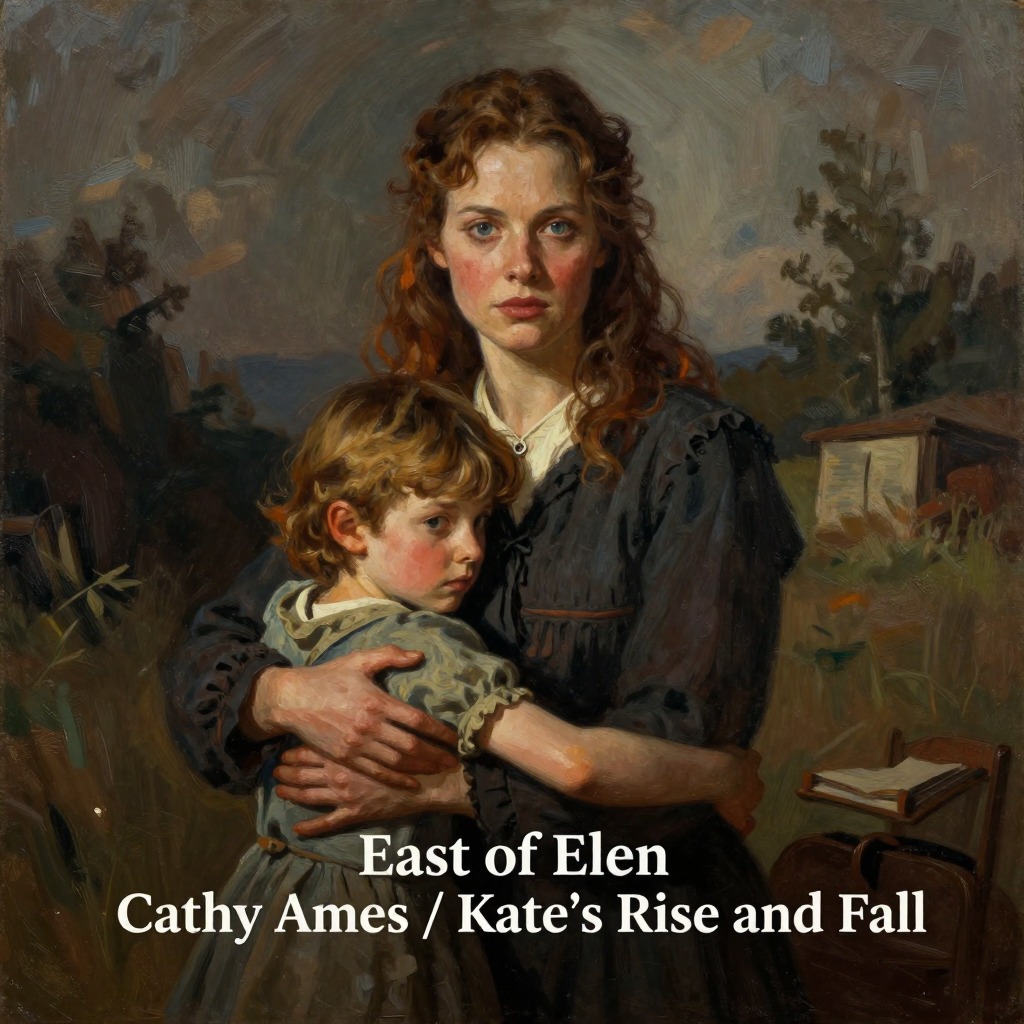
Kate's Will
East of EdenKate's Will is the handwritten document Catherine Trask left on her desk before her suicide, bequeathing her entire estate—over one hundred thousand dollars in gold certificates—to her son Aron Trask. The will, signed with her legal married name, becomes a final, ironic instrument of inheritance that Sheriff Quinn must deliver to Adam Trask, who must then decide whether to honor a bequest from a woman he cannot acknowledge and to a son who has already fled in horror from the truth about her.
Origin and Circumstances
On the afternoon of her suicide, Kate forced her arthritic, crooked hands to write a two-line holograph will on a sheet of paper she left face upward on her desk. The document read simply: "I leave everything I have to my son Aron Trask." She dated the sheet and signed it "Catherine Trask"—her legal married name, not the alias "Kate" by which she was known in Salinas. The will was written in the gray, windowless lean-to she had built as a refuge from the light and from the world, a room whose walls seemed to suck up light and destroy it. She had just finished combing her hair, applying rouge and powder, and filing her nails before she swallowed the morphine capsule she had carried for years on a chain around her neck.
Discovery and Legal Status
Sheriff Horace Quinn discovered the will among the blood-soaked papers in Joe Valery's pockets after Valery was shot dead while fleeing arrest. The document had been folded, and the blood was on the outside; Quinn dampened the papers with a wet handkerchief to separate them. He immediately recognized its significance. He took the will to a lawyer, who confirmed that if Catherine Trask was the testator's legal name and Aron Trask was her son, the will was "as good as gold." Quinn also used the safe-deposit keys he found on Kate's body to open her box at the Monterey County Bank, where he discovered over one hundred thousand dollars in gold certificates—and nothing else except a marriage certificate. The will thus carried the full weight of law, naming Aron as the sole heir to a fortune accumulated through the operation of a brothel that specialized in sadistic "circuses" and through the systematic blackmail of prominent men.
The Burden of the Bequest
When Sheriff Quinn brought the will to Adam Trask, Adam shrank from it, asking whether the stains were Kate's blood. Quinn assured him they were not. Adam read the two lines and immediately said that Aron did not know she was his mother and that he was sure Aron would not want anything of hers. He proposed tearing it up and forgetting it. Quinn advised against that, pointing out that the will was legally valid and that the money existed. He urged Adam to tell Aron everything—every single thing—immediately. Adam agreed to follow Quinn's advice, but when he called for Aron, the boy was not home. He had not been home for two nights. Cal, when asked, said he did not know where his brother was. The will thus arrived at a moment of maximum crisis: Aron had already enlisted in the army under a false age after Cal had taken him to see Kate, and Adam was about to suffer a massive stroke from which he would never fully recover.
Thematic Significance
The will functions as a final, terrible inversion of the novel's central concern with choice and inheritance. Kate, who throughout her life denied any moral law and who told Adam that she believed only in evil and folly, nevertheless made a legal gesture toward her son—but toward the son who most resembled her in appearance and who was least able to bear the truth about her. The money she left was the product of blackmail, prostitution, and murder, yet it was legally clean. The will thus poses the question of whether a poisoned inheritance can be purified by the intentions of the recipient, or whether it carries an ineradicable stain. Lee, contemplating the irony, reflected that Aron, whose purity was "a little on the self-indulgent side," might live all his life on the profits from a whorehouse. The will remains unexecuted at the novel's end, suspended between Adam's stroke, Aron's disappearance into the army, and the unresolved question of whether anyone can accept such a gift without being corrupted by it.