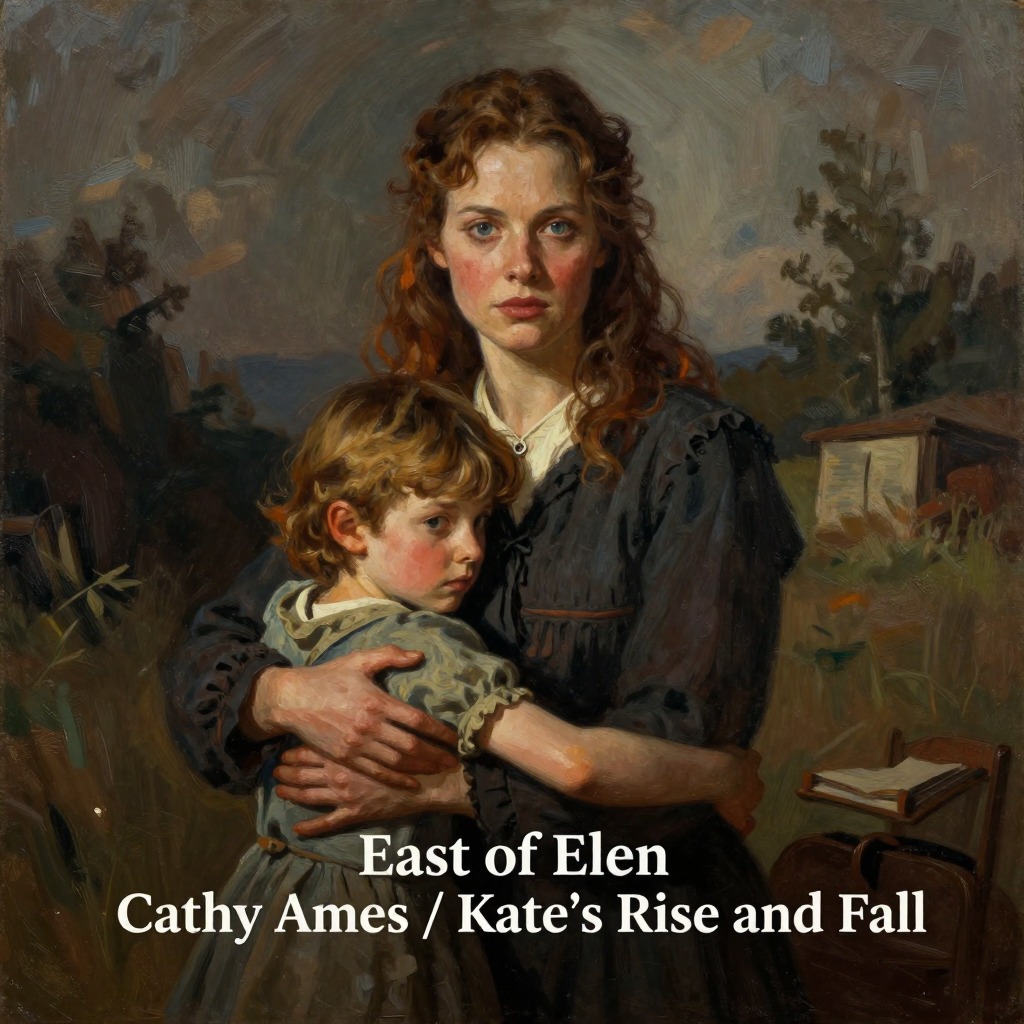
Mrs. Ames
East of EdenMrs. Ames, the mother of Cathy Ames, is a figure of conventional maternal anxiety and willful blindness. She is the first and most persistent person to be deceived by her daughter, and her inability to perceive Cathy's true nature makes her an unwitting enabler of the girl's monstrous development. Her role in the narrative is to demonstrate how ordinary, well-meaning people can be manipulated and how their own fears and social conventions can be used against them.
Identity and Background
Mrs. Ames is the wife of William Ames, who operates a small tannery in a town in Massachusetts. She is the mother of an only child, Cathy. As a parent, she is a worrier, convinced that all her friends have the same problems with their children. She is described as being "so bound and twisted in a cocoon of gauzy half-lies, warped truth, suggestions, all planted by Cathy, that she would not have known a true thing if it had come to her." This description establishes her as a woman whose perception of reality has been fundamentally corrupted by her daughter's manipulations. Her maternal instincts are strong but misdirected; she is protective of Cathy but utterly incapable of understanding her.
Role in Cathy's Early Crimes
Mrs. Ames is the central figure in the first major incident of Cathy's childhood. She discovers Cathy in the carriage house with two fourteen-year-old boys, Cathy lying on the floor with her skirts pulled up and her wrists tied with a heavy rope. Mrs. Ames's reaction is one of hysterical outrage. She becomes the "final authority" on the event, and out of her hysteria "a sadistic devil peered." She demands blood, insisting that the boys be punished to protect the town. Her testimony ensures that the boys are whipped to raw cuts and sent to a house of correction, despite their claims that Cathy had started the whole thing and had tied her own hands. Mrs. Ames's inability to conceive of her daughter's guilt, combined with her righteous fury, makes her the instrument of a grave injustice. She later tells neighbors that Cathy is "haunted by it" and that questioning her sends her into shock, a narrative that Cathy herself has crafted to control the situation.
Complicity in Cathy's Escape
Mrs. Ames is also instrumental in the events leading to Cathy's final escape from home. When Cathy, at sixteen, refuses to go to school and declares she will never go again, Mrs. Ames is the one who insists on a whipping. She forces her husband, William Ames, to whip Cathy, and afterward she hates him for doing it. This act of violence, which Cathy endures with cold calculation, is the catalyst for Cathy's decision to run away. Mrs. Ames's demand for punishment, born of her own frustration and fear, provides Cathy with the perfect pretext to leave. After Cathy's disappearance, Mrs. Ames sits in the kitchen, white and shaking, listening to the blows and screams she has demanded. Her role in this event is that of a conventional mother who, unable to control her daughter, resorts to the only tool she knows—physical punishment—and in doing so, she drives her daughter away forever.
Thematic Significance
Mrs. Ames represents the failure of conventional morality and maternal instinct in the face of true evil. She is a woman who believes in the goodness of her child and in the efficacy of punishment, but both beliefs are shown to be tragically inadequate. Her story illustrates how a parent's love, when combined with willful blindness and a reliance on social norms, can be manipulated to serve the purposes of a monster. She is a cautionary figure, demonstrating that the inability to see what is truly in front of one's eyes can have devastating consequences. Her character underscores the novel's theme that evil is not always recognized, and that those who are supposed to protect the innocent can, through their own limitations, become complicit in its work.