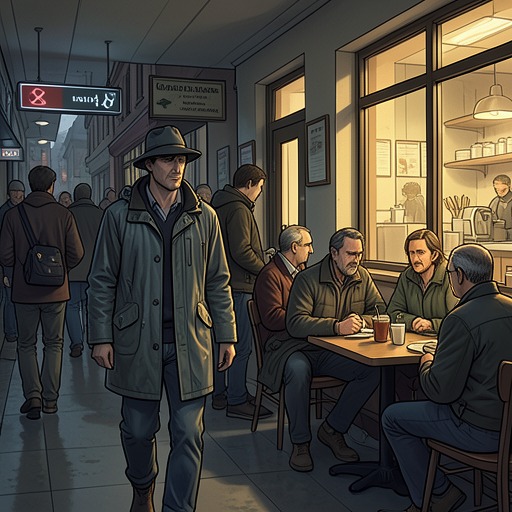
“There’s no wrong way. Whatever gets you there.”
East of the MountainsThe drifter’s “There’s no wrong way. Whatever gets you there.” turns a dispute about direction into a compact argument for adapting when the expected route is unavailable. Spoken to Ben Givens, who insists that crossing the river would take him east when he needs to travel west, the line does not erase the difference between the two directions. Instead, it challenges Ben’s assumption that a useful journey must proceed along the route he had already chosen. Its force lies in that modest shift: the immediate problem is not solved by the saying itself, but the terms of the problem widen from staying on course to finding some way forward.
A Detour Measured Against Ben’s Plan
The exchange begins with an unusually concrete obstacle. Ben has had his thumb out for an hour and a half without a driver slowing down. The drifter suggests that he cross the river and try Highway 26, where people slow down at the intersection. Ben answers that this is the wrong way because it is east and he is headed west. The drifter reduces the apparent cost of the detour to a mile; Ben still objects that it is wrong. Against this increasingly exact exchange of directions and distance, “There’s no wrong way” sounds less like a geographical claim than a refusal to treat the first plan as absolute.
The second sentence, “Whatever gets you there,” supplies the qualification that makes the first useful. The destination still matters: the drifter speaks of getting somewhere, not of aimless movement. What changes is the standard for judging the route. Ben measures the proposal against the direction he intended to travel; the drifter measures it against whether it might help him reach his destination. The difference is practical rather than abstract. The advice does not demonstrate that the eastward crossing will work, and the scene gives no such guarantee. It offers a different way to assess an imperfect option when the direct one has stalled.
The Saying Beside an Interrupted Hunt
Ben is stranded after crossing the mountains to hunt quail, but his damaged eye, injured in an accident involving young people in a Volkswagen van, makes it difficult for him to see well enough to shoot. He tells the drifter that he may as well go home. This background sharpens the line’s relevance without making it a direct answer to the later hunting decision: at first, Ben is discussing how to get moving again after both his ride and his immediate hunting purpose have become uncertain.
The drifter’s advice is accompanied by help rather than left as a maxim. He puts Ben’s duffel over his shoulder and sets out with him toward the river. That action gives the saying a physical counterpart: the proposed way forward involves an inconvenient change of direction, and the drifter is willing to carry part of Ben’s burden while they attempt it. The line’s practical meaning is therefore anchored in the scene’s small acts—an alternate route, a bag lifted, and two people walking toward the crossing—not in a promise that the detour will resolve everything.
A Later Change of Mind
Later, when the drifter again suggests that Ben put his dogs in the bushes and hitchhike, Ben declines. He sees that the nearby breaks may hold chukar and says that he came to hunt and will hunt them. The drifter observes that Ben has changed his mind; Ben agrees, adding, “That happens.” This later exchange makes the earlier advice resonate, but it does not prove that Ben consciously acts because of it. What it shows directly is a change in his immediate intention: after speaking of going home, he decides to hunt where he is.
The parallel is precise. In the first exchange, Ben treats a route that points east as wrong because it departs from his westward plan. In the later one, he no longer treats going home as the only consequence of his impaired aim and failed ride; he finds a reason to remain and hunt. His decision is made concrete when he ties his dogs to a fence post, lays out his coat, vest, and gear, and assembles his Winchester 21. The saying can be read alongside that turn as an invitation to reconsider what counts as a viable next move, while the narrative leaves Ben’s choice recognizably his own.
Meaning and Limits
The line’s central contrast is between fidelity to a planned route and responsiveness to circumstances. It does not say that every choice is equally safe, successful, or morally sound. In this scene, its claim is narrower: a detour need not be disqualified merely because it initially appears to lead in the wrong direction. The drifter speaks from within an immediate problem, and the subsequent assistance gives his words a grounded, companionable character rather than presenting them as a formal doctrine.
The expression also gains meaning from the way the scene separates destination from method. Ben’s westward direction, his damaged eye, the failed attempt to hitchhike, and the possibility of hunting nearby all belong to different versions of what he might do next. The drifter’s phrase makes room for a route—or an intention—that Ben had not accepted before. Yet the later decision remains distinct from the literal river crossing: the evidence establishes that Ben changes his mind about hunting, not that he follows every element of the drifter’s first suggestion. The line matters as an opening toward adjustment, not as a guarantee of arrival.