Bea Harden
East of the MountainsBea Harden enters Ben Givens’s story as a neighbor from an earlier life and becomes a practical companion at a decisive turning point. Formerly Beatrice Cade, she recognizes Ben’s family history, gives him water and a ride, and presses him to account for his decision to keep living. Her significance lies in the way those actions join ordinary care to a larger reversal: rather than offering an abstract answer to Ben’s despair, she points him toward what he has just done for someone else.
Identity and Background
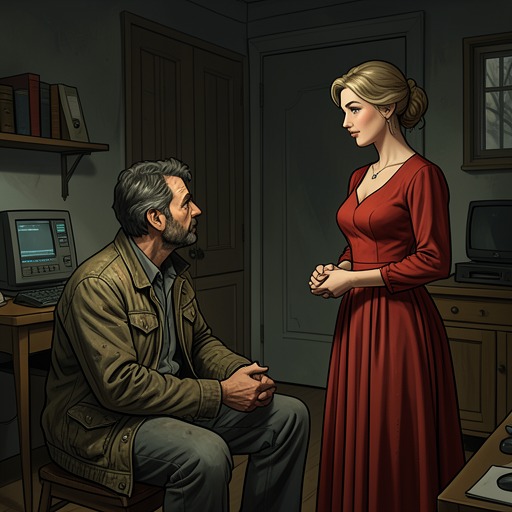
Bea Harden is introduced as the woman of the house at the Harden home. Ben Givens guesses that she is almost his age. Her gray hair, deep wrinkles, liver spots, housedress, cardigan, and calf-high rubber boots give her an unpolished, work-worn appearance. Her hair is amiss, her dress is stained, and hay clings to her; pruning shears protrude from her sweater pocket. The details suggest a person amid physical work, not someone dressed for a formal meeting. They also establish a contrast between the familiar domestic setting and the life-or-death crisis Ben brings into it.
Bea identifies herself by the name she used while growing up: Beatrice Cade. She tells Ben that she lived across the river when he was growing up in Wenatchee, and that her father worked with Ben’s father on the Icicle Ditch. Her family also ran a milliner’s shop in town, which Ben’s mother sometimes visited. This compact recollection places the two families within the same local world, connected by work, commerce, and the routines of a small community. Ben does not remember the Cade name, so their shared past is initially more vivid to Bea than to him.
The recognition is grounded in specific people and places rather than a general claim of childhood friendship. Bea recalls Ben’s father and mother, the ditch where the fathers worked, and the shop her family kept. As she kneads her bent, knobby, arthritic fingers, the bodily detail of the present sits beside her precise account of the past. Her memory restores a link Ben cannot immediately recover, but it does not erase the years that have passed or make their recollections identical.
Work, Kinship, and Practical Care
Bea’s relationship to the Harden household is clarified when Ben asks whether her husband is William. She answers that William Harden is her brother-in-law. The distinction matters: the encounter links her to William without establishing that she is his wife. Ben’s question about whether William has wolfhounds follows, bringing the Harden name into the immediate danger that has shaped Ben’s journey. The exchange leaves Bea’s own longer history in the background; when asked why she is picking, she says it is a long story.
Her manner of helping is direct. She pours water at the sink, and Ben sits up and drinks the whole cup. When he tells her that he has colon cancer, she responds with alarm. She then drives him in her El Dorado through working orchards, past trellised Fujis and laden Granny Smiths, with pickers in shirtsleeves and hills covered in different varieties of apples. The route makes her assistance concrete: she is not simply a listener to Ben’s trouble but the person transporting him through the landscape in which the next part of their conversation takes place.
The orchard journey also places Bea among the labor and changing agricultural scenery of the Columbia country. She drives past apple trucks and workers picking the last fruit, then crosses the river at East Wenatchee and continues past Rock Island. When Ben points out where his childhood home stood, she slows and stops at the roadside. The old orchard descends toward the river; the new house is screened by mature willows. Bea calls the place pretty and notices the poplars. Her attention is modest but specific: she looks at what remains and what has grown, while Ben answers that many things have changed.
A Witness to Ben’s Reversal
Bea’s most consequential role comes as she asks Ben why he changed his mind. Her questions make the change a subject that must be spoken aloud, rather than a decision left unexplained. Ben says cowardice was the main reason and observes that shooting himself was not easy. Bea counters that there are sleeping pills, refusing to treat the failed method as proof that his suicidal intent has disappeared. Her response recognizes the danger still present in the conversation even as Ben has turned away from the immediate attempt.
She then gives him a different measure of what has happened: he saved a baby the night before. The reminder is striking because it rests on a concrete act, not an assurance that his illness or grief has been resolved. Bea directs Ben’s attention away from the mechanics of suicide and toward a life he helped preserve. The scene does not make her a rescuer with a complete answer; it gives her a clear intervention at the moment when Ben is being asked to explain why he has turned back.
The conversation unfolds beside the Columbia, at a bend high above the river, with the Frenchman Hills in view and ducks passing overhead. Bea’s question and the surrounding landscape place Ben’s private decision within the familiar country he has crossed to reach it. After they cross the river again, he tells her that he and Rachel Givens made a pact to bury their ashes together. Bea’s presence thus accompanies not only his change of mind but also his articulation of an enduring bond to his dead wife. The novel leaves the weight of that pact with Ben; Bea has made room for him to say it by staying beside him and asking what changed.
Narrative Significance
Bea connects the novel’s ending to two kinds of continuity: the remembered community of Ben’s childhood and the immediate responsibilities of the present. Her memories of the Cade family and the Icicle Ditch recover a local history Ben cannot fully recall. Her drive past orchards and back toward his boyhood home makes that history visible in a landscape that has changed, even as familiar features—the river, hills, and orchards—remain. She neither claims that the past can be restored nor asks Ben to deny what has been lost.
Her care is defined by action and attention. She gives water, drives, stops when Ben points out his former home, asks him to explain his change of mind, and recalls the baby he saved. These gestures make her a witness rather than a substitute decision-maker: Ben names cowardice, speaks of the pact with Rachel Givens, and remains responsible for his own choice. Bea’s contribution is to keep the choice open to conversation and to bring a recent act of care into view. In that role, the returning Beatrice Cade becomes part of the novel’s movement from a solitary plan for death toward a renewed connection with other lives.