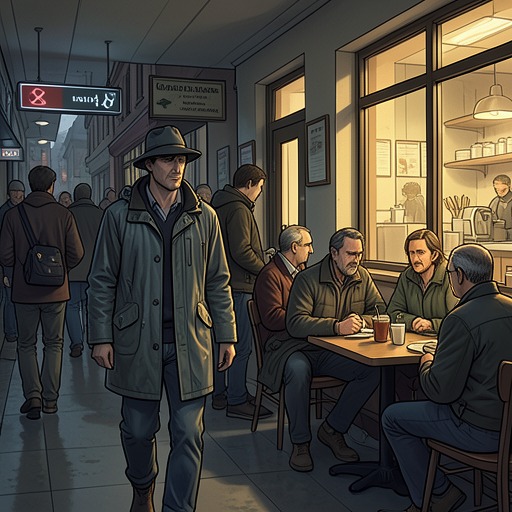
Ben Givens and Bea Harden's Connection
East of the MountainsBea Harden is at once a stranger to Ben Givens and someone rooted in his earliest family history. Their connection emerges when he is injured, displaced, and close to giving up: she recognizes his name, gives him practical help, and listens as he explains how he reached this point. Her kindness does not erase the distance between them, but it gives Ben a place to speak and helps bring his journey toward home.
A Childhood Connection Rediscovered
Bea tells Ben that she knew him when she lived across the river as a child in Wenatchee, where her name was Beatrice Cade. Ben does not remember the name. His memory, he admits, is poor, but Bea can supply the family history he cannot recall: her father worked with Ben’s father on the Icicle Ditch, and her family ran the town milliner’s shop, which Ben’s mother, Lenora, sometimes visited. Bea also knew Ben’s aunts. Their connection is therefore older than their encounter on the road, though it has survived more clearly in her memory than in his.
That imbalance lends the reunion its particular intimacy. Bea recognizes the family before Ben recognizes her; she does not demand that he perform a memory he lacks. Instead, she offers concrete details of the households and work that once brought their families together. Their past is neither a close friendship revived nor a wholly new acquaintance: it is a shared local history that makes the present meeting feel less arbitrary without making Ben pretend to remember what he cannot.
Care Amid Conflict
When Ben asks whether Bea’s husband is William, she clarifies that William is her brother-in-law. Ben then asks whether William has wolfhounds, and the conversation reaches the immediate source of the trouble: Ben killed one of William’s hounds, and William took Ben’s gun. Bea reacts with anger and says she will speak to him. Ben, whose side hurts, tells her not to raise the matter and says William can keep the gun; he does not want it back. Bea points out that the gun is his, but her offer to intervene does not become a contest over what Ben should choose. She is prepared to defend him, while he is prepared to relinquish the object at the center of their conflict.
Her care is practical as well as protective. After Ben tells her he has colon cancer, she drives him in her El Dorado through a sunlit stretch of orchards: trellised Fujis, Granny Smiths, Galas, Braeburns, and Red Delicious fill the hills, while power lines cross the river in the distance. Bea tries to comfort him with stories of people she knows who went into remission, including a cancer survivor who credited raw calf’s liver juice and Winesap apples. Ben answers that the liver juice sounds familiar, and Bea observes that he sounds like a doctor. Her reassurance does not settle the question of his illness; it makes room for conversation without pretending to know what will happen.
At her home, Bea urges him to eat breakfast, rest on the couch, and use the bathroom. Ben asks for a ride back to the rented truck he left on Joe Miller Road, insisting that he can drive despite his condition. Bea puts out her hand for his keys and tells him she will get the truck returned to U-Save. When he says he has no other way home, she promises to drive him across and calls herself a good Samaritan. Her help is specific: she takes responsibility for the keys, the truck, and the journey rather than offering comfort alone.
The Stranger Who Can Listen
After Ben and Bea collect Rex from the clinic in Quincy, Bea drives him toward George. Ben checks the staples in Rex’s wounds, strokes his coat, and settles him on a blanket in the back seat. On the road, as irrigators stand in the fields and the cultivated land meets the dry steppe in sharp lines, Bea asks about Ben’s blackened eye. He begins at the beginning: Rachel’s death, then his daughter and grandson, and the sequence that left him with a lost shotgun, an injured dog, a damaged eye, and no settled home. He does not give every detail, but tells the story in order. For Ben, speaking it aloud feels good; Bea seems the right person precisely because she is a stranger, even as their earlier family connection complicates that description.
Bea names the plan Ben had been pursuing as suicide and says she could not imagine it. Later, she asks what made him change his mind. Ben attributes the change mainly to the difficulty of shooting himself, but Bea answers by recalling something he has done: he saved a baby the previous night. The reminder shifts the emphasis from Ben’s failed attempt to end his life toward an act that preserved another’s. She does not claim that one deed resolves his grief or illness; she offers it as evidence Ben may be overlooking while he explains his decision.
A Ride Home, Not a Cure
As they cross the river, Ben tells Bea that he and Rachel made a pact to bury their ashes together. The promise connects his wish to return home with his continuing attachment to his wife, whose death he has just recounted. When he says that he is going home partly because of that pact, Bea replies that she understands. Their exchange does not turn her into a substitute for the family he has lost or establish a lasting intimacy beyond the journey. Instead, she receives his reasons without arguing him out of them.
Bea drives him over Ryegrass Summit and through the Quilomene toward the Kittitas Valley. She remarks on October’s beauty on that side of the mountains; Ben agrees that autumn is more vivid there. The route gives their encounter a physical conclusion: after Bea has listened, offered help, and reminded him of the baby he saved, she carries him toward home. Her significance lies in that combination of recognition and unfamiliarity. She knows something of the family Ben cannot remember, yet listens as someone outside the immediate burdens he fears imposing on his daughter and grandson. In the final movement of his journey, that distance makes candor possible, and her concrete assistance helps his decision to return become an actual ride home.