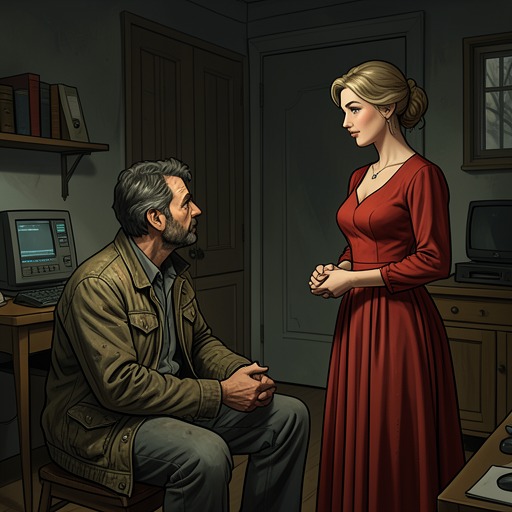
Ben Givens and Renee
East of the MountainsBen Givens and Renee’s relationship is shaped by genuine affection and a painful imbalance of knowledge. Ben thinks carefully about the questions his sudden death would leave her, then chooses to reassure her while withholding the truth about his condition and intentions. His care for his daughter is real, but so is his resolve to keep her outside the crisis he is facing.
The Daughter Left to Reconstruct His Disappearance
As he lies in a motel room, Ben imagines Renee trying to piece together his final hours from the evidence he would leave behind. She would find that his car had been towed from North Bend on Saturday, October 17, and that he had taken a room in Quincy the next day, 125 miles to the east. She would wonder how he had covered the distance and what had happened to his dogs. The imagined inquiry expands to the Grant County coroner, sheriff, the man who towed the car, and Ilse Peterson, who could tell her about the wolfhound attack, Tristan’s death, and Rex’s recovery.
In Ben’s imagined account, Renee might visit the place where he became entangled in barbed wire and seek William Harden’s version of events. The image others would recall—a battered, filthy man in dust-bitten hunting clothes, carrying an overloaded rucksack—would trouble her because it would not explain everything. Ben even anticipates that suspicion could fall on Harden and that questions to Bill Ward might bring the truth about Ben’s cancer to light. This imagined aftermath shows Ben considering not only his own death but the burden of uncertainty it would place on his daughter.
Reassurance as Concealment
Ben decides that he should call Renee and tell her that matters have settled down: he is safe in his motel, the night after Tristan’s death is behind him, and the car-wreck details have been handled. He plans to say that he will hunt blue grouse west of the river without a dog while Rex convalesces, then bring Rex home in a rental car within a day or two. He also considers explaining his swollen eye as the reason he misjudged the barbed-wire fence. The explanation would make the injury part of an account Renee could later use to understand what happened, while concealing the larger crisis.
Ben recognizes that his policy is dishonesty, but frames it as dishonesty on behalf of the living rather than for his own advantage. He does not want Renee to discover a death that appears mysterious or to prompt an investigation into the missing family shotgun and his plans. When he first picks up the phone, Chris answers, and Ben is not ready for that conversation. Later, he calls Renee in Seattle. She says she thought he was hunting and notes that Chris told her he had called. The exchange makes clear that she is attentive to his whereabouts, even though she does not know what he is hiding.
Affection at the End of the Call
During the later conversation, Ben steers away from a subject he does not want to pursue, then closes the call gently. He tells Renee that he loves her, sends his best to his son-in-law and Chris, wishes her luck with her screenplay, and asks her not to worry. He succeeds in convincing her that he is all right. The reassurance is therefore both an expression of tenderness and a deliberate falsehood: he offers the emotional certainty she needs while refusing to disclose how precarious his own situation is.
The call does not resolve the distance between what Renee knows and what Ben plans. Instead, the contrast defines their bond in this passage. Ben’s imagined concern for the questions she would ask coexists with his decision to keep the decisive facts from her; his final words of love are sincere, while the safety they imply is not. His effort to spare Renee worry becomes part of the secrecy surrounding his intended disappearance.