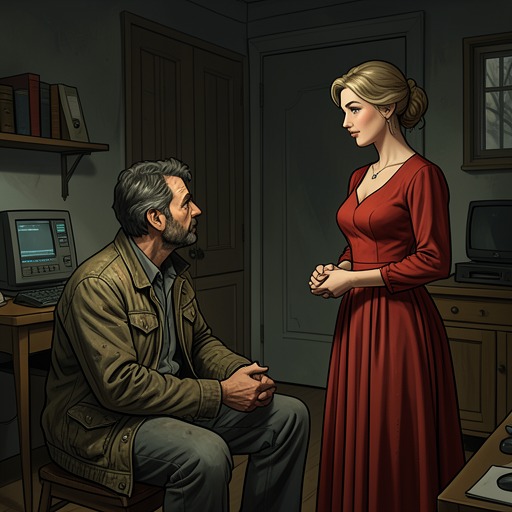
Ben Givens and Renee Givens-Kane's Father-Daughter Relationship
East of the MountainsBen Givens and Renee Givens-Kane’s father-daughter relationship comes into focus through a conflict between protection and presence: Ben has tried to spare his family the pain of watching him die, while Bea Harden insists that being present for his death could teach them compassion. The relationship’s final image is not a reconciliation scene or a promise about what comes next, but Ben at home, calling his daughter and telling her he has returned.
Family as a Feared Burden
When Ben recounts how he reached his present condition, he names the deaths and surviving family members that frame his predicament: Rachel Givens’s death, then his daughter and grandson. He does not go into the details of those losses or relationships. Instead, he tells Bea the story of his recent passage through crisis, including his lost shotgun, wounded dog, blackened eye, and transience. The account is linear, and speaking it to a stranger feels good to him. His choice of listener matters: at this point, the person who hears the story is not his family but someone with no prior claim on him.
On the drive, Ben explains the reason behind that distance. He says, “I didn't want to burden my family,” and imagines putting them through nine months of misery. His stated purpose is protective rather than accusatory: he does not say that his daughter has failed him or would be unable to care for him. Instead, he treats his own suffering as something he can keep from the people he loves. That reasoning makes the separation painful even before the passage shows any response from Renee; his attempt to spare the family also means withholding from them the knowledge of what he is facing.
Bea’s Challenge to His Reasoning
Bea answers directly that Ben’s illness is not a burden. She asks him to imagine what his family might learn by witnessing his death, and then presses the point: their experience, she says, could help them become more compassionate. Ben allows that this sounds good in principle, but Bea insists that the value is real. The exchange shifts the meaning of family presence. Ben has regarded it as an imposition he should prevent; Bea presents it as a possible form of learning and connection for those who love him.
The conversation does not establish that Ben immediately accepts Bea’s view, nor does it show Renee learning about his illness at that moment. Its importance lies in putting his private justification into words and having another person contest it. Ben has told a stranger about his family and his wish not to make them miserable; Bea’s reply makes that wish answerable to the family’s possible experience, rather than leaving it as an unquestioned act of kindness. The scene gives no account of Renee’s own thoughts, so her side of the relationship remains deliberately outside the exchange.
The Call from Home
After Ben reaches home, he turns up the heat, goes to the bedroom, and settles on the bed in his dusty hunting clothes. Rex lies beside him. After a while, Ben picks up the telephone and dials his daughter’s number. She answers by identifying herself as Renee Givens-Kane; Ben replies, “Its me,” and then, “I'm home.” The call is brief, but its placement gives it weight: after the long account to Bea and the argument over whether family should be spared, Ben makes contact with his daughter himself.
The words do not explain where he has been, disclose what Renee already knows, or tell the reader how she reacts. They establish only the immediate fact of his return and his decision to announce it to her. That limit is important. The scene does not claim that one call repairs everything between father and daughter, or that Renee has already understood his illness and his earlier intentions. Instead, it shows a first, concrete movement out of isolation: Ben addresses his daughter directly, in his own voice, from the home he has reached.
Significance of the Relationship
The relationship is presented through two different kinds of speech. To Bea, Ben gives a linear account of the painful route that brought him to this pass and names his intention not to burden his family. To Renee, he offers only a few words, but those words cross the distance his protective silence has created. The contrast is not between a stranger who understands him and a daughter who does not; the passage supplies no basis for that judgment. It is between what Ben can disclose to a stranger and the simple contact he finally initiates with his daughter.
The call also leaves the relationship open rather than neatly resolved. Renee answers, but her response beyond identifying herself is not recorded. Ben does not give a detailed explanation or ask her for anything. The exchange’s force comes from its modesty: “I'm home” locates him again among the living and gives his daughter news of his presence. Against his earlier wish to spare his family by keeping them at a distance, the call makes return itself the message.