Ben Givens and Wright Givens's Father-Son Relationship
East of the MountainsBen Givens and Wright Givens’s father-son relationship is built less through declarations than through work, instruction, and time spent together outdoors. Wright teaches Ben how to labor on the family orchard, read the land, hunt, and prepare food; Ben’s eventual departure for military service exposes the affection and dependence that their practical bond has carried all along.
A childhood shaped by the orchard
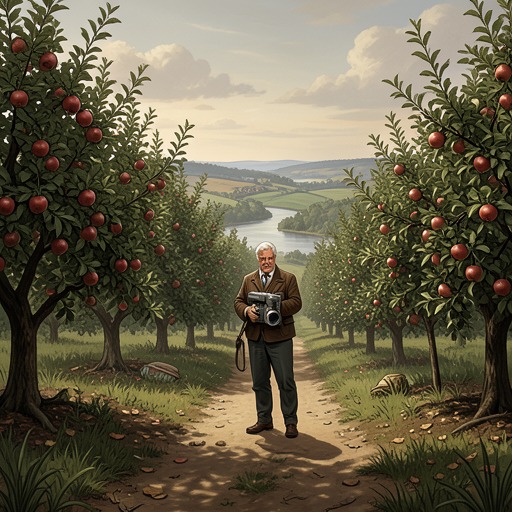
Ben grows up within the working landscape his parents have planted on the east bank of the Columbia River. The family’s holdings include rows of Golden Delicious, Winesaps, and Rome Beauties, alongside cherries and apricots, with a farmhouse on a knoll and the sheds, stable, and other buildings needed to support the orchard. Wright is not a distant figure in this setting: he and his sons share the labor that keeps it functioning.
Ben makes apple boxes from pine shook, weeds the kitchen garden, splits cordwood, and milks cows twice daily. In spring, he helps Wright and Aidan Givens set out pollinating hives; when weeds clog the sluice gates, Ben and Aidan clear the ditches by hand. Their year proceeds through planting, disking, supporting young trees, thinning fruit, propping laden branches, harvesting, pruning, and burning water sprouts. The relationship is therefore grounded in repeated cooperation: a father’s household and livelihood are also the son’s daily work, learned season by season.
The orchard’s discipline has a wider counterpart in the open country beyond it. Ben and Aidan go with the dogs into the desert in search of quail, chukars, and sage grouse, sometimes camping overnight and cooking what they have shot. Work and recreation both teach sustained attention to land and animals, though the family’s most defining lesson in hunting comes when Wright takes Ben on his first deer hunt.
A father’s instruction in the hunt
At ten, Ben rides with Wright and Aidan into the hills after new snow. They cross the river at Coleman’s Landing and follow the Colockum Stagecoach Road, camping on a bench above the river. Wright explains how deer move and how wind affects their caution. The talk is practical, but it also places Ben inside a body of knowledge about the terrain and the habits of the animals that his father has acquired and now passes on.
At dawn, Wright identifies a buck’s track in Stray Horse Canyon and leads the boys along it, explaining the animal’s route and choosing how to approach without exposing their own trail. On a ridge saddle, he has them tether the horses below and sit with their backs to one another so they can watch in every direction. After forty minutes, Wright’s rifle fires; the buck falls. Ben’s heart races, and he leans against his father, who places a hand on his shoulder. In that brief exchange, expertise and reassurance meet: Wright controls the hunt, but he also steadies his son as the consequences of the shot become immediate.
Wright then shows the boys where the bullet passed through the deer and explains how the meat should be cooled and drained. He demonstrates the dressing of the animal, including removing scent glands and preventing urine from tainting the meat, while Ben and Aidan watch. Before the practical work continues, Wright removes his hat, kneels beside the buck, and asks his sons to kneel with him. They lay their hands on the animal as he gives thanks to God for the meat. The scene makes the hunt simultaneously a technical skill, a source of food, and an occasion for reverence.
Riding away with blood across his coat and hands, Wright tells the boys, “That’s how it’s done,” and says it is how they will want to do it when he is no longer around. His words turn instruction into an act of inheritance. He does not simply show Ben how to kill and dress a deer; he models a sequence of responsibilities—understanding the animal, using the meat, and acknowledging what has been taken. The promise of future absence gives the lesson an emotional weight that the procedure alone would not carry.
The strain of departure
That sense of attachment becomes explicit when Ben receives an invitation to join the Army’s mountain troops. The invitation recalls his enthusiasm for skiing and presents enlistment in the 10th Mountain Division as a way to meet the war on terms suited to his experience. Wright accepts that if Ben must go, he may as well go as a mountain trooper, but acceptance does not conceal his wish that his son stay.
Wright tells Ben, “I wish you wouldn’t go at all,” and adds, “I wish you could stay. I need you.” Ben answers that his father will get along; Wright replies that he will not. The exchange breaks through the practical restraint that has governed their shared life. Wright’s need is not framed as a lesson or an assignment but as a direct admission of emotional dependence. Ben nevertheless says he has to go. His father repeats that he wishes he would not, leaving the separation unresolved rather than disguising it as a simple approval of duty.
The enlistment conversation also changes the meaning of the earlier hunting lesson. Wright had imagined a future in which Ben would carry on without him; now Ben is preparing to leave while Wright remains at the orchard. The two moments place inheritance and separation side by side: the father teaches his son how to act in his absence, yet confesses that the son’s actual absence will be painful.
Work remembered beyond the household
Later, Ben passes orchards during the busy autumn harvest and sees pickers working among ladders, bins, tractors, and fruit-laden trees. The landscape recalls the family world in which he learned labor alongside Wright, but it also shows harvest as a broader social undertaking: orchard workers rest in small groups, children lie in the grass, and men and women move carefully among branches to avoid bruising the apples. Ben’s childhood orchard work thus belongs to a larger cycle of agricultural labor, not only to a private bond between father and son.
Across these scenes, Wright’s care takes a form that is both demanding and intimate. He equips Ben with practical knowledge, includes him in the family’s work, steadies him beside a fallen animal, and teaches him to treat the harvest as something received rather than merely taken. His plain admission that he needs Ben makes visible the attachment underlying those habits. Their relationship is significant because it joins affection to responsibility: what passes from father to son is not only a skill, but a way of working, noticing, and responding to the world.