Ben Givens joins the 10th Mountain Division
East of the MountainsBen Givens’s decision to join the 10th Mountain Division turns a letter about skiing into a departure for war, and makes visible the cost of that choice at home. Recruited through his experience in the mountains, he chooses a particular form of Army service rather than waiting for the draft to decide his fate. But enlistment is not presented as a clean break from family: his father accepts the logic of going while pleading for the son he needs to remain.
The Call to the Mountain Troops
In May, a letter arrives from Willard Anderson, president of the Leavenworth Ski Club. Anderson remembers Ben passing on the jump at Ski Hill and writes to invite him into a military unit organized around the high country. The 87th Mountain Infantry Regiment, he explains, was activated at Fort Lewis the day after The attack on Pearl Harbor and had trained on the slopes of Mt. Rainier. The 10th Mountain Division followed, and it is now recruiting, with help from the National Ski Patrol. Anderson’s appeal rests on a close fit between Ben’s enthusiasm for the mountains and the Army’s need for men able to serve in them.
The letter also frames the choice as a way to retain some agency under conscription. Anderson contrasts joining the mountain troops with simply going wherever the draft sends Ben, urging him to “meet the war on your own terms, and wearing skis as well?” The appeal does not offer a way out of the war; it offers a way to enter it on terms connected to a life Ben already knows. The skis in Anderson’s formulation make military service sound at once practical and personal: the familiar skill becomes the means by which Ben approaches an unfamiliar obligation.
Acceptance and Family Resistance
Ben’s father does not reject the idea that his son may have to serve. He says that if Ben must go, he may as well go as a mountain trooper. Yet that practical concession immediately gives way to a more intimate plea: “I wish you wouldn't go at all,” he says. “I wish you could stay. I need you.” Ben answers, “You'll get along.” His father replies, “No, I won't.” The exchange makes the family cost plain without turning it into an argument Ben can resolve. His father can recognize the sense of the choice and still fear the loss of his presence.
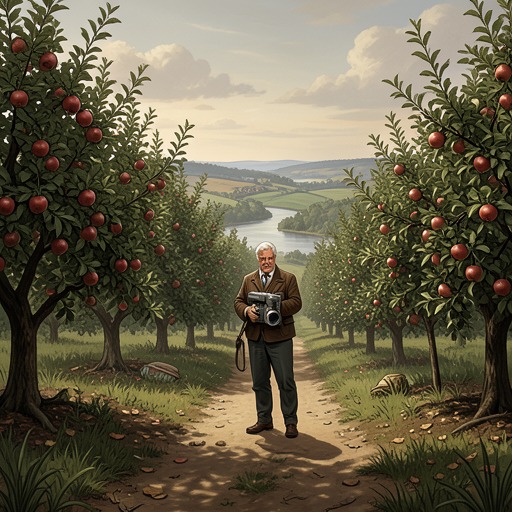
The Army’s order makes the possibility concrete. One afternoon, a letter from the adjutant general’s office in Washington directs Ben to report for active service in the 10th Mountain Division. He reads it twice, and his heart begins to pound. He then goes to find his father in the south orchard, where he is laying new irrigation pipe. The setting holds the decision against ordinary farm work: the Farmall has been hauling pipe, the day is clear, windless, and hot, and the orchard shade is pierced by the afternoon light. His father shuts off the tractor and reads the letter. His first response is only, “Well.” Ben tells him, “I'm all accepted.”
They lean against the Farmall while his father reads the order again. Afterward, he says, “I don't like this,” and “I don't want you to go.” He puts a hand on Ben’s shoulder and squeezes, then says that it does not seem right for Ben to go off to fight a war. Ben’s answer is that he has to go anyway. His father points out the fact that sharpens the exchange: “You're seventeen.” The enlistment is thus marked both by official acceptance and by the youth of the person being sent away.
Joining and the Coming Departure
The later conversation with another person reduces the decision to its plainest terms. Asked what he will do, Ben answers, “I joined up.” Asked when he goes, he says, “End of October.” The exchange confirms that the letter and the family conversation have become action: he has joined, and a departure is approaching. The evidence establishes the end of October as the time he expects to go, while the order itself is the formal instruction to report for active service.
The event’s emotional shape comes from the difference between Ben’s concise statements and his father’s repeated resistance. Ben says he has been accepted and that he has to go; his father says he does not want him to leave and needs him at home. Neither response cancels the other. The enlistment proceeds without a triumphant farewell or a reconciliation that makes the separation easy. Instead, the decision stands in the space between an obligation Ben accepts and a father who cannot accept its cost.
Retrospective Significance
The episode joins Ben’s mountain experience to the larger historical demands of war, but it also preserves the small, specific circumstances through which that history enters a family: a recruiting letter, an order read twice, irrigation pipe, a shut-down Farmall, and a hand squeezed onto a shoulder. The contrast between the Army’s formal language of active service and the father’s direct declaration of need gives the decision its human scale. The division offers Ben a chosen route into service; it cannot make that service any less a departure from the orchard and the people who depend on him.
The novel later shows Ben working in other demanding forms of care: assisting Ilse Peterson with surgery on Rex, assessing a seriously ill orchard worker while acknowledging the limits of what he can diagnose without equipment, and confronting an obstructed labor decades after his obstetric internship. Those later scenes do not establish that his military service caused his medical expertise. They do, however, place this youthful decision within the longer account of a life repeatedly called toward difficult responsibilities. At seventeen, Ben answers the call of war through the skills associated with the mountains; his father’s plea ensures that the choice remains, at its center, not an abstraction about service but a painful departure from home.