Ben Givens's terminal cancer diagnosis
East of the MountainsBen Givens's terminal cancer diagnosis is the decisive reversal that makes his professional understanding of mortality personal: the doctor who once treated failing hearts must now reckon with an illness he cannot cure and an ending he believes he can foresee.
Diagnosis and the Physician's Reversal
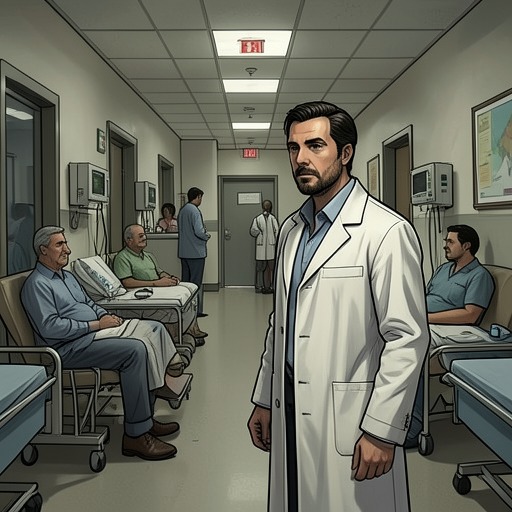
For years, Ben had approached medicine as a practice of intervention. His precise, powerful hands and confidence in his work had helped patients trust him, while a tactical focus kept him from feeling wholly responsible when they died. He understood that bodies were mortal and their hearts fallible, but death had remained something encountered in other people, at a distance. His own diagnosis broke that distance. Told that he had only months to live, he recognized the verdict not as an abstraction but as a prognosis he could neither treat away nor evade.
The Prognosis and Its Foreseen Course
The diagnosis was not merely a name for an illness: Ben understood its anatomy and its likely progression. The cancer had spread from the mucosa of his colon to nearby lymph nodes and then to his liver. His medical experience made the prospect unusually concrete. He imagined bedsores and broken bones, infection from a catheter, fluid drained from between his organs, vomiting, dehydration, weakness, cracked lips, difficulty swallowing, pneumonia, fever, and finally the sensation of strangling. In his forecast, he would dwindle to eighty-five pounds and gasp his last in a nursing-home bed; only then, he expected, would Bill Ward give him morphine through a drip to hasten death. The diagnosis thus brought not only a limited span of life but an anticipated sequence of bodily losses over which Ben believed he would have little control.
That forecast sharpened his distinction between being dead and the process of dying. He could sometimes imagine death itself as painless, like sleep, but regarded the passage toward it as a trial that might include pain beyond argument or endurance. He knew the counterargument: gradual dying could make ordinary details newly vivid, deepen love, and allow time for reflection. Yet he doubted that such consolations could withstand the worst pain, which he had seen patients endure and understood might overwhelm every reassuring idea. He did not consider the wish to avoid that suffering cowardly; to him, pain was indifferent to character or virtue, and endurance offered no simple proof of bravery.
From this reasoning came his decision to end his life before the disease could carry him through the course he feared. He saw suicide as a deliberate way to remove the pain and horror of dying, a rational choice among evils rather than a rejection of the fact of death. Still, his composure was unstable: he could briefly regard his end with calm detachment, then return to melancholy, estrangement, and the fear that he would regret leaving the world. The diagnosis made death certain in his mind, but it did not resolve how he should meet it.
The Diagnosis in Daily Life
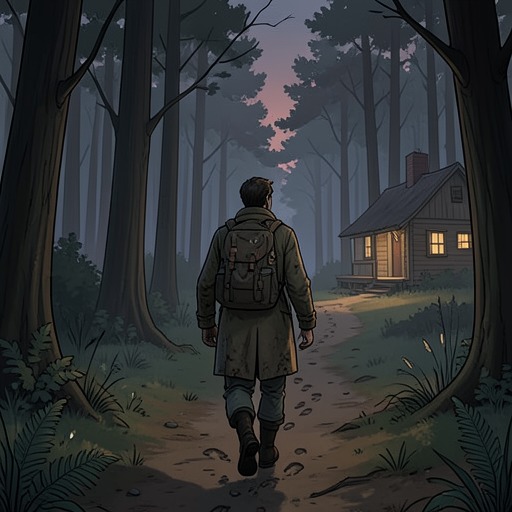
The diagnosis followed Ben into ordinary attempts at rest. In a motel room in Quincy, Washington, he massaged his side as if he could knead the cancer away; the pain in his gut was sharp enough to keep him awake. Seeking relief, he smoked a marijuana cigarette given to him by a drifter, but the altered state brought confusion and paranoia rather than certainty. He worried that the smoke would expose him to the police, opened the windows, and lit incense from a carton given to him by young travelers. Its long journey from Tibetan monks near the Sikkimese border to a motel in sagebrush country briefly seemed to him evidence of God’s reach, even as his own body remained beyond his control.
The illness also made his fear of death harder to keep beneath his habitual stoicism. In a fruit pickers’ hut, Ben felt the chill of death, though exhaustion, nausea, and marijuana left him unsure how much to trust his perception. The carabiner and piton against his chest—equipment designed to hold a climber to a rock face—became a measure of the difference between the young travelers’ romantic challenge to danger and his own knowledge of bodily decline. He searched again for a way to make leaving the world endurable, but found no answer; his days alternated between fear and brief intervals of calm, when work, love, or simple distraction drew his attention elsewhere.
In the motel, he turned from television to the Bible and read the Book of Job. Its account of suffering disturbed him: God and Satan seemed indifferent to their test, and Job’s eventual restoration, wealth, and new family felt too neatly happy until Ben remembered that Job still died. The reading did not settle the meaning of his illness. Instead, it sharpened the distance between a consoling story of recovery and the certainty he understood in his own prognosis.
The Earlier Lesson of an Incurable Illness
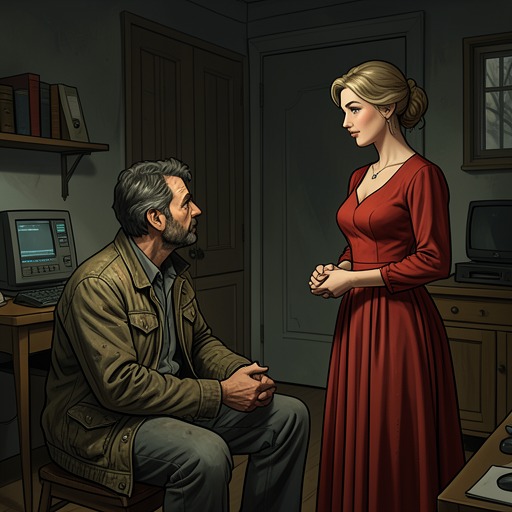
Ben had confronted the limits of medicine before his own diagnosis, when Dr. Williams told the family that his mother, Lenora Givens, had pancreatic cancer and could not be cured. Ben answered with the protest of a son who still expected a doctor to be able to intervene; Dr. Williams replied that a doctor was not a magician. The conversation then turned from cure to suffering: Ben’s father asked whether there was a limit to the opium, and Dr. Williams left the amount to a judgment about how much pain Lenora could bear and when it had become enough. The exchange offers an earlier, intimate counterpart to Ben’s later prognosis. Medicine could name the disease and ease some of its pain, but it could not promise rescue or supply a rule for deciding when suffering had gone too far.