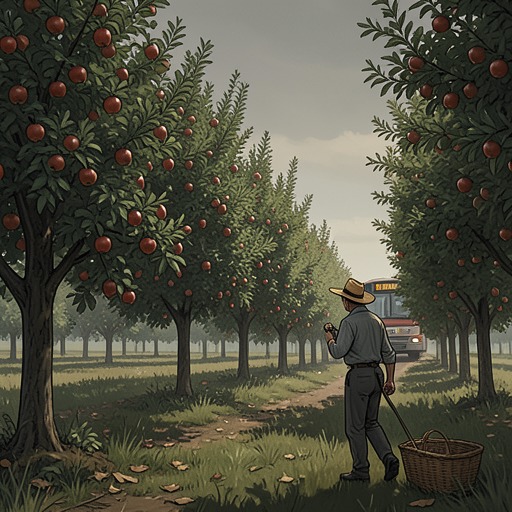
Ben and Emilio's journey to the Wolfhound orchard
East of the MountainsBen and Emilio’s journey to Wolfhound Orchard transforms a chance encounter into a chain of practical obligations: an injured, grieving doctor helps a young migrant find work, and the work site soon calls on that same doctor to assist a woman in labor. The route is marked not by a single revelation but by repeated acts of care, undertaken while Ben himself struggles to keep moving.
From Orchard Country to the Bus Station
Ben’s help for Emilio grows from a landscape and a kind of labor he already knows. As a boy, Ben worked in his parents’ orchards alongside Aidan Givens: making apple boxes, cleaning irrigation ditches, tending young trees, and thinning and supporting fruit-heavy branches. The seasonal cycle culminated in the August harvest. Migrant pickers arrived from across the country after following work north through successive crops; they brought families, bedrolls, and stories of a life shaped by travel and short-term labor. That childhood gives Ben a practical understanding of the work Emilio is seeking, rather than merely a general impulse to help.
At the Wenatchee bus station, Ben has already acted on his medical training. When Angel collapses coughing blood, Ben calls emergency services, identifies himself as a doctor, gives the operator the station’s location at First and Chelan, and explains that Angel needs immediate assistance. He directs the arriving technicians to the sick young man and communicates his concern about the symptoms. After the ambulance leaves with Angel and his brother, another boy remains behind with plastic bags. Ben’s own condition is poor: he is limping, burdened by his rucksack, and suffering from the effects of a recent car wreck. Yet he does not simply leave the stranger to manage alone.
The boy cannot speak English, and Ben cannot readily communicate in Spanish. Emilio conveys that he wants work picking apples, using gestures and a few words. Ben buys a Spanish travel guide and an English-Spanish dictionary, then studies them with Emilio on a sidewalk, trying to establish that apple harvesting is the job he means. Their exchange is halting, but it gives the encounter a direction: Ben can connect a request for work to a place and an employer.
A Meal, a Name, and a Job
Before making calls, Ben recognizes that Emilio is hungry and takes him to a restaurant on Wenatchee Avenue. He orders himself tea and Emilio a T-bone steak with fried potatoes. Emilio eats carefully and with evident dignity, while Ben struggles with the language books. He learns that Emilio is not the brother of the two boys who had been traveling with him; they had met while picking pears near Yakima and then gone on. Emilio has continued alone because he still wants work. He gives Ben only his first name. His employment card, however, bears the name Raul Ramirez, a detail that sits beside the limited story Emilio chooses to tell.
Ben does not press him for an account of how he became separated from others or what life he left behind. The silence is not a failure of the journey’s purpose: the immediate need is food and a chance to work, not a complete explanation of Emilio’s past. After the meal, Ben buys him apple pie and milk, then calls the Job Services Office. A job specialist explains that the harvest is nearly over and the available agricultural work will last only days. Ben keeps asking where Emilio can go and secures a referral to Wolfhound Orchard, where positions are available.
Back at the table, Ben explains the opportunity as best he can and opens a map of Chelan County. He traces the route to Malaga, down the west side of the Columbia on the Malaga-Alcoa Highway, repeating that there are apples to pick. Emilio understands. Their roles begin to shift: Ben has found the destination, but as they continue through town Emilio will carry both their bags when Ben’s pain forces him to stop. The assistance is no longer moving in only one direction.
The Road to Wolfhound Orchard
Ben rents a half-ton Ford despite his visible injuries and the clerk’s suspicion of the two travelers. The drive takes them through the Stemilt Hills, climbing a thousand feet above the river along switchbacks and tight turns. Orchards cover hillsides that had once held grapes, English walnuts, and pears. They pass fruit pickers’ camps, trailers, cabins, and a silent cherry-packing shed; farther on, workers stand on ladders in the apple rows. Ben points out the crop to Emilio, making the promised work visible in the landscape itself.
The journey costs Ben physically. At the community church he stops with the engine running because his side hurts too much for him to continue. Later, as evening deepens, he parks near Joe Miller Road and walks with one arm held across his abdomen. At Wolfhound Orchard, contractor Lyle Parmenter checks Emilio’s employment card and Ben’s identification. He notices Ben’s surname and asks whether he is related to the Givens family across the river. Ben denies the connection. Parmenter also doubts that an older man can handle picking, calling it young men’s work. Ben answers that age has taught him how to do the job correctly. The exchange makes the orchard a place where Ben’s own past labor is tested against his present, injured body.
The camp is part of the working conditions Emilio has entered, not just a destination on Ben’s map. Sanchez leads them along a dirt track past dark orchards, fire-damaged pear branches, a row of weathered cabins, a washhouse, and a large equipment shed. Beyond the pines, pickers’ trailers form a rough arc in a dusty field. The camp has a washhouse with hot water, showers, a heater, and a washing machine; it also has the close, shared atmosphere of a seasonal workplace. Ben collapses onto a bench, but dismisses Sanchez’s concern as indigestion. Emilio, by contrast, has reached the place where he can seek the employment he traveled for.
The Doctor’s Work Continues
That night, Emilio wakes Ben and urgently asks for a doctor. Sanchez explains that a woman in the camp is having a baby and that the child is stuck. Ben agrees to go with them. They cross the orchard beneath the stars, pass trailers where workers have gathered, and reach the woman’s trailer. The journey’s destination has become more than a source of wages: the doctor who brought a worker to the camp is now needed by the people living there.
Ben assesses the situation and sees that the baby’s head is showing. He tells the family that it is too late to reach a hospital and asks how hot the water is. The moment brings his medical identity into the foreground again, after he has already used it for Angel and accepted responsibility for Rex’s treatment earlier in his journey. In each case, care takes concrete form despite cost, fatigue, or pain: he calls for emergency help, stays to assist with Rex’s treatment, and now responds to the camp’s urgent request.
The journey therefore resists a simple division between helper and helped. Ben brings Emilio to work, but Emilio waits patiently when Ben must stop, carries their bags, and wakes him when someone needs a doctor. The orchard is both a return to a world Ben once knew through family labor and a new setting for service among migrant workers. His route ends not in withdrawal from other lives but in renewed involvement with them.