Columbia River
East of the MountainsThe Columbia River anchors the novel’s geography and its central environmental contradiction: the river that shaped Ben Givens’s childhood has been dammed and redirected to make the surrounding desert productive. Its changing waters connect family memory, agricultural labor, and a landscape transformed by irrigation, while Ben’s attachment to both the old river and the orchards built with its water leaves him unable to treat that transformation as either simple progress or simple loss.
Setting and the remembered river
Ben’s recollection of his birthplace begins with distance and time. Approaching Vantage, he points north upriver and tells Kevin Lamont that he was born about thirty miles away, beyond the canyon and around several bends, before there were dams. The river is therefore not merely a landmark along the road: it marks the difference between the country of Ben’s childhood and the altered terrain he sees in the present.
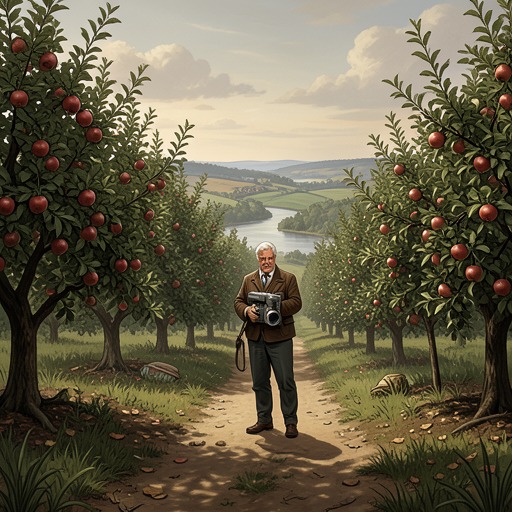
His family’s orchard stood on the river’s east bank. Lombardy poplars sheltered its carefully ordered rows, which descended toward the water; irrigation ditches, branch props, barns, sheds, and a farmhouse on a knoll made the river’s edge a working agricultural landscape. The Givens family cultivated thirteen acres of Golden Delicious apples, two acres each of Winesaps and Rome Beauties, and eight acres of cherries and apricots. The farm’s arrangement joined the river to the routines and infrastructure of cultivation: water ran through the ditches, while the trees and buildings occupied land once experienced as open country.
Orchard labor and seasonal abundance
The river country was shaped not only by irrigation but by repeated labor. Ben made apple boxes, tended the kitchen garden, split firewood, and milked cows; with his father and brother Aidan Givens he helped place pollinating hives and clear weeds from the irrigation ditches by hand. The work followed the seasons: young trees were planted or removed in spring, rows were disced in early summer, branches were supported and fruit thinned in midsummer, and pruning continued into fall and winter. The orchards’ apparent order depended on this sustained physical work.
Harvest made that dependence especially visible. On June 11, when the cherries ripened early, Wright Givens set the picking day. Ben, his father, and nine migrant workers, including the Emery family and its children, gathered at first light; Rachel Lake, Mrs. Emery’s niece, had come from Waterville, Maine, to stay for the harvest. Pickers were assigned trees, buckets, and ladders. Ben stripped the cherry limbs carefully, preserving the stems, as the fruit filled the buckets and crates. The day ended when the afternoon heat softened the cherries: the family and workers loaded the fruit and took it to the siding for pickup by the Consolidated Cherry Packing Company.
In the later harvest landscape, the scale of the work remains visible along the river. Near Wenatchee, Washington, apples fill the orchards and haul trucks, while pickers carry canvas bags and tractors move bins between rows and sidings. The labor is also present in less settled spaces: fruit pickers squat in makeshift camps by the river, with children nearby. The agricultural abundance associated with the river thus appears alongside the migrant workers whose work sustains it, and whose living conditions are not equivalent to the prosperity of the apple-growing town.
Dams, irrigation, and ecological change
The present-day river appears in sharply altered forms. At Vantage, Wanapum Dam holds the water back into a still green lake; farther along the route, the bus passes Rock Island Dam and the Rock Island industrial landscape. Near Wenatchee, Washington, the river is described as a broad, frothing lake, its surface broken by wind-driven whitecaps. These scenes place dams and industry within the same working region as the orchards, making the river’s altered course part of the ordinary infrastructure of local life.
Ben sees the consequences most clearly on the road north. The country he remembers as sagebrush waste, coulees, and willow draws has become fields of seed peas, potatoes, alfalfa, peppermint, and wheat, as well as orchards. Water that once ran in the riverbed has been diverted across the land and into the soil around crops. The change is so comprehensive that his remembered categories no longer seem to fit: the river has ceased to be simply a river, and the desert is no longer simply desert.
That transformation is not presented as the work of a single villain. Ben recognizes that he helped burn the sage country and that farmers like his father took the river for granted, believing it belonged to them and acting within the assumptions of their time. He understands both the appeal of the orchards and the damage bound up in their water supply. The river’s defeat enables apples to grow far from its former course, but Ben cannot reconcile that use with his love for the free-flowing river—or with his affection for small birds and the practice of shooting them over pointing dogs. His memory exposes the moral tension inside a way of life he inherited and helped sustain.
Return and the land’s limits
The Columbia River also gives Ben a precise destination for his intended death. He seeks a place near the river beyond Quincy, across Babcock Ridge and the mouth of Lynch Coulee, upriver toward Rock Island. The route is described through local landmarks, but its purpose is stark: he wants to end his life in the country where it began. The river country carries both the promise of return and the weight of his despair.
By the novel’s closing journey, Ben has chosen to go home with Rex rather than continue toward that intended end. On the road to George, irrigators stand in the fields, but the cultivated land strikes him as fertile only provisionally. The boundary between field and desert is abrupt; beneath the crops lies the arid plateau, and if the water stops arriving, the crops will die. This final view does not erase the orchards’ beauty or the labor they require. Instead, it makes their dependence on diverted water visible, placing the landscape’s abundance beside its fragility.
The river therefore holds together what Ben’s journey repeatedly tries to separate: birthplace and destination, sustenance and depletion, memory and change. Its waters support the harvest that defined his family’s life, but their redirection has altered the country he remembers. Ben’s return does not resolve that contradiction; it brings him back to a place where love of the cultivated land and grief for the river remain inseparable.