Doris Perez's difficult labor and the baby's birth
East of the MountainsDoris's difficult labor and the birth of her daughter become a test of Ben's medical identity at the Wolfhound Orchard: decades after his obstetrics training, and far from a hospital, he must turn incomplete knowledge into urgent practical care. The episode moves from uncertainty about whether he can help to a successful delivery, while preserving the limits of what he can do for Doris and the newborn afterward.
The Call for Help
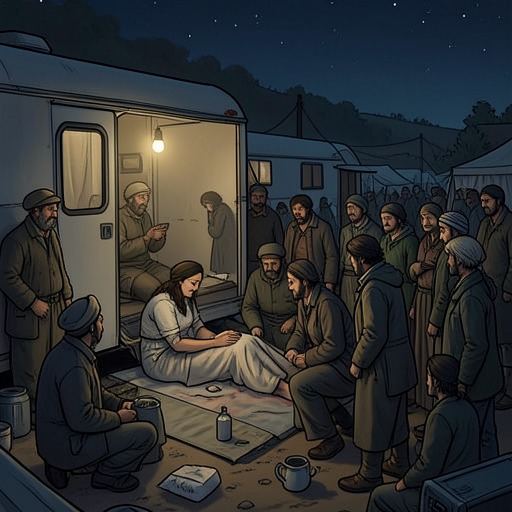
Ben is awakened by Emilio, who repeatedly calls him señor and asks urgently for a doctor. Sanchez, the field boss, explains that a woman in the camp is having a baby and asks whether Ben can do anything. Ben agrees to go with him. The request arrives in an improvised setting: the people around Doris have no professional attendant available, and her labor is already underway.
In the trailer, Ben finds Doris laboring while several people try to help. Jimmy Perez is beside her; another woman speaks urgently in Spanish, and a short woman prepares hot water at a propane stove. Their presence makes the scene a shared effort, but no one else claims the medical knowledge needed to manage the birth. Ben's first response is not to pretend certainty: he asks whether the woman at the stove is a midwife, and she says she knows nothing.
Experience and Its Limits
Ben pauses with a hand to his forehead as he confronts how long it has been since he last attended a birth. He had assisted with deliveries for six weeks during his obstetrics internship in 1954, forty-four years earlier. He calls for an ambulance and says Doris needs a hospital. This is both a recognition of his limitations and an attempt to get her the care he cannot provide in the trailer.
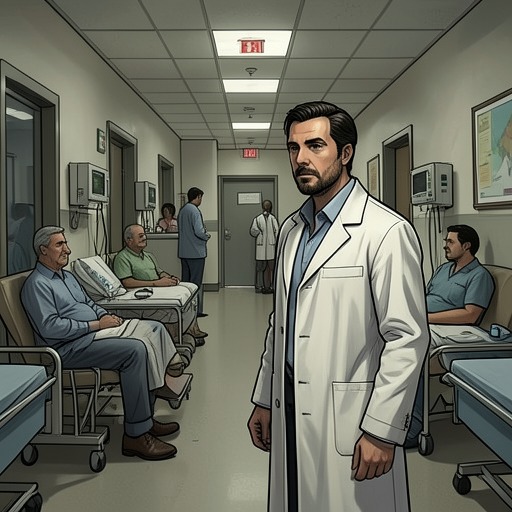
That caution belongs to a broader pattern in the episode's surrounding medical encounters. Ben has recently assisted Dr. Peterson with surgery on Rex, despite having spent his career repairing human hearts rather than treating dogs. Earlier, asked to assess a sick orchard worker, he calls the illness a mystery and lists tuberculosis or pneumonia as possibilities among many infections; he stresses that he cannot diagnose or treat the man without even a stethoscope, and advises a hospital visit. In each case, Ben distinguishes a willingness to help from the claim to possess resources or certainty he lacks.
With Doris, the situation changes when Ben sees that the baby's head is showing. He tells Jimmy that it is too late to go to the hospital. The decision is no longer whether to deliver Doris in the trailer, but how to do so as safely as he can with the people and supplies present. His old training cannot restore the missing hospital, ambulance, or equipment. It can, however, guide his attention to what is happening and what must be done next.
The Delivery
As the birth becomes imminent, Ben watches the progress and tells those around him that the baby is coming. The delivery does not proceed easily: the child is stuck at the shoulders and is not breathing. Ben searches for a way to free the baby, using his hands to find the position of the arm and gradually release the shoulder. His actions are difficult for Doris, but he continues because the baby must be delivered. The scene presents medical care as immediate responsibility under pressure, not as mastery or ease.
The baby finally emerges, a girl. Ben catches her and works to stimulate her breathing: he clears her mouth, blows on her face, turns her, flicks her feet, and pats her back. She begins to move and make small cries, and her color improves. Jimmy crosses himself; the people present respond with relief and wonder. Ben remains trembling, a bodily sign that the outcome has not been emotionally or physically effortless even though the delivery has succeeded.
He then swabs the baby and places her, covered, on Doris's belly. When a sharp knife and twine are requested, Sanchez supplies a folding blade and Ben sterilizes it with rubbing alcohol. He ties the umbilical cord in two places before cutting between them. He checks that the placenta has been delivered and examines the baby again; she is nursing vigorously. These practical steps extend the scene beyond the dramatic moment of birth into the work of making sure mother and child are cared for afterward.
Aftercare and Significance
Ben checks Doris's lower abdomen and finds that her uterus has contracted; he sees no immediate danger from bleeding. He does not treat that assessment as a substitute for professional follow-up. He tells Jimmy to take both Doris and the baby to a doctor as soon as Doris has rested, pointing them toward a clinic in Wenatchee and noting that Doris needs stitches. His advice acknowledges what the successful delivery cannot resolve: the need for continued medical care in a community where access to it is not immediate.
When Sanchez later reports that mother and baby are sleeping, Ben asks what they named the child. Sanchez answers, Ellen Dolores. Ben again asks him to remind the family that both mother and baby should see a doctor. The name and the report of rest give the episode a quiet aftermath, but not a claim that all risks have passed; Ben's final concern remains follow-up care.
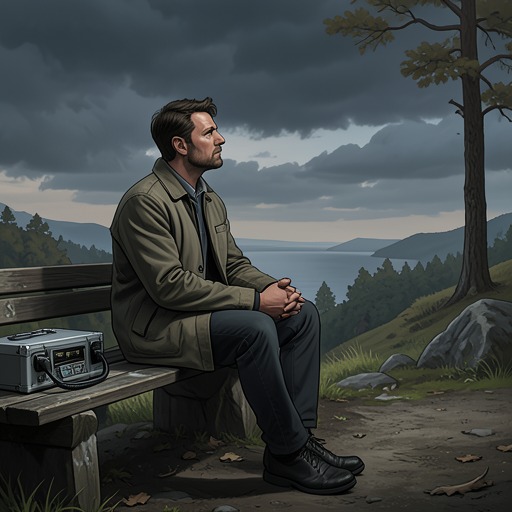
The episode's decisive change is from a request Ben might have refused on grounds of distance and age to an emergency he must meet because transfer is no longer possible. His medical past returns not as unquestioned authority but as a limited resource: he has not attended a birth in decades, lacks the setting and equipment of a hospital, and still has to act. The birth also contrasts with his earlier intention to die in the sage country. At a moment when he had expected his own story to end, he is called into another family's crisis and helps bring a child into the world. The episode does not erase his own suffering; it places that suffering beside a concrete act of care and an obligation that continues after the immediate emergency.