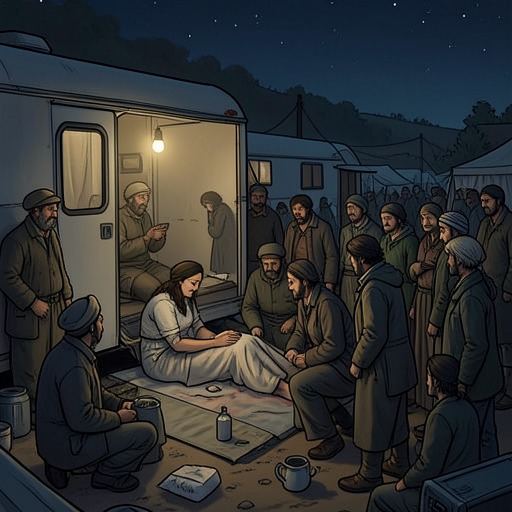
Doris's obstructed labor
East of the MountainsDoris's obstructed labor turns a request for medical help into an immediate responsibility for Ben Givens: after learning that she has been in labor for more than twenty-four hours, he initially calls for an ambulance, but the baby's progress makes a hospital transfer impossible. With no recent experience in childbirth and no obstetric equipment described, he must act on what he can see and recall. He delivers a girl, whose shoulders are stuck, by finding and freeing her folded arm. The episode brings Ben's medical identity back into practice under pressure, while leaving the newborn's later condition unstated.
Prolonged Labor and Limited Help
Ben first asks how long Doris has been in labor. The answer is more than twenty-four hours. The woman with her says she knows nothing about assisting with birth, leaving Ben without an experienced attendant to guide what happens next. His response is to seek hospital care rather than assume that he can manage the situation himself: he says that an ambulance is needed and that Doris should go to a hospital.
The time elapsed matters because the labor is already advanced. Doris bears down, and Ben sees that the baby's head is showing. He tells Jimmy Perez that this means it is too late for the hospital. The change is practical and immediate: what had been a plan to transfer care becomes a birth he will have to manage where Doris is. The narrative does not identify a failed ambulance response or explain why an ambulance cannot be used at that point; it makes the visible progress of labor the reason Ben gives for recognizing that transfer is no longer possible.
Ben's Uncertain Authority
Ben's hesitation reflects a real limit in his experience. He had not attended a woman in labor since his internship, forty-four years earlier. In 1954, he had spent six weeks assisting with deliveries, but that distant training is not presented as equivalent to current obstetric practice. He pauses with a hand to his forehead before calling for the ambulance, and later does not immediately answer when asked what he can do. He is not introduced as a specialist in childbirth, and the scene does not turn him into one; instead, it follows his shift from seeking help to responding to an emergency already underway.
That shift belongs to a larger return to medical work. After Ben's car crash and his journey through the sage country, he treated Rex's wounds in the field, using gauze and his medical kit before a veterinarian later performed further surgery. At the Greyhound station, he called emergency services for Angel, a seriously ill young man, and urged that Angel receive hospital care. These episodes differ in circumstance, and Doris's labor is not simply another treatment task: it leaves Ben with an urgent decision about a birth he cannot transfer. Together, they show his knowledge being used imperfectly but concretely, in situations where another person's need interrupts his intended withdrawal from life.
The Birth
Once Ben sees that the baby's head is showing, he turns to the practical conditions at hand and asks how hot the water is. As Doris continues to push, he watches the baby's head emerge, but the delivery stops at the shoulders. The newborn is not breathing, and Ben understands that time is critical. The account keeps the focus on his response: he positions Doris's knees toward her body, tries to release the obstruction, and searches for a way to free the baby without delay.
When his initial efforts do not work, Ben reaches inside to locate the baby's arm, which is folded across her collarbones. He finds the elbow, draws the small hand into reach, and uses a gradual release of traction to free one shoulder; the other follows more easily. The girl then slides free. The difficult delivery is thus resolved not by a sudden intervention from outside, but through Ben's sustained effort to identify what is preventing the birth and adjust his approach. Jimmy Perez has feared the baby is dead; Ben insists otherwise, and the newborn is delivered alive enough for him to announce that there is a new baby and identify her as a girl. The text does not establish what happens to her health afterward.
Significance and Limits of the Outcome
Doris's labor makes care more than a matter of professional title. Ben's earlier insistence that Angel needed a clinic or hospital recognized the limits of treating a seriously ill stranger without equipment; here he first makes the same appeal for hospital care, then confronts the point at which that option is no longer viable. His actions do not erase the long gap since his obstetric internship. Rather, the scene holds that limitation beside the obligation to act when the situation changes faster than help can be arranged.
The birth also marks a contrast with Ben's stated intention, elsewhere in the journey, to die in the sage country. His medical attention has repeatedly been drawn toward vulnerable others: first Rex, then Angel, and now Doris and her child. This is not evidence that his own crisis has simply disappeared, nor does the account give a complete aftermath for Doris or the newborn. Its decisive change is narrower and concrete: at the moment when transfer is too late, Ben takes responsibility for the delivery, and a girl is born.