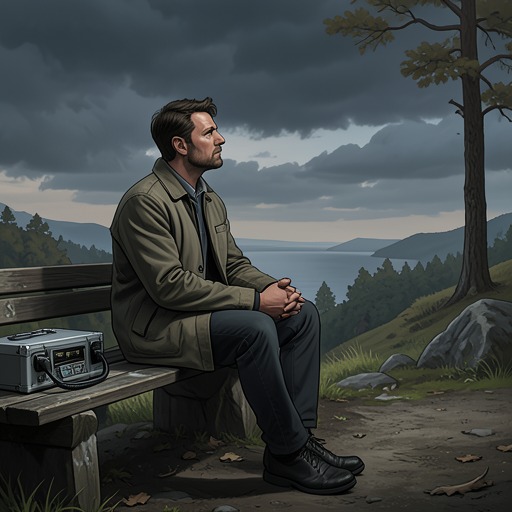
Dr. Williams
East of the MountainsDr. Williams is the Givens family’s longtime physician, a familiar presence across generations whose skill cannot save Ben Givens and Aidan Givens’s mother from pancreatic cancer. He is both a working country doctor, accustomed to tending injuries and illness, and the bearer of a prognosis no treatment can change. His defining scene is not a triumph of medical power but an act of difficult honesty: he explains what medicine cannot do, then stays with the family as care becomes a question of how much suffering can be eased.
Identity and Place in the Family
Dr. Williams’s place in the family is established through the accumulated intimacy of ordinary medical work. He brought Ben and Aidan into the world, treated their father for a rattlesnake bite, and stitched Aidan’s hand after an apple-box accident. These episodes make him more than an outside consultant delivering a diagnosis: he has accompanied the family through birth, injury, and everyday danger. That long familiarity gives his words weight, while making the news he brings especially painful.
The narrative renders him through a few concrete details: he is tall, wears thick glasses, and has a long, prominent jaw. In the parlor after tending to Ben’s mother, his sleeves remain rolled up; he warms his back by the fire and holds a snifter of brandy. The tired doctor sets the glass on the mantel, looks out toward the dark hills, presses his glasses against his temples, then removes and polishes them. These gestures delay the conversation without concealing its purpose. He finally asks the boys to sit down and tells them their father has asked him to speak because their father cannot manage it himself.
The Diagnosis and Its Limits
Dr. Williams names the facts plainly. The family has learned in Spokane that Ben’s mother has a tumor, pancreatic cancer, and that there is no cure. Ben challenges the message by pointing out that the speaker is a doctor. Dr. Williams does not answer with a technical explanation or promise further intervention; he distinguishes medical learning from magic, saying, “A doctor isn't a magician, you know. I wish I was, believe me, Ben. If I was, I'd cure your mother.” His response acknowledges both the authority Ben expects him to wield and the human wish behind that expectation.
The admission is reinforced by the treatment already underway. Ben’s mother has little appetite, is sickened by the smell of food, and suffers fever, chills, and vomiting. Dr. Williams visits twice a week to bring more tincture of opium. After blood trickles from her mouth, he comes at midnight, gives her a sponge bath, and shows Ben’s father how to move her carefully and change the sheets one side at a time. He increases the opium dose; she quiets. The work is modest in relation to the illness, but precise and bodily: easing discomfort, helping with care, and guiding the family through tasks they must now perform themselves.
Care and the Burden of Choice
The limits of Dr. Williams’s authority become most exposed in the conversation about opium. Ben’s father asks whether there must be an amount that is too much. Dr. Williams replies that it is for him to decide, a question of how much pain his wife can bear and when enough is enough. The answer neither gives the husband a simple rule nor pretends that the medical decision can be separated from the family’s anguish. It leaves him facing the measure of suffering directly.
When the father says he does not know how far the decision goes or what it means, Dr. Williams answers, “I know just what you're saying. That's the hell of it.” The line does not resolve the dilemma; it recognizes it. His response matters because he neither disguises the uncertainty with professional confidence nor withdraws from the family’s distress. In this scene, care includes candidly naming the painful responsibility that remains when medicine can relieve symptoms but cannot cure the disease.
Narrative Role and Significance
Dr. Williams’s role in the episode is at once clinical and familial. He reports the diagnosis, administers and adjusts the opium, teaches Ben’s father how to care for a failing body, and gives the sons the news their father cannot say aloud. The sequence moves from medical fact to intimate labor: cancer is incurable, but the patient still needs to be washed, turned, comforted, and cared for. His authority operates within that distinction rather than overcoming it.
The scene also places the physician beside the family without making him responsible for deciding what no one can decide easily. The women who help during the day and the family members who take over after work in the orchard form a wider circle of care; Dr. Williams’s visits and instruction are part of that effort, not a substitute for it. His significance lies in holding together knowledge and helplessness: he can identify the disease and offer relief, but he cannot promise recovery or spare the family the consequences of choosing how to ease their mother’s final suffering.