Frenchman Hills
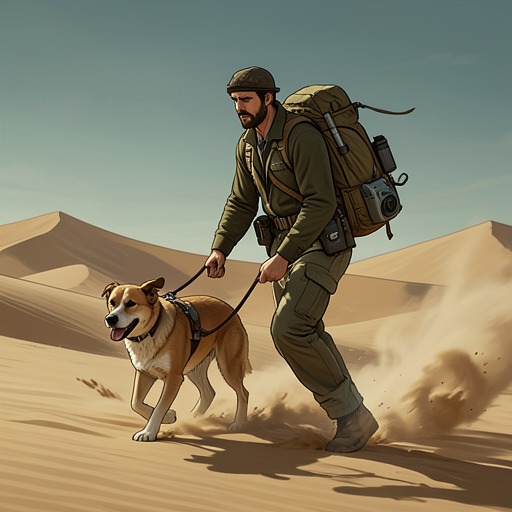
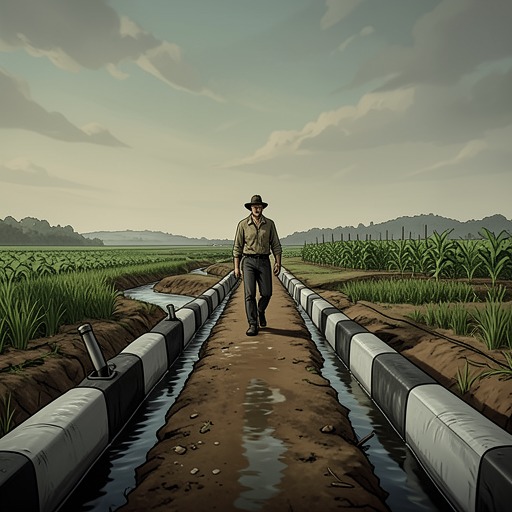
East of the MountainsFrenchman Hills is a landscape of sage, prairie, draws, and working farmland that becomes the setting for Ben Givens’s arduous journey with his dogs. Its open distances and hidden ravines first draw him into a nighttime chase; its fields, roads, and canals later guide him toward George, Washington, with the injured Rex carried on his back. The passage through the hills makes the border between desert and agriculture both a geographical fact and a lived test of endurance.
Landscape and the Orchard Boundary
The hills belong to a country where cultivation gives way to open desert. Elsewhere in Ben Givens’s childhood landscape, his parents’ orchard occupied the east bank of the Columbia River: rows of Golden Delicious, Winesaps, Rome Beauties, cherries, and apricots descended toward the river, sheltered by Lombardy poplars. The farmhouse stood on a knoll among elms and willows, with sage fragrance and wind in the trees. At the orchard’s edge began a different world of buttes, coulees, unnamed canyons, and arid expanses. Frenchman Hills lies within the narrative’s return to this alternation of cultivated ground and wild country.
The orchard was not simply scenery. Ben’s work followed the seasons: making boxes, milking cows, clearing weeds from irrigation ditches, planting and removing trees, disking between rows, thinning fruit, supporting branches, picking, and pruning. When the cherries ripened early, Wright Givens set June 11 as the start of the harvest. Ben, his father, migrant workers, and their families picked among ten thousand trees; Rachel Lake, newly arrived from Waterville, Maine, joined them in borrowed work clothes. The labor of harvest gives the irrigated landscape a human rhythm that contrasts with the hills’ exposed distances.
Night Pursuit in the Sage
During Ben’s passage through the hills, a coyote flashes across the moonlit sage, and his dogs race after it. Ben takes up his father’s side-by-side shotgun and follows, although the gun recalls both his earlier suicide attempt and his growing regret about the weapons he has carried. On the open prairie, he moves by moonlight and starlight, as he once moved as an infantryman in Italy. His left knee tightens; wheel ruts offer easier walking, but their hairpin turns confuse his sense of direction as the hounds’ cries mingle with the barking of his own dogs.
The pursuit brings him to a draw choked with sumac and willows. He believes the coyote has found cover while the hounds tear through the brush to drive it out. From the lip of the draw, Ben calls for Tristan and Rex, alarmed when neither comes to him. The coyote bursts from the thicket and escapes into the sage; then wolfhounds charge after it. Among the pack Ben sees Rex. The ravine turns the hills’ apparent openness into a trap of tangled cover and unseen danger, and the chase becomes a search for his own dog as much as a confrontation with the pursuit of wild animals.
Crossing Toward George
After the night’s ordeal, Ben studies his compass and estimates that a route shading northeast will take him to a section road or the West Canal, then onward to George, Washington. He reckons the destination may be ten miles away and knows the journey will take most of the day, especially with Rex to carry. He makes a sling from his blanket, lifts the dog over one shoulder, and sets out under rain clouds, adjusting the load to spare Rex pain. The distance is measured not only in miles but in pauses for breath, a strained back, and the effort to continue when rest threatens to become permanent.
The terrain changes as Ben leaves the sage and crosses a vast fallow field toward power pylons, keeping the river bluffs behind him to the southwest. He passes a stack of rotting hay bales under black tarpaulins, then reaches wheel ruts and signs restricting hunting to permitted or leased land. Their warnings confirm that he had trespassed the previous night. Beyond the hills, the cultivated plateau displays wheat fields, trellised Gala apples, and rows of Red Delicious trees trained in umbrella shapes. When he finds a branch canal, he treats its water with iodine before drinking and gives Rex water from his palm along with the remaining chukar meat. The agricultural landscape provides a route and water, but not ease: Ben must cross it exhausted, carrying the consequences of the night with him.
The Hills in the Wider Orchard Country
Later, on Joe Miller Road, Ben passes orchards busy with the apple harvest: pickers work from ladders, fill bags, and ease fruit into bins; tractors move bins to the sidings, while children rest in the grass and dogs lie among the rows. He asks a woman for directions to Wolfhound Orchard and continues toward the Hardens’ property. This harvest scene recalls the ordered, labor-intensive orchards of his upbringing, while the earlier crossing of Frenchman Hills has shown how quickly that cultivated order can give way to exposed sage, rough tracks, and uncertain passage.
Frenchman Hills therefore links two recurring landscapes in Ben’s life without making them interchangeable. The orchard is shaped by seasonal work and the careful handling of fruit; the hills demand navigation, endurance, and care for a wounded animal. In the desert Ben follows the hounds because he cannot abandon his obligations to Tristan and Rex; on the road beyond it, carrying Rex becomes the concrete expression of that duty. The hills’ narrative force lies in this passage from pursuit and danger toward the worked, inhabited country where Ben’s journey can continue.