Givens Family Orchard
East of the MountainsThe Givens Family Orchard is both a productive family farm on the east bank of the Columbia River and the landscape through which Ben Givens’s earliest memories take shape. Its cultivated abundance depends on precise, persistent labor and on water redirected into the dry country. The orchard is at once a place of livelihood, family inheritance, and intimacy—and a reminder that the fertile landscape was made by transforming the river and the desert.
Setting and Layout
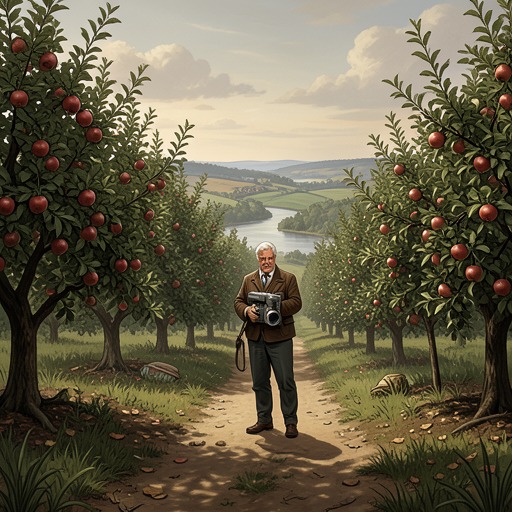
Ben’s parents planted the orchard in rows that descended toward the Columbia River, sheltered by Lombardy poplars. The farm’s scale and variety are carefully specified: thirteen acres of Golden Delicious apples, two of Winesaps, two of Rome Beauties, and eight acres of cherries and apricots. Irrigation ditches ran among the trees, where quack grass grew thick and props leaned against the forked limbs that would bear the weight of fruit.
The orchard was part of a larger working homestead. A weathered shed served for making boxes and packing apples in oiled tissue; nearby stood a hay-filled barn, a stable, a chicken house, an outhouse, an icehouse, and a small-well pump house. The farmhouse occupied a knoll among shade elms and willows. Beyond it, the setting sun bronzed the western hills, while sage scented the house and the wind moved through the trees throughout the year. The cultivated rows ended at the desert: buttes, coulees, canyons, and expanses of sage country. That abrupt meeting of orchard and arid land makes visible how much the farm’s greenery depended on water and labor.
A Calendar of Work
The orchard’s abundance is not effortless scenery; it is the result of work repeated through the seasons. Ben made apple boxes from pine shook, weeded the kitchen garden, split firewood, and milked cows twice daily. In spring he helped his father and Aidan Givens put out pollinating hives. When weeds clogged the sluice gates, Ben and Aidan stood in the ditches to clear them by hand. They planted windbreaks and pollinating trees, set new trees in April and May, and pulled out finished ones.
The work continued as the fruit developed. In early summer the family disced between the rows to keep mice away from the orchard. In July, they put spreader sticks in yearling trees and strapped the branches back. Through midsummer, they thinned fruit and propped or secured branches so they would not crack under the apples. August brought picking; fall and winter meant pruning and burning piles of water sprouts. This cycle ties the orchard’s harvest to practical knowledge of trees, water, and timing, as well as to repeated bodily effort. The same landscape that can appear serene in memory is also a workplace whose tasks extend across the year.
Harvest and Family History
One cherry season began early: Wright Givens set June 11 as the first day of picking. At first light, the pickers gathered by the siding. Ben and his father worked alongside nine migrant workers; the group also included the Emerys’ four young children and Rachel Lake, Mrs. Emery’s niece, who had come from Waterville, Maine, to stay for the harvest. Rachel arrived without suitable work clothes and wore denim pants and a flannel shirt borrowed from Mrs. Emery.
Wright assigned each picker trees, a bucket, and a ladder. Ben stripped cherries from the branches, clearing leaves from his bucket and taking the fruit with its stems intact. Beneath the trees, the sound of cherries striking the buckets gave the harvest its own rhythm. The scale of the work stretched far beyond a single day: ten thousand trees and successive weeks and months of fruit, until the motions and crops followed the workers into their dreams. When the heat made the cherries soft, Wright called off picking. The family and workers loaded the fruit onto a flatbed truck and lined the boxes up at the siding for pickup by the Consolidated Cherry Packing Company.
The orchard also provides the setting for Ben and Rachel’s first sustained encounters. During cherry season he sees her picking high among the branches and later riding a horse through the sage toward a plateau. When they begin working side by side, Rachel has returned from Wenatchee in clothes that fit; the shared task of cleaning leaves from cherry crates gives their first conversation an ordinary, workaday setting. Later, in the apple rows, the two take a picnic basket into the shade and sit among trees heavy with fruit. As evening deepens, the orchard becomes a place for conversation and growing closeness. Its harvest-time labor and its quieter spaces belong to the same landscape.
The Orchard and a Changed River Country
The orchard’s green rows stand in tension with the dry country around them, and Ben’s later reflections make that tension explicit. On the journey back toward the Columbia, he sees fields and orchards where he remembers sagebrush, coulees, and willow draws. Irrigation has redirected the river across the land and into crops; the river of his youth no longer runs as it once did. Ben recognizes that his father and other growers claimed the water without intending harm, but that the fruit-growing economy and the old river cannot be reconciled without loss. His attachment to apple orchards exists alongside his recognition that their expansion helped defeat the river and replace the desert.
The later agricultural landscape preserves signs of both productivity and strain. Near Wenatchee, the buses and roads pass orchards crowded with pickers, loaded haul trucks, and fruit awaiting transport. Yet the orchards coexist with industrial sites, dams, and makeshift camps where migrant workers stay. On the road to George, Ben sees irrigators set in fields and sharp boundaries between cultivated land and steppe. The crops depend on water that may not always arrive; without it, he reflects, they will die of thirst. The orchard’s abundance therefore cannot be separated from the engineered water system that sustains it or from the arid land it has displaced.
Narrative Significance
The Givens Family Orchard joins family memory to the material history of the Columbia Basin. Its detailed inventory of varieties, buildings, tools, and seasonal tasks gives the farm a concrete identity, while the recurring harvest connects childhood labor to adult recollection. The orchard is also where Ben’s relationship with Rachel takes root: first through the work of picking cherries, then in the intimacy of evenings among apple trees.
At the same time, the orchard resists a simple pastoral ideal. Its fruit is gathered through a demanding annual cycle and by a workforce that includes migrant laborers; its green abundance depends on a river redirected into agricultural use. The place Ben loves is inseparable from the changes he mourns. That doubleness makes the orchard more than a remembered home: it is the landscape in which labor, attachment, and ecological cost meet.