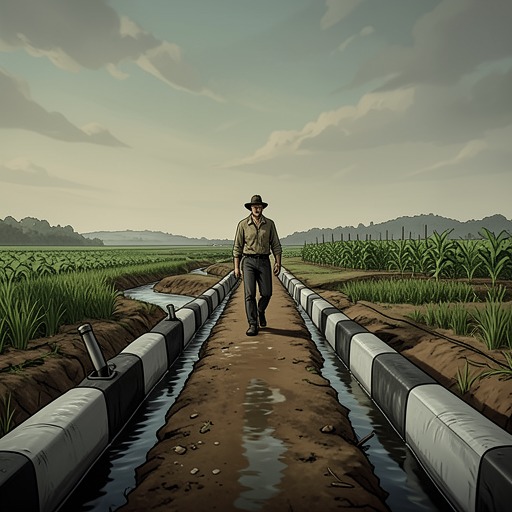
Irrigated Agriculture's Transformation of Rivers and Desert
East of the MountainsIrrigated Agriculture's Transformation of Rivers and Desert describes a landscape remade for cultivation and the personal history entangled in that change. Dams and diverted water make orchards and broad fields possible where Ben Givens remembers sagebrush, coulees, and a fast-flowing river. The resulting abundance is real, but so is its cost: the river is subdued, desert habitat is removed, and Ben sees that the values of his inherited way of life cannot be reconciled without tension.
The River Country Before and After the Dams
As Ben travels over Ryegrass toward Vantage, the land opens into long, barren slopes descending toward the Columbia River. Across the water, the distant breaks shimmer in October sunlight; nearer the road, the river is held behind Wanapum Dam as a still, green lake. The view places the river’s earlier force and its engineered present in the same frame. Ben says he was born about thirty miles upriver, before any dams existed, locating his own beginnings in a landscape already altered by the time he revisits it.
That remembered country was not simply empty land waiting to be cultivated. Ben recalls sagebrush wastes broken by coulees and willow draws, with the river running in its bed. On the road north toward Quincy, Washington, he sees seed peas, potatoes, alfalfa, peppermint, and wheat, along with walnut trees and a feed lot. What he recognizes as his childhood landscape has been converted into fields and orchards: diverted river water now seeps into the ground to reach crop roots rather than continuing along its former course. The geographical change is also a change in what the land is for.
The Orchard as a Working Landscape
Ben’s parents planted apple trees on the east bank of the Columbia River. Their orchard combined rows of Golden Delicious, Winesaps, Rome Beauties, cherries, and apricots with irrigation ditches, Lombardy poplars, branch props, and buildings for packing and storage. The farm also included picker shanties, a barn, a stable, a chicken house, an outhouse, an icehouse, and a pump house. This detailed inventory makes cultivation a whole system of water, trees, equipment, shelter, and labor rather than a picturesque view of fruit-bearing branches.
Ben and Aidan Givens learned that system through recurring physical work. They made apple boxes, tended the kitchen garden, split firewood, milked cows, and helped place pollinating hives. When weeds blocked the sluice gates, they cleared the irrigation ditches by hand. Across the seasons they planted and removed trees, disced between rows, tied young branches, thinned fruit, propped limbs, picked, pruned, and burned water sprouts. The orchard’s yield depended on repeated maintenance, and the family’s intimate knowledge of the land grew through that labor.
The harvest also depended on workers who arrived from elsewhere. In June, Wright Givens set a date for the cherry picking, and the crew gathered at first light: Ben, his father, nine migrant workers, the Emery family and its four young children, and Rachel Lake, Mrs. Emery’s niece, newly arrived from Waterville, Maine. Assigned trees, ladders, and buckets, they picked until cherries struck the bucket bottoms like hail. Ben worked carefully to remove fruit with its stems intact; the account’s vast imagined scale of trees and successive harvests ties the orchard’s abundance to the hands required to gather it. The agricultural landscape is therefore also a labor landscape, organized around seasonal work and the movement of pickers.
Cultivation Across the Plateau
During Ben’s later journey, the cultivated region appears as an expanding patchwork of fields. A fallow field, power pylons, hunting-permit signs, and leased hunting land mark the limits and management of access. From the Frenchman Hills, Ben sees disced fields and standing grain corn, Gala apples trained on spindle-shaped trees, and Red Delicious trees arranged in open-centered forms, with branch props stacked nearby. The orderly rows and specialized growing methods contrast with the open, unplanted country he has crossed. Even water for drinking now comes from a canal he considers unsafe except in desperation, treated with iodine before he and Rex can use it.
The broader transformation is visible again on the bus past Rock Island Dam, a silicon plant, and an aluminum smelter. Cherry trees stand bare while apple orchards carry heavy crops; pickers fill bags, tractors move bins, and loaded trucks travel the roads. The river is described as a broad, windblown body of water among dams and industrial development. Near Wenatchee, Washington, fruit production coexists with a less prosperous side of the harvest economy: the former apple-filled rail yard is now little used, while pickers live in makeshift camps beside the river. The landscape’s agricultural productivity does not erase the uneven circumstances of the people who work in it.
Inheritance and Ecological Contradiction
Ben does not place responsibility for the changed landscape on an alien group. He knows that he helped burn the sage country himself. He understands his father’s generation as people who claimed the river for irrigation and fruit growing without intending evil, but who were confident in their entitlement and limited by the assumptions of their time. Their actions made orchards possible far from the river; they also helped defeat the free-running river and remove the sage country that Ben remembers.
That history becomes a conflict within Ben’s own attachments. He believes in both the old river and the apple orchards, yet he recognizes that growing apples through the river’s diversion conflicts with loving the river as it was. He sees a related contradiction in loving small birds while shooting them over pointing dogs. The comparison connects irrigation and hunting as practices that make use of a living landscape even when affection for that landscape persists. Ben cannot simply shed these inherited habits, any more than he can shed his name. His reflection is not a declaration that the earlier life was innocent; it is an account of how belonging to a place can carry both love and complicity.
Harvest, Boundaries, and an Uncertain Future
On Joe Miller Road, the working orchards are crowded with ladders, bins, tractors, and people. Pickers rest in small groups or continue steadily among the trees; coats, hats, and canteens hang from branches, while children and dogs occupy the orchard grass. Workers descend ladders with full bags and ease apples into bins to avoid bruising them. The scene presents harvest as abundant, organized, and labor-intensive, but it also shows how completely cultivated space has replaced the former open ground.
The same conversion troubles Ben on the road to George, Washington. Large irrigators occupy fields, and cultivation ends abruptly at the desert’s edge in clean lines. The plateau’s sage has been pulled out by the roots; what remains uncultivated is steppe, while the planted ground appears fertile to Ben but falsely so. He imagines the crops dying if the water ceases to arrive. Against the apparent triumph of irrigation, the remaining arid land asserts its own character: the plateau was dry before cultivation, and dryness is not merely a failure of agriculture. The novel’s landscape thus holds two conditions together—the harvest that irrigation sustains and the ecological fragility, displacement, and historical loss beneath its rows.